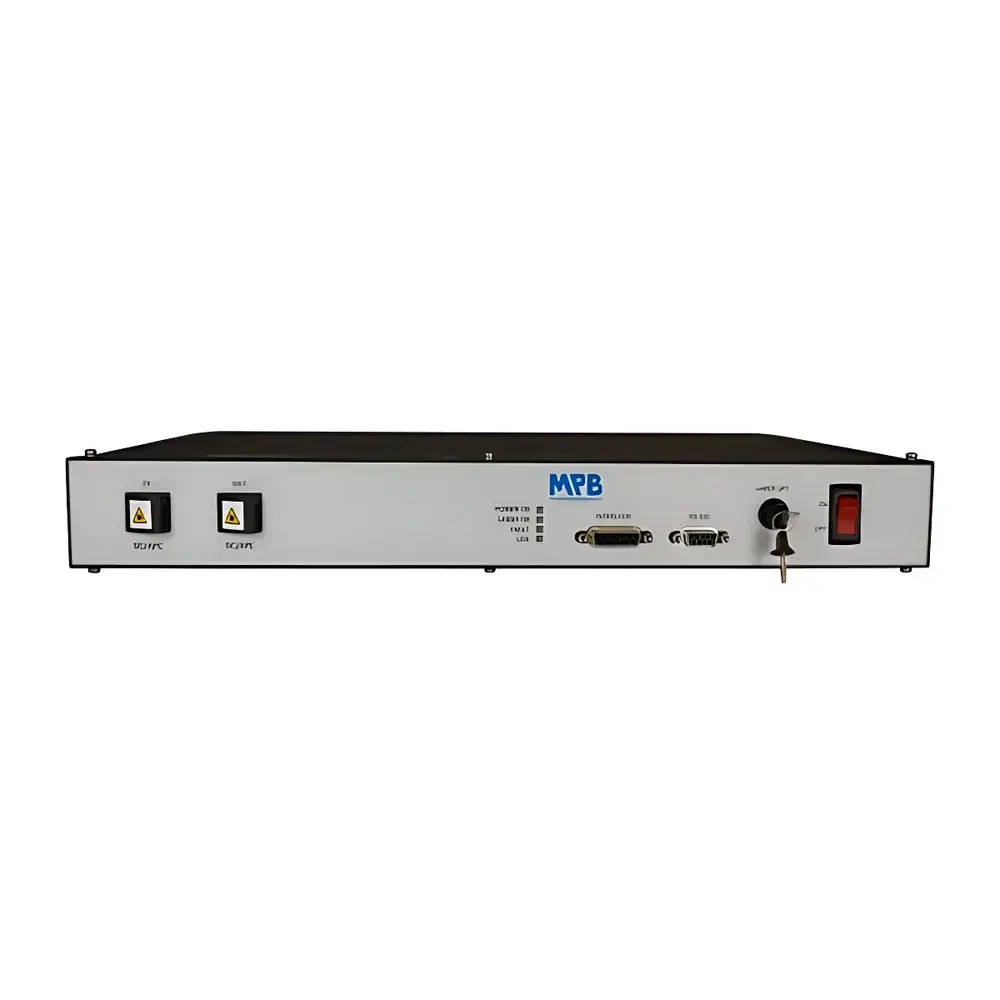
MPBC Fiber Optic Amplifier Series (C/L/O-Band)
| Brand | MPBC |
|---|---|
| Origin | Shanghai, China |
| Manufacturer Type | Authorized Distributor |
| Regional Classification | Domestic (China) |
| Model | Fiber Optic Amplifier |
| Pricing | Available Upon Request |
Overview
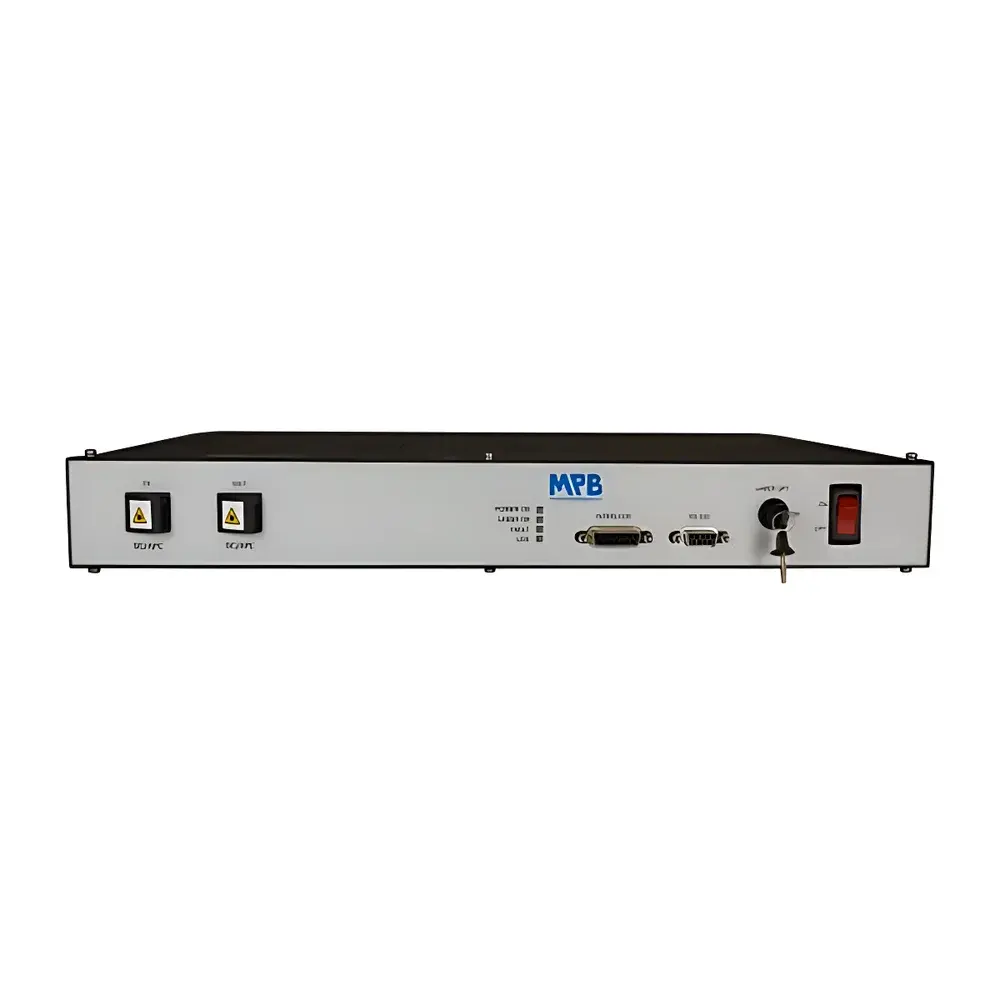
The MPBC Fiber Optic Amplifier Series is a family of high-performance, laboratory- and production-grade optical amplifiers engineered for precision signal boosting across three critical telecommunication and research bands: the C-band (1524–1566 nm), L-band (1566–1625 nm), and O-band (1270–1340 nm). These amplifiers operate on the principle of stimulated emission in rare-earth-doped or bismuth-doped silica fiber gain media—specifically optimized for low-noise, polarization-insensitive, and spectrally stable amplification. Unlike broadband ASE sources or semiconductor optical amplifiers (SOAs), MPBC’s fiber-based architecture delivers superior noise figure performance, high small-signal gain (>65 dB in selected configurations), and excellent power stability under varying input conditions. The series supports both single-channel and multi-channel deployment, with modular 1RU AC-powered chassis designs suitable for integration into optical test benches, fiber sensor interrogation systems, component characterization setups, and manufacturing calibration workflows.
Key Features
- Three wavelength-optimized variants: C-band, L-band, and O-band amplifiers—each tailored to distinct spectral requirements in telecom, sensing, and metrology.
- Multiple control modes: Automatic Current Control (ACC), Automatic Power Control (APC), and Automatic Gain Control (AGC), enabling stable operation under fluctuating input power or temperature conditions.
- Low noise figure: As low as 3.5 dB (L-band preamplifier) and ≤5.0 dB (O-band amplifier at –20 dBm input), ensuring high signal-to-noise ratio preservation in weak-signal applications.
- Gain flatness <1.5 dB (Gain-Flattened Series), critical for WDM system testing and multi-wavelength sensor interrogation.
- Real-time bidirectional power monitoring: Integrated input/output photodiodes with analog voltage outputs and digital readout via GUI or RS232/Ethernet interfaces.
- Compact, rack-mountable 1RU form factor with front-panel touchscreen (O-band models) or graphical user interface (GUI) accessible via USB, RS232, or optional Ethernet port.
- Polarization-insensitive gain—eliminates alignment sensitivity and ensures reproducible performance regardless of input SOP (State of Polarization).
- Remote interlock and key-switch safety circuitry compliant with IEC 61000-6-4 and Class 1 laser product requirements per IEC 60825-1.
Sample Compatibility & Compliance
The MPBC Fiber Optic Amplifier Series is compatible with standard SMF-28, PM1550, and specialty bismuth-doped fibers. It accepts input signals from CW lasers, DFBs, tunable lasers, and broadband sources with input power ranges from –30 dBm to +10 dBm (depending on model and operating mode). All units comply with CE marking requirements for electromagnetic compatibility (EMC) and low-voltage directive (LVD). The control firmware supports audit-trail-capable logging (timestamped power readings, gain settings, alarms) aligned with GLP/GMP documentation practices. While not FDA-cleared, the devices meet relevant portions of IEC 61326-1 (electrical equipment for measurement, control, and laboratory use) and are routinely deployed in ISO/IEC 17025-accredited optical test laboratories.
Software & Data Management
MPBC provides a native Windows-compatible GUI application supporting real-time parameter configuration, live power monitoring, and data export in CSV format. Communication protocols include ASCII-based RS232 command sets (SCPI-compatible subset) and TCP/IP socket interface for Ethernet-enabled units. Firmware updates are performed via USB mass storage mode. All models support programmable alarm thresholds (e.g., output power deviation >±0.5 dB), automatic shutdown on interlock break, and non-volatile memory retention of last-used settings. For integration into automated test systems (ATE), LabVIEW™ drivers and Python API wrappers are available upon request—enabling seamless incorporation into NI TestStand or custom Python-based optical characterization platforms.
Applications
- Fiber Optic Sensing: Boosting weak interferometric or FBG-reflected signals in distributed acoustic sensing (DAS), strain/temperature monitoring, and structural health monitoring systems—where low noise and polarization insensitivity directly impact detection limit and dynamic range.
- Optical Test Benches: Serving as boosters or preamplifiers in end-to-end link budget verification, OSNR measurement, and EDFA cascade characterization; particularly valuable in validating gain tilt, transient response, and cross-gain modulation in multi-stage amplification chains.
- Passive Component Characterization: Enabling accurate insertion loss, return loss, and gain flatness measurements of WDM filters, couplers, isolators, and FBGs—leveraging stable, spectrally uniform output and calibrated power monitoring.
- Manufacturing & Calibration: Used internally by MPBC for FBG inscription process validation and spectral characterization of comb sources—ensuring grating reflectivity uniformity and channel spacing fidelity within ±0.02 nm.
- Research Instrumentation: Supporting ultra-low-light experiments in quantum optics (e.g., heralded photon amplification), time-domain reflectometry (OTDR), and swept-wavelength interferometry where shot-noise-limited detection demands minimal added amplifier noise.
FAQ
What control modes are supported—and how do they differ in application?
ACC maintains constant pump diode current (ideal for stable lab environments); APC regulates total output power (preferred for variable-input scenarios); AGC sustains fixed gain across input power fluctuations (essential for cascaded amplifier chains and sensor systems with drifting source power).
Is the O-band amplifier truly polarization-insensitive across its full 70 nm bandwidth?
Yes—measured polarization-dependent gain (PDG) is <0.2 dB across 1270–1340 nm, verified using Mueller matrix analysis and Poincaré sphere mapping per ITU-T G.698.2 Annex A.
Can the amplifier be integrated into a PXI or VXI automated test system?
While native PXI/VXI hardware is not offered, the RS232 and Ethernet interfaces—with documented SCPI-like command syntax—enable robust integration via standard GPIB-to-serial bridges or TCP/IP drivers in Keysight PathWave, MATLAB Instrument Control Toolbox, or Python PyVISA.
Does the unit support external triggering or synchronization for pulsed operation?
No—these are CW amplifiers optimized for continuous-wave signal enhancement. For pulsed amplification (e.g., ns-ps pulses), consult MPBC’s separate Er/Yb-doped fiber amplifier modules with gated pump control.
Are calibration certificates traceable to NIST or other national standards bodies?
Factory calibration reports (included) reference internal standards traceable to NPL (UK) and NIM (China) via accredited third-party labs; full NIST-traceable calibration with uncertainty budgets is available as an optional service.