
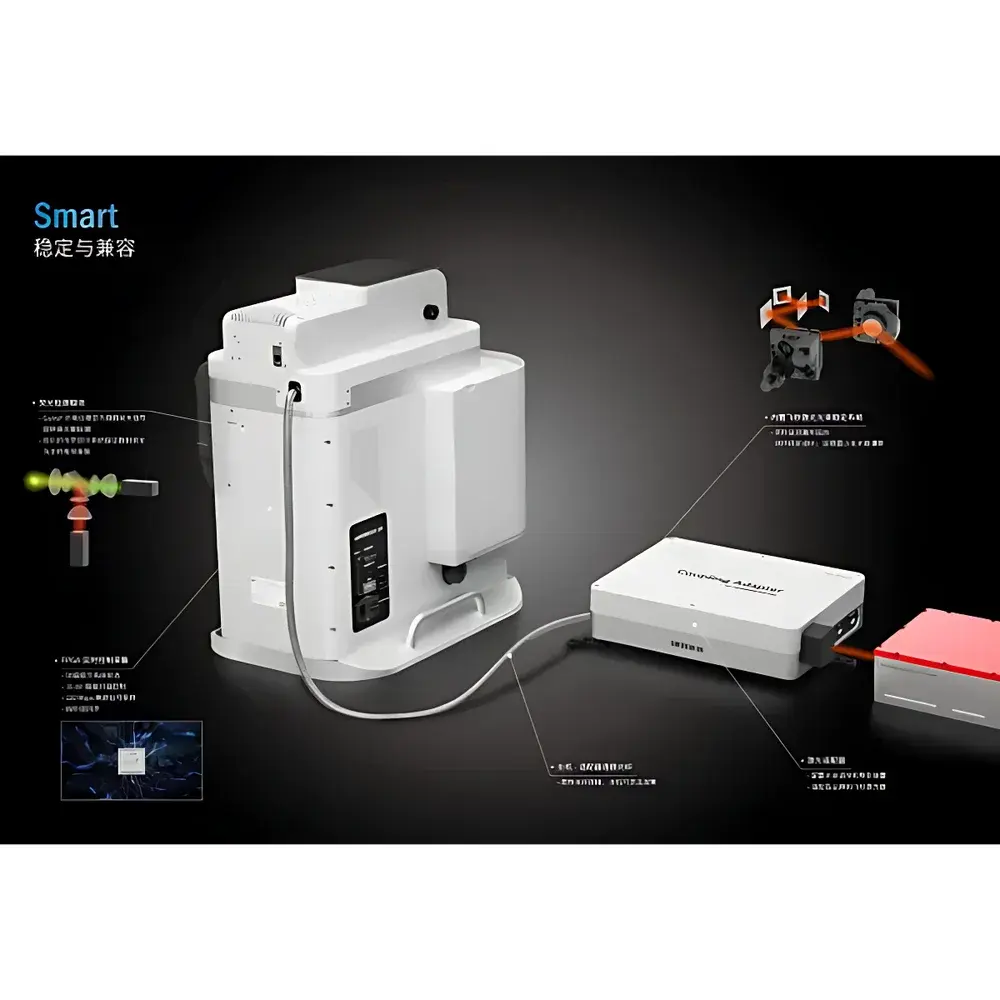
Auniontech SUPERNOVA-100 Miniaturized Two-Photon Microscope
| Brand | Auniontech |
|---|---|
| Origin | Shanghai, China |
| Model | SUPERNOVA-100 |
| Probe Mass | 1.2–6 g |
| Lateral Resolution | ≤ 0.65 µm |
| Field of View | 1.0 mm × 0.87 mm |
| Imaging Depth | up to 800 µm |
| Excitation Wavelength | 470 nm (LED) & 920 nm (fs laser, optional) |
| Emission Detection Range | 300–720 nm |
| Green Channel | 520 ± 25 nm (GCaMP6/GFP) |
| Red Channel | 625 ± 25 nm (RCaMP/tdTomato/mCherry) |
| PMT Type | High-sensitivity GaAsP |
| Controller FHIRM-HR Sampling Rate | ≥ 120 MSps |
| FHIRM-U Analog Input Resolution | ≥ 14 bit |
| FHIRM-LF Analog Bandwidth | ≥ 60 MHz |
| Fiber-Coupled AOM Response Time | < 250 ns |
| XYZ Stage Bidirectional Repeatability | 1 µm |
| Full-Frame Imaging Speed (CCD) | ≥ 40 Hz @ 1920×1200 px |
| System Footprint | 595 × 400 × 668 mm³ |
| Operating Temperature | 20–30 °C |
| Relative Humidity | < 60 % |
| Optional Modules | 3D Zoom Module (FHIRM-HR/U/LF), fs Laser (920 nm), Behavior Setup, Vibration Isolation Table (1200×750×750 mm³) |
Overview
The Auniontech SUPERNOVA-100 is a purpose-engineered miniaturized two-photon microscope designed for high-fidelity in vivo calcium imaging and structural observation in freely behaving or head-fixed small mammals—primarily mice. Leveraging near-infrared (NIR) two-photon excitation at 920 nm (compatible with commercial femtosecond lasers), the system enables deep-tissue optical sectioning with reduced phototoxicity and out-of-focus background fluorescence. Its core optical architecture implements a scanless, fiber-coupled design with integrated acousto-optic modulation (AOM) for rapid beam steering and shuttered excitation control. The 1.2–6 g head-mounted probe features an optimized optical path with diffraction-limited performance, achieving ≤ 0.65 µm lateral resolution—sufficient to resolve individual dendritic spines—and a large field of view (1.0 mm × 0.87 mm) enabling simultaneous monitoring of thousands of neurons across cortical layers. With penetration depth up to 800 µm, the SUPERNOVA-100 supports longitudinal imaging across all six cortical laminae in murine models.
Key Features
- Ultra-lightweight, head-mountable probe (1.2–6 g) engineered for minimal behavioral interference and long-term chronic implantation
- High-resolution two-photon imaging: ≤ 0.65 µm lateral resolution; axial resolution optimized via adaptive optics-ready optical design
- Large FOV (1.0 mm × 0.87 mm) supporting population-level neural activity mapping without tile stitching
- Deep-tissue capability: validated imaging depth of up to 800 µm in vivo, covering cortex, hippocampus, and subcortical regions
- Modular controller suite: FHIRM-HR (≥120 MSps sampling), FHIRM-U (≥14-bit analog input), FHIRM-LF (≥60 MHz bandwidth) for synchronized multimodal electrophysiology integration
- Dual-channel fluorescence detection: GaAsP photomultiplier tubes with bandpass filters centered at 520 ± 25 nm (green) and 625 ± 25 nm (red), supporting GCaMP6, RCaMP, tdTomato, and mCherry
- Fiber-integrated AOM with <250 ns response time for precise temporal gating and laser safety interlock
- Motorized XYZ stage (1 µm bidirectional repeatability) for rapid ROI localization and coarse focusing prior to head-mounted operation
Sample Compatibility & Compliance
The SUPERNOVA-100 is validated for use in adult C57BL/6 mice, transgenic lines expressing genetically encoded calcium indicators (e.g., GCaMP6f, jRGECO1a), and viral vector–transduced preparations. Its mechanical and thermal design complies with standard animal housing and IACUC-approved surgical protocols for cranial window implantation and chronic tethered recording. While not certified for clinical or diagnostic use, the system adheres to ISO 13485-aligned manufacturing practices for research instrumentation. Data acquisition workflows support GLP-compliant metadata tagging—including timestamp synchronization across fluorescence, EEG, EMG, and DBS channels—enabling audit-ready experimental records. All optical components meet RoHS directives; laser safety interfaces conform to IEC 60825-1:2014 Class 1 requirements when operated with integrated shuttering and interlocks.
Software & Data Management
System operation and data acquisition are managed through the SUPERGIN platform—a cross-platform (Windows/Linux) application built on Qt and Python-based real-time control libraries. SUPERGIN provides hardware abstraction layers for seamless integration with third-party DAQ systems (e.g., National Instruments, Tucker-Davis Technologies), enabling synchronized acquisition of optical, electrophysiological, and behavioral signals at native sampling rates. Raw image streams are saved in HDF5 format with embedded timestamps, channel metadata, and spatial calibration parameters. Post-acquisition processing is performed using SUPERANALY—a modular MATLAB- and Python-compatible toolkit featuring motion correction (non-rigid registration), neuropil subtraction, ΔF/F computation, spike inference (CNMF-E), and ROI-based time-series export. Both software packages support FAIR data principles and generate MIAME/MINSEQ-compliant logs for reproducibility and publication readiness.
Applications
- Longitudinal in vivo calcium imaging of neuronal ensembles during learning, memory consolidation, and sensory processing
- Structural plasticity studies: spine turnover, axonal bouton dynamics, and microglial surveillance over weeks
- Multi-modal integration: simultaneous two-photon imaging with intracranial EEG, electromyography (EMG), or deep brain stimulation (DBS)
- Cortical layer-specific functional mapping across L1–L6 in awake, head-fixed or freely moving paradigms
- Pharmacological intervention studies requiring high spatiotemporal fidelity and minimal photodamage
- Development of closed-loop optogenetic systems interfaced via TTL-triggered AOM gating and real-time feedback loops
FAQ
Is the SUPERNOVA-100 compatible with non-Auniontech femtosecond lasers?
Yes—the system uses standardized fiber-coupled input (FC/APC) and accepts 920 nm pulsed sources from Spectra-Physics, Coherent, Toptica, and other vendors meeting M² < 1.3 and pulse width < 150 fs specifications.
What is the recommended laser power at the sample plane?
Typical incident power ranges from 15–50 mW at the objective back aperture, adjustable via AOM attenuation; exact values depend on indicator expression level, depth, and desired SNR.
Can the system be upgraded for three-photon imaging?
The optical train and detector spectral range (300–720 nm) are inherently compatible with 1300 nm excitation; upgrade requires replacement of the dichroic mirror, emission filters, and PMT photocathode—available as a factory service option.
Does SUPERGIN support real-time online analysis during acquisition?
Basic motion correction and ROI averaging are supported in real time; advanced algorithms (e.g., deconvolution, spike inference) run offline in SUPERANALY to ensure deterministic timing and minimal CPU load during acquisition.
What environmental conditions are required for stable operation?
Ambient temperature must be maintained between 20–30 °C with relative humidity < 60 %; vibration isolation (e.g., 1200×750×750 mm active/passive table) is strongly recommended for sub-micron stability during long-duration sessions.





