
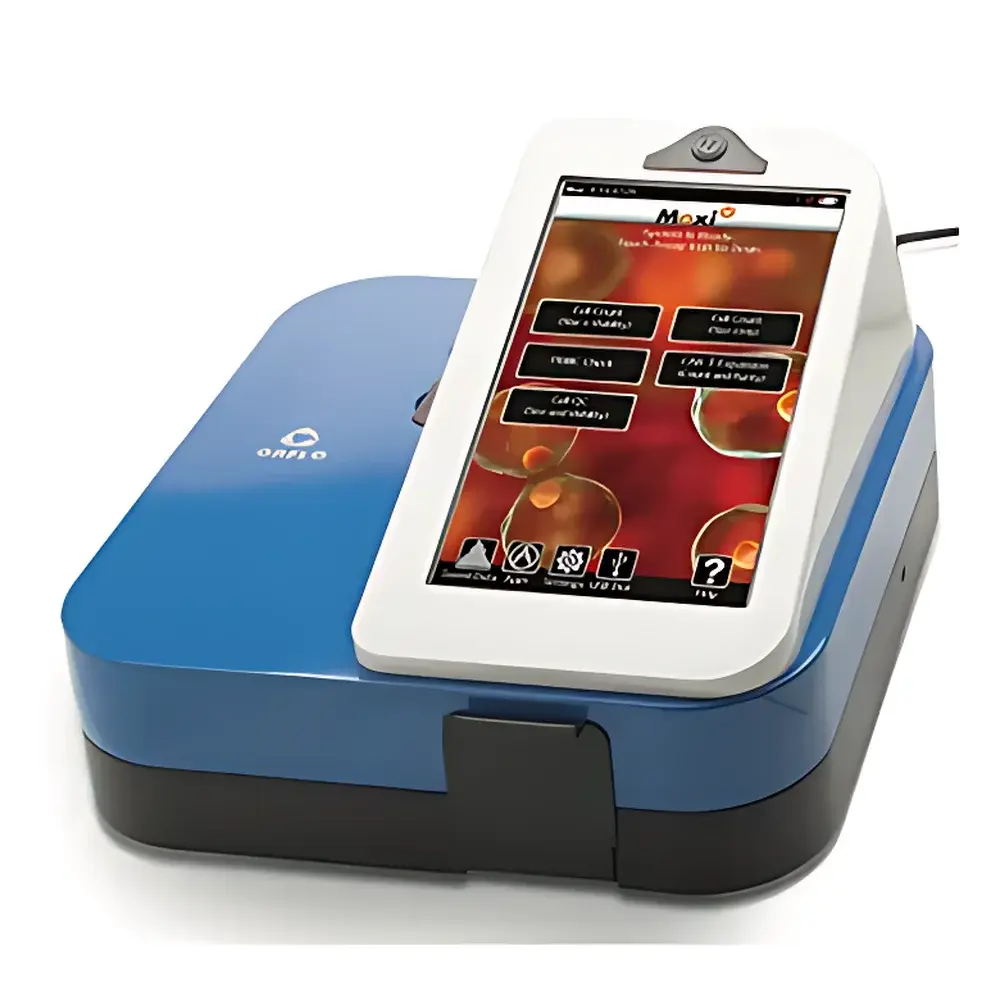
Orflo Moxi V Coulter-Principle Fluorescent Cell Counter
| Brand | Orflo |
|---|---|
| Origin | USA |
| Model | Moxi V |
| Detection Time | 10 s |
| Minimum Detectable Concentration | 5 × 10³ cells/mL |
| Sample Volume | µL-range (single-use microcapillary cartridge) |
| Cell Size Range | 3–35 µm |
| Detection Channels | Coulter impedance + PDT (Photo-Dye-Threshold) fluorescence channel |
| Regulatory Compliance | Designed for GLP-compliant labs |
Overview
The Orflo Moxi V is a benchtop Coulter-principle fluorescent cell counter engineered for high-precision, rapid quantification and characterization of heterogeneous cell suspensions. Unlike optical or image-based counters, the Moxi V employs electrical sensing zone (ESZ) technology—commonly referred to as the Coulter principle—in which cells suspended in electrolyte pass one-by-one through a microfabricated aperture. Each cell displaces a volume of conductive fluid proportional to its own volume, generating a voltage pulse whose amplitude correlates directly with cell diameter and whose integrated area reflects cell volume. This volumetric measurement provides intrinsic size resolution independent of optical properties, morphology, or staining efficiency. Integrated with a dedicated PDT (Photo-Dye-Threshold) fluorescence detection channel, the system simultaneously acquires viability data using membrane integrity dyes (e.g., propidium iodide or trypan blue analogs), enabling dual-parameter analysis—count, size distribution, and viability—in a single 10-second assay.
Key Features
- Coulter impedance counting with volumetric calibration: Delivers absolute cell concentration without reliance on dilution factors or reference beads.
- PDT fluorescence channel: Enables quantitative viability assessment via threshold-gated dye exclusion, optimized for low-background detection across diverse cell types including fragile primary cells and small particles (e.g., platelets, yeast, microalgae).
- Microcapillary sample delivery: Uses disposable, pre-calibrated cartridges requiring only 10–20 µL of sample—eliminating pipetting error, cross-contamination, and carryover.
- Real-time size histogram generation: Reports particle diameter from 3 to 35 µm with sub-micron resolution in the 3–12 µm range; CV < 3% for monodisperse standards under controlled conditions.
- Onboard application templates: Preconfigured workflows for mammalian cell counting, CAR-T QC, platelet enumeration, yeast viability, and algal biomass assessment—each with user-adjustable gating and reporting parameters.
- Touchscreen interface with embedded OS: No external PC required; firmware supports secure user authentication, method locking, and electronic signature capture for regulated environments.
Sample Compatibility & Compliance
The Moxi V accommodates a broad spectrum of suspension-based biological samples without preprocessing: adherent and suspension mammalian cells (including stem cells and hybridomas), human and murine PBMCs, platelets, Saccharomyces cerevisiae and Pichia pastoris, Chlamydomonas reinhardtii and other microalgae, and even synthetic microparticles used in process validation. Its Coulter-based architecture ensures robust performance with turbid, clumped, or autofluorescent samples where optical systems often fail. The instrument is designed and validated in accordance with ISO 13485 quality management principles. When operated with compliant software configurations—including audit trail activation, electronic signatures, and role-based access control—the system meets documentation requirements for GLP, GMP, and FDA 21 CFR Part 11 compliance in QC laboratories supporting biologics manufacturing and clinical trial material release.
Software & Data Management
Data acquisition, analysis, and export are managed via Orflo’s proprietary Moxi Software Suite (v5.x), available for Windows-based workstations or embedded on-device. All measurements are timestamped and stored with full metadata: operator ID, cartridge lot number, calibration status, gate settings, and raw pulse data. Reports are exportable in PDF (with digital signature), CSV (for LIMS integration), and FCS 3.1 format (compatible with FlowJo and Cytobank). Audit trails record all parameter changes, result exports, and user logins—retained for ≥18 months unless purged per institutional retention policy. Optional network connectivity enables centralized instrument monitoring and remote firmware updates under IT-administered security protocols.
Applications
- Mammalian cell culture QC: Daily passage verification, bioreactor inoculum standardization, and post-thaw recovery assessment.
- Cell therapy manufacturing: CAR-T and NK cell enumeration with concurrent viability and size profiling to detect activation-induced swelling or apoptosis-related shrinkage.
- Platelet and RBC fragment analysis: Discrimination of platelets (2–4 µm) from microvesicles and erythrocyte debris in platelet-rich plasma preparations.
- Yeast fermentation monitoring: Viability tracking during ethanol or recombinant protein production, with size shifts indicating budding stage or stress response.
- Microalgal biotechnology: Biomass density estimation and health screening in photobioreactors, where chlorophyll autofluorescence would interfere with conventional flow cytometers.
- Method transfer and validation: Used as a reference method in comparative studies against hemocytometers, image-based counters, and flow cytometers per ASTM E2877-22 guidelines for cell counting accuracy verification.
FAQ
What sample volume is required for a Moxi V measurement?
A single measurement requires only 10–20 µL of undiluted sample, delivered via a sterile, single-use microcapillary cartridge.
Can the Moxi V distinguish between live and dead cells without fluorescent dyes?
No—viability assessment requires a membrane-impermeant fluorescent dye (e.g., PI, 7-AAD, or AO/PI). The Coulter channel alone provides count and size but no viability information.
Is calibration required before each use?
Cartridges are factory-calibrated and serialized; no user calibration is needed. System verification is performed automatically at startup using internal reference pulses.
Does the Moxi V support regulatory submissions for IND or BLA packages?
Yes—when deployed with documented IQ/OQ/PQ protocols, validated software configuration, and full audit trail enabled, raw data and reports meet ICH M10 and FDA guidance for bioanalytical method validation.
How does the Moxi V handle cell aggregates or debris?
The system applies proprietary pulse-width discrimination algorithms to reject doublets and transient debris events; users may adjust the pulse width gate manually during analysis to optimize for specific sample types.





