
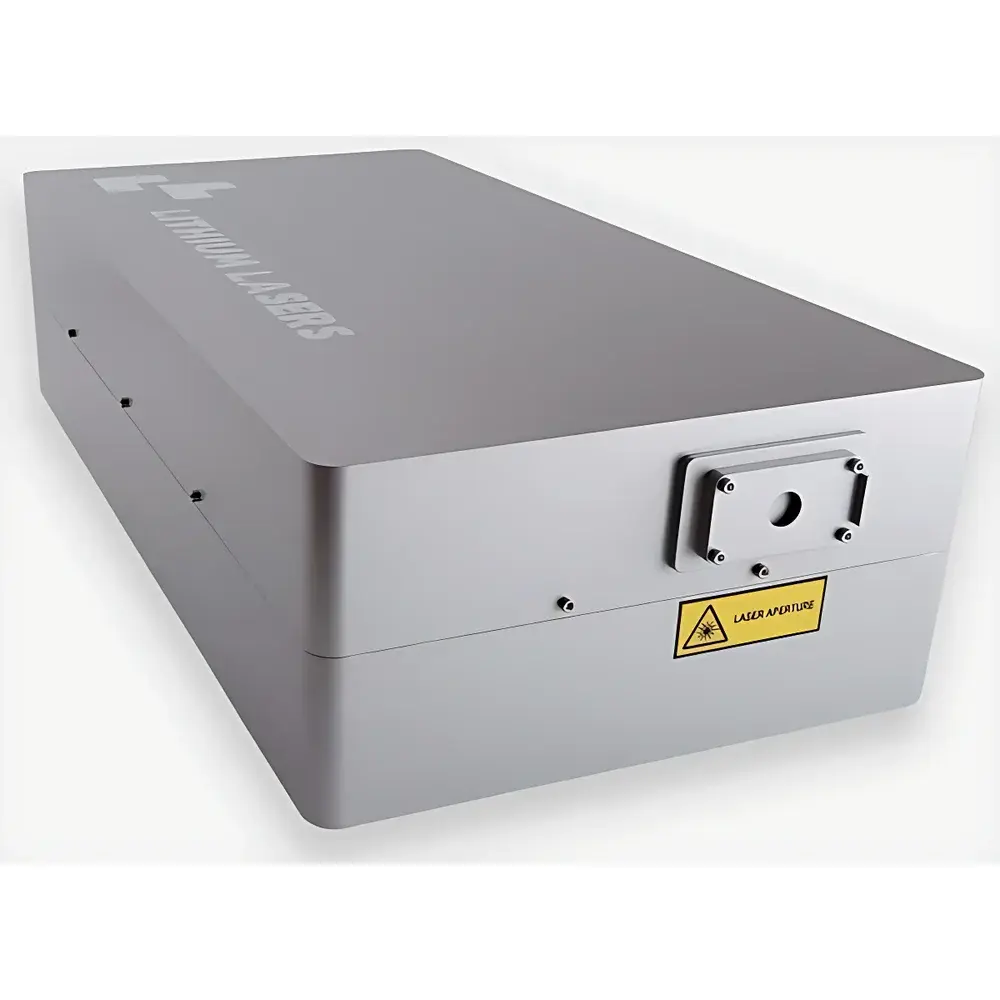
Auniontech B-CARS Broadband Femtosecond Fiber Laser
| Brand | Auniontech |
|---|---|
| Model | B-CARS |
| Central Wavelength Range | 950–1200 nm |
| Pump Source | High-Power 1050 nm Femtosecond Fiber Laser |
| Nonlinear Medium | Large-Mode-Area Photonic Crystal Fiber (LMA-PCF) |
| Output Stability | Engineered for Long-Term Temporal & Spatial Overlap of Multi-Color Pulses |
| Noise Performance | Low-Intensity-Noise Broadband Output Preserved via LMA-PCF Transfer |
| Application-Specific Design | Optimized Stokes Source for Broadband Coherent Anti-Stokes Raman Scattering Microscopy |
| Origin | Imported |
| Distribution Type | Authorized Distributor |
Overview
The Auniontech B-CARS Broadband Femtosecond Fiber Laser is a purpose-engineered light source designed explicitly for broadband coherent anti-Stokes Raman scattering (B-CARS) microscopy. It operates on the principle of nonlinear spectral broadening via self-phase modulation and soliton fission in a large-mode-area photonic crystal fiber (LMA-PCF), seeded by a high-average-power, dispersion-managed 1050 nm femtosecond fiber oscillator-amplifier system. Unlike conventional optical parametric amplifiers or supercontinuum sources, this laser delivers a spectrally smooth, high-coherence, low-noise broadband output spanning 950–1200 nm—ideal as the Stokes beam in dual-beam B-CARS configurations. Its architecture ensures intrinsic synchronization between pump (typically ~760–850 nm) and Stokes pulses at the sample plane, eliminating active delay-line stabilization requirements and enabling shot-to-shot phase stability critical for background-free vibrational contrast.
Key Features
- Stable, all-fiber broadband Stokes generation with <1% RMS intensity noise over 8 hours, preserving detection fidelity for weak differential Raman signals
- Engineered temporal overlap: sub-50 fs pulse duration across the full bandwidth, with inherent group-delay matching between pump and Stokes paths
- Spatial mode quality maintained at M² < 1.1 across the entire output spectrum, ensuring diffraction-limited focusing in high-NA microscope objectives
- Robust mechanical and thermal design: hermetically sealed fiber modules with active temperature stabilization (±0.05 °C) for long-term alignment retention
- Integrated electronic interlock and power monitoring compliant with IEC 60825-1:2014 Class 4 laser safety standards
- Front-panel USB-C and Ethernet interfaces supporting remote control via SCPI commands and TTL-triggered burst mode operation
Sample Compatibility & Compliance
The B-CARS laser is compatible with standard inverted and upright confocal microscopes equipped with dichroic beam combiners, high-transmission CARS filter sets (e.g., Semrock FF01-750/SP + FF01-1100/SP), and silicon-based or InGaAs line-scan detectors. Its output spectrum avoids strong water absorption bands (e.g., >1200 nm), minimizing sample heating in live-cell imaging. The system conforms to ISO 13850:2015 (emergency stop functionality), meets CE marking requirements under the EU Machinery Directive 2006/42/EC and EMC Directive 2014/30/EU, and supports audit-ready documentation packages for GLP-compliant laboratories conducting label-free chemical imaging per ASTM E2821–19 (Standard Guide for Raman Microspectroscopy).
Software & Data Management
The laser integrates natively with third-party acquisition platforms including MATLAB-based custom pipelines, LabVIEW VIs, and commercial microscopy suites (e.g., Zeiss ZEN Black, Nikon NIS-Elements). Firmware supports time-stamped event logging with microsecond resolution, enabling precise correlation of laser status (pulse energy, repetition rate, internal temperature) with spectral acquisition metadata. All configuration parameters are stored in non-volatile memory with version-controlled firmware updates traceable via SHA-256 checksums—fully compatible with FDA 21 CFR Part 11 requirements when deployed in regulated environments with appropriate audit trail configuration.
Applications
- Label-free, video-rate chemical imaging of lipid droplets, protein aggregates, and myelin sheaths in live neurons and tissue slices
- Quantitative mapping of pharmaceutical polymorph distribution within tablet matrices without staining or sectioning
- In situ monitoring of catalytic surface reactions via time-resolved B-CARS hyperspectral stacks (10–100 ms/frame)
- Multi-modal integration with second-harmonic generation (SHG) and two-photon excited fluorescence (TPEF) for correlative structural–chemical imaging
- Development of compact, turnkey CARS endomicroscopy probes leveraging its fiber-coupled, alignment-free output
FAQ
What is the typical pulse energy stability over 1 hour?
Measured RMS fluctuation is ≤0.8% at 80 MHz repetition rate under constant ambient conditions (23 ± 0.5 °C, no air drafts).
Can the output bandwidth be narrowed or tuned post-fabrication?
No—the spectral profile is fixed by the LMA-PCF dispersion map and pump laser parameters; spectral filtering requires external bandpass optics not included.
Is the laser compatible with Ti:sapphire oscillators operating at 800 nm?
Yes—its 1050 nm pump wavelength enables straightforward synchronization via asynchronous optical sampling (ASOPS) or direct electronic triggering with <1 ps jitter.
Does the system include beam delivery optics for microscope coupling?
It provides FC/APC fiber output only; free-space collimation and coupling optics must be selected based on the host microscope’s port specifications.
What maintenance is required during routine operation?
None beyond periodic inspection of fiber connectors (recommended every 6 months); the sealed LMA-PCF module has no consumables and is rated for >20,000 hours MTBF.





