
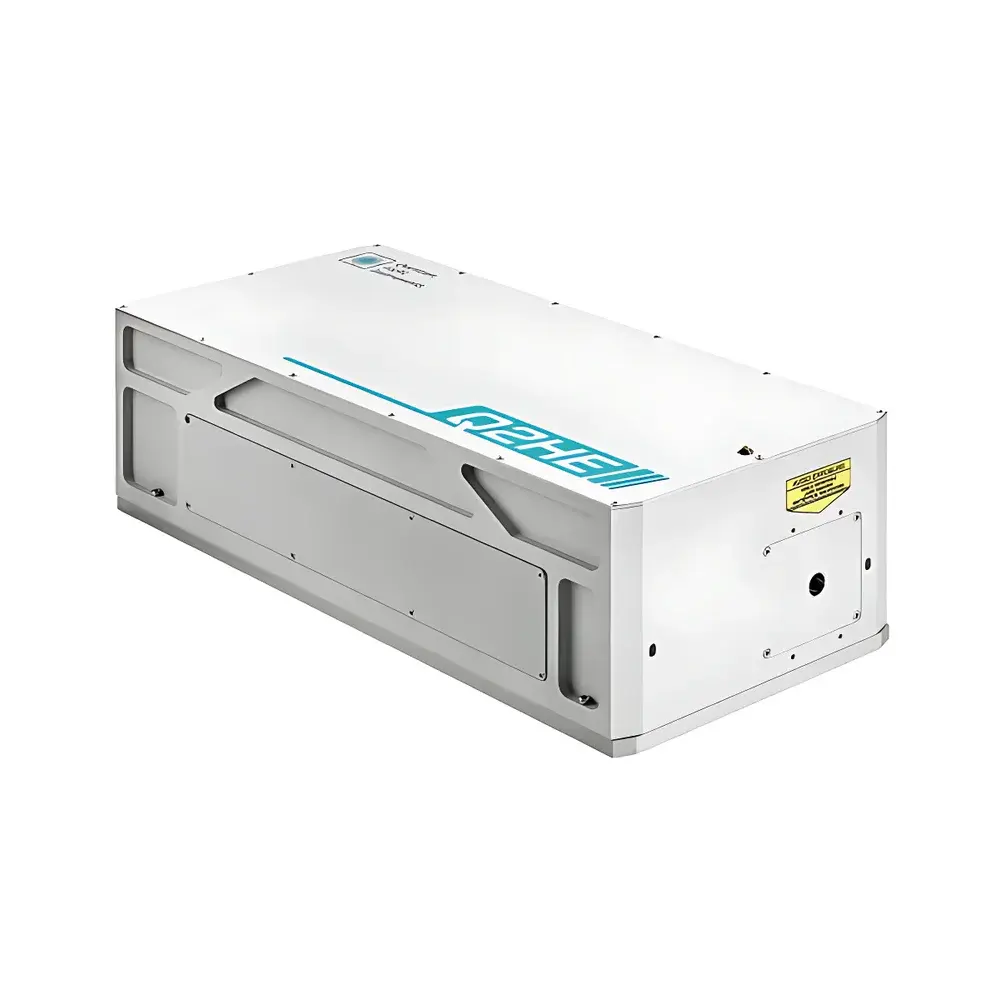
Auniontech Q2HE Series Nanosecond Pulsed Solid-State Laser (100 mJ, 4 W, 10–100 Hz)
| Brand | Auniontech |
|---|---|
| Model | Q2HE |
| Wavelength Options | 1064 nm / 1053 nm |
| Pulse Energy | up to 100 mJ |
| Average Power | up to 4 W |
| Repetition Rate | 10–100 Hz (adjustable for 1053 nm) |
| Pulse Width | <7 ns (1064 nm), <6 ns (1053 nm) |
| Cooling | Air-cooled |
| Harmonic Generation | Up to 5th harmonic (211–213 nm) |
| Control Interface | Ethernet with API support |
| Trigger Modes | Internal & External |
| Dimensions | Compact integrated laser head + lightweight external controller (8 VDC, 50–150 W input) |
Overview
The Auniontech Q2HE Series is a high-performance, diode-pumped solid-state (DPSS) nanosecond pulsed laser engineered for demanding scientific and industrial applications requiring stable, high-energy pulses in a compact, maintenance-free architecture. Operating at fundamental wavelengths of 1064 nm or 1053 nm, the Q2HE leverages advanced crystal thermal management—eliminating water cooling and bulky power supplies—to deliver exceptional pulse-to-pulse stability and long-term reliability. Its sub-7 ns pulse duration, low beam divergence (<2 mrad), and high spatial beam quality (M² < 1.3) make it particularly suited for nonlinear frequency conversion processes, including efficient generation of harmonics up to the fifth order (211–213 nm). Designed as a true “turnkey” system, the Q2HE integrates all critical electronics—including Q-switch driver, temperature stabilization circuitry, and pulse monitoring sensors—into a single, robust laser head. A lightweight external controller provides only the essential interface: DC power input (8 VDC, 50–150 W) and Ethernet connectivity for full remote operation.
Key Features
- High pulse energy output: up to 100 mJ at 1064 nm (model-dependent); up to 100 mJ at 1053 nm with variable repetition rate (10–100 Hz)
- Average power up to 4 W—optimized for high-duty-cycle operation without thermal degradation
- Air-cooled design with no external chiller required; enables deployment in space-constrained labs and portable instrumentation platforms
- Integrated real-time pulse energy monitoring via analog/digital output (0–5 V or RS232), supporting closed-loop feedback in automated systems
- Full Ethernet-based control and diagnostics: web-accessible GUI, RESTful API, and SCPI-compatible command set for seamless integration into OEM equipment or custom DAQ environments
- Dual trigger capability: internal master oscillator mode or external TTL/CMOS synchronization with jitter <1 ns RMS
- Long diode lifetime exceeding 2 × 10⁹ shots—validated under continuous rated operation per ISO 11551
- Optional fiber-coupled output (with SMA905 or FC/PC connector), harmonic modules (SHG, THG, FHG, 5HG), and calibrated attenuators with motorized actuation
Sample Compatibility & Compliance
The Q2HE is routinely deployed in regulated analytical workflows where traceability, repeatability, and audit readiness are essential. Its digital control architecture supports timestamped event logging and firmware-level parameter locking—enabling alignment with GLP and GMP documentation requirements. While not certified as medical or IEC 60825-1 Class IV laser product out-of-box, the system complies with international laser safety standards when used with appropriate interlocks and enclosures (e.g., ANSI Z136.1, EN 60825-1:2014). Harmonic outputs meet spectral purity specifications referenced in ASTM E2739 (LIBS calibration) and ISO 17025-accredited MALDI source validation protocols. All optical interfaces adhere to SEMI F47 mechanical and electrical interface guidelines for integration into vacuum-compatible PLD chambers.
Software & Data Management
Auniontech provides the Q2HE Control Suite—a cross-platform application (Windows/macOS/Linux) offering real-time waveform visualization, pulse energy trending, and automated calibration routines. The embedded Ethernet interface exposes a complete set of programmable parameters—including repetition rate, Q-switch delay, harmonic selection, and energy setpoint—via HTTP POST requests or TCP socket commands. For enterprise integration, the laser supports OPC UA server functionality (optional firmware upgrade) and generates structured JSON logs compliant with ISA-95 Part 2 data models. Audit trails include user login events, parameter changes, and hardware fault codes—all stored with UTC timestamps and SHA-256 integrity checksums. Optional FDA 21 CFR Part 11 compliance package includes electronic signatures, role-based access control, and immutable archive export to network-attached storage.
Applications
- Laser-Induced Breakdown Spectroscopy (LIBS): High pulse energy and short duration enable robust plasma initiation on conductive/non-conductive samples, with signal-to-noise ratios optimized for ppm-level elemental detection in geological, metallurgical, and environmental matrices.
- Time-of-Flight Mass Spectrometry (TOF-MS): Sub-7 ns pulses minimize temporal broadening during ion extraction, preserving mass resolution >10,000 (FWHM) in reflectron configurations.
- Matrix-Assisted Laser Desorption/Ionization (MALDI): Tunable 1053 nm operation reduces matrix fragmentation while maintaining sufficient photon flux for soft ionization of peptides and oligonucleotides.
- Pulsed Laser Deposition (PLD): Stable energy delivery over >10⁶ shots ensures stoichiometric transfer of complex oxides (e.g., YBCO, LNO) onto single-crystal substrates under UHV conditions.
- Flash Photolysis & Ultrafast Pump-Probe Studies: Synchronized dual-wavelength operation (fundamental + harmonic) enables precise excitation/probe delay control down to 10 ps resolution using external delay generators.
- Nonlinear Optical Characterization: High peak power (>14 MW) and excellent beam quality support quantitative measurement of χ⁽²⁾ and χ⁽³⁾ coefficients in bulk crystals and 2D materials.
FAQ
Is the Q2HE compatible with vacuum environments?
Yes—the laser head is designed for ambient operation, but optional vacuum feedthrough kits (CF35 or KF40) are available for harmonic module integration directly inside deposition chambers.
Can pulse energy be adjusted in real time during operation?
Yes—via analog voltage input (0–5 V) or Ethernet command, enabling dynamic energy ramping synchronized with stage motion or detector gating.
What is the beam pointing stability specification?
<15 µrad RMS over 8 hours at constant ambient temperature (23 ± 1 °C), measured per ISO 13694.
Does the system support external cavity wavelength tuning?
No—the Q2HE operates at fixed fundamental wavelengths (1064 nm or 1053 nm); tunability is achieved solely through harmonic generation and optional broadband OPO integration (separate module).
How is firmware updated, and is rollback supported?
Firmware updates are performed via secure HTTPS upload through the web interface; versioned backups and signed rollback images are retained in non-volatile memory per IEC 62443-3-3 SL2 requirements.






