
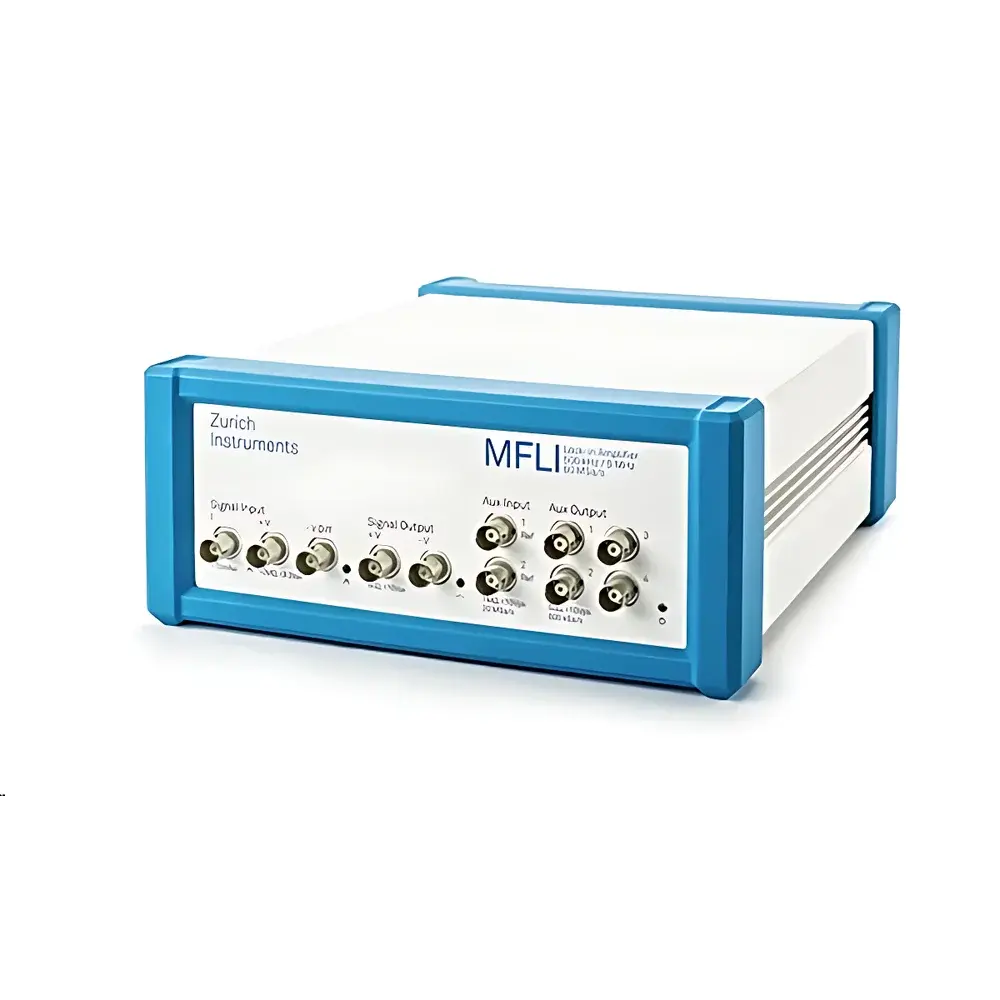
Zurich Instruments MFLI Series 500 kHz / 5 MHz Lock-in Amplifier
| Origin | Switzerland |
|---|---|
| Manufacturer Type | Authorized Distributor |
| Origin Category | Imported |
| Model | MFLI_Lock_in_Amplifier |
| Component Category | Optical Instrument Component |
| Price | USD 1200 (Component Unit) |
Overview
The Zurich Instruments MFLI Series 500 kHz / 5 MHz Lock-in Amplifier is a high-performance, digitally enhanced lock-in measurement system engineered for precision detection of weak AC signals buried in noise across DC to 5 MHz. Based on a fully digital architecture combining low-noise analog front-ends with real-time FPGA-based signal processing, the MFLI implements quadrature demodulation using synchronous detection principles—where an input signal is multiplied by reference waveforms (sine and cosine) at the target frequency, followed by low-pass filtering to extract amplitude (R), phase (Θ), and orthogonal components (X, Y). This approach delivers exceptional dynamic reserve (>120 dB), sub-microdegree phase resolution (10 µdeg), and time constants ranging from 500 ns to 76 s—enabling reliable measurements in demanding applications such as optical chopper systems, quantum transport experiments, and low-temperature scanning probe microscopy. Unlike legacy analog lock-ins (e.g., Stanford Research SR830), the MFLI eliminates drift-prone analog filters and leverages oversampled 16-bit ADCs (60 MSa/s) with digital filter synthesis, ensuring long-term stability, reproducibility, and full traceability of all signal paths.
Key Features
- Frequency range: DC to 500 kHz standard; upgradable to DC–5 MHz via MF-5FM option
- Dynamic reserve exceeding 120 dB—enabling detection of signals <1 nV against high-amplitude noise floors
- Time constant range: 500 ns to 76 s, supporting ultrafast transient analysis and ultra-low-frequency spectroscopy
- Phase resolution: 10 µdeg (0.00001°); frequency resolution: 1 µHz—critical for precision metrology and frequency-domain impedance mapping
- Dual-input configuration: differential voltage input (10 MΩ || 20 pF or 50 Ω) and transimpedance current input (1 nA–10 mA full scale)
- Four auxiliary outputs (±10 V, 612 kSa/s) and two auxiliary inputs (±10 V, 15 MSa/s) for real-time feedback control and external triggering
- Integrated 10 MHz reference clock I/O and bidirectional 32-bit digital I/O (via SCSI connector) for multi-instrument synchronization
- Connectivity: Gigabit Ethernet (1 GbE) and USB 2.0 (480 Mbit/s), supporting deterministic latency and remote operation
- Power flexibility: AC mains or 12 V DC (battery-compatible)—ideal for portable cryogenic or field-deployable setups
Sample Compatibility & Compliance
The MFLI supports both voltage and current sensing modes, making it compatible with photodiodes, bolometers, Hall sensors, SQUIDs, and piezoresistive cantilevers. Its differential input architecture minimizes common-mode interference in optomechanical or electromagnetic environments. The instrument complies with IEC 61000-4 electromagnetic compatibility standards and meets CE/UKCA regulatory requirements for laboratory instrumentation. While not inherently FDA 21 CFR Part 11–compliant as a standalone unit, its LabOne software platform supports audit-trail-enabled workflows when deployed in GLP/GMP environments—particularly when integrated with third-party LIMS or validated data acquisition pipelines. All firmware updates are digitally signed and version-controlled, aligning with ISO/IEC 17025 traceability expectations for calibration laboratories.
Software & Data Management
The MFLI operates exclusively through Zurich Instruments’ LabOne software—a browser-based, cross-platform interface built on HTML5 and WebSockets. LabOne provides six core measurement tools: Oscilloscope (real-time waveform capture up to 60 MSa/s), Spectrum Analyzer (FFT-based spectral density estimation), Sweeper (parameter sweeps with automated averaging), Plotter (multi-channel time-series visualization), PID Advisor (for closed-loop stabilization), and Impedance Analyzer (when combined with MF-IA option). All data—including raw ADC streams, demodulated outputs (X/Y/R/Θ), and metadata (timestamps, settings, calibration coefficients)—are exported in HDF5 format, ensuring FAIR (Findable, Accessible, Interoperable, Reusable) data principles. Embedded web server functionality allows secure remote access from any device with a modern browser—eliminating client-install dependencies and simplifying integration into university teaching labs or distributed research networks.
Applications
- Optical modulation analysis: synchronized detection of signals from chopper-stabilized photodetectors and pulsed laser systems
- Quantum transport: conductance quantization studies in 2DEGs, graphene devices, and topological insulators at milli-Kelvin temperatures
- Nanoscale imaging: feedback control in scanning tunneling microscopy (STM) and atomic force microscopy (AFM) with phase-sensitive deflection sensing
- Materials characterization: broadband dielectric spectroscopy, magneto-transport, and photoconductivity lifetime mapping
- Low-frequency geophysics: seismic sensor calibration and microseism monitoring using ultra-low-noise current preamplification
- Acousto-optic and electro-optic modulation: precise phase-shift tracking in interferometric sensing configurations
FAQ
Can the MFLI operate without a host PC?
Yes—the embedded web server enables full instrument control via any network-connected device with a browser; no local software installation is required.
Is simultaneous voltage and current measurement possible?
Standard MFLI supports either voltage or current input per channel; simultaneous dual-mode operation requires the MF-MD Multi-Demodulator option.
What is the maximum usable bandwidth for demodulated signals?
All demodulated outputs (X, Y, R, Θ) are available at up to 200 kHz bandwidth over LAN, with auxiliary analog outputs supporting up to 612 kSa/s for hardware-in-the-loop applications.
How is calibration traceability maintained?
Zurich Instruments provides factory calibration certificates traceable to NIST standards; users may perform in-situ verification using the built-in 10 MHz reference oscillator and internal test signals.
Does the MFLI support third-party programming interfaces?
Yes—LabOne exposes a comprehensive Python API (zhinst.ziPython), MATLAB drivers, and C/C++ SDKs, enabling integration with custom automation frameworks and LabVIEW-based test systems.





