
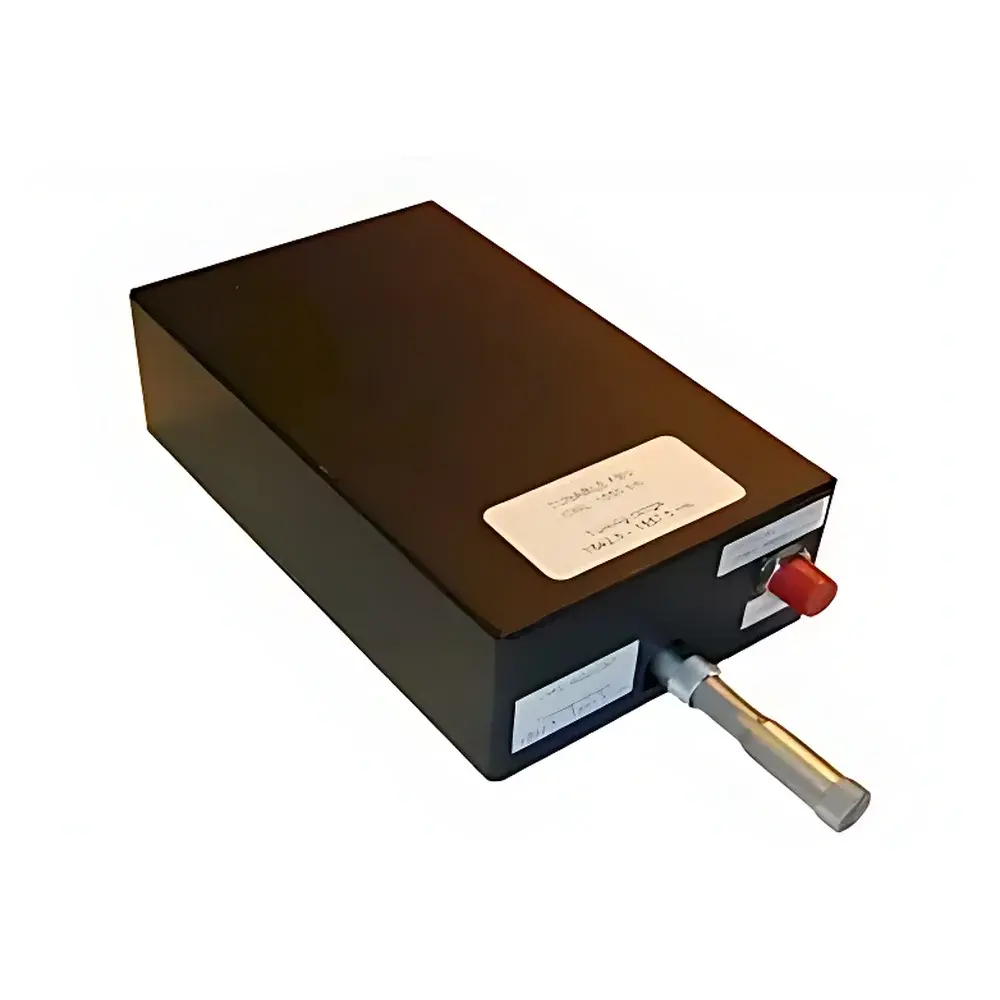
OE-Land+ HR-FBG Fiber Bragg Grating Module
| Origin | USA |
|---|---|
| Manufacturer Type | Authorized Distributor |
| Origin Category | Imported |
| Model | HR-FBG |
| Component Category | Optical Instrument Component |
| Price Range | USD 1 – 499 (per unit, FOB) |
Overview
The OE-Land+ HR-FBG Fiber Bragg Grating Module is a high-reliability, precision-engineered optical component designed for wavelength-selective reflection in demanding photonic systems. Based on UV-induced periodic refractive index modulation in the core of photosensitive optical fiber, the HR-FBG operates on the fundamental principle of Bragg resonance: λB = 2neffΛ, where λB is the reflected Bragg wavelength, neff the effective mode index, and Λ the grating period. This deterministic physical relationship enables highly predictable spectral response, making the HR-FBG suitable for applications requiring stable, narrowband spectral control—including cavity stabilization in high-power fiber lasers, dynamic dispersion compensation, gain flattening in EDFAs, and reference-grade sensing in metrology-grade instrumentation. The module integrates a robustly packaged FBG with low-PDL (<0.1 dB), low-PMD (<0.1 ps), and athermal mechanical housing to minimize thermal drift—critical for long-term operation in industrial and laboratory environments.
Key Features
- High-reflection (>99.5%) FBG with center wavelength tolerance ≤ ±0.1 nm across 900–2400 nm range
- Optimized for high-power handling: rated for continuous-wave pump power up to 1000 W (with appropriate thermal management)
- Athermal packaging (75 × 10 × 5 mm) mitigates thermally induced wavelength shift—typical drift < 0.5 pm/°C over 0–50 °C operating range
- Low insertion loss (20 dB across >50 nm stopband)
- Compatible with SMF-28, PMF, DCF, and large-mode-area (LMA) fibers; standard FC/PC or FC/APC receptacles or fiber-pigtailed configurations available
- Customizable parameters: bandwidth (FWHM < 0.2 nm typical), reflectivity profile (uniform, apodized, or chirped), and polarization-maintaining alignment
Sample Compatibility & Compliance
The HR-FBG module is compatible with single-mode (SM), polarization-maintaining (PM), dispersion-compensating (DCF), and large-mode-area (LMA) fibers—enabling integration into amplifier cavities, interferometric sensors, and telecom-grade amplification stages. It complies with IEC 61300-2-4 (fiber optic connector durability), Telcordia GR-1209-CORE (reliability under thermal cycling), and RoHS 2011/65/EU. For regulated environments, its stable spectral performance supports GLP-compliant optical calibration workflows and meets baseline requirements for traceable wavelength references per ISO/IEC 17025 when used within validated system architectures. No embedded electronics or software—no FDA 21 CFR Part 11 or EU Annex 11 implications apply.
Software & Data Management
As a passive, all-fiber optical component, the HR-FBG requires no firmware, drivers, or host software. Spectral characterization data (transmission/reflection spectra, group delay, polarization-dependent loss) is delivered in standard formats (CSV, S1P/S2P touchstone files) upon request for integration into optical design tools such as Lumerical MODE, OptiSystem, or MATLAB-based analysis pipelines. Calibration reports include traceable measurement uncertainty budgets aligned with NIST-traceable OSA (optical spectrum analyzer) references. For OEM integration, OE-Land provides full spectral test reports with ±0.02 nm wavelength accuracy (calibrated at 23 ± 0.5 °C) and batch-level consistency documentation.
Applications
- High-power fiber laser cavities: As rear or output coupler mirrors in kW-class Yb-doped, Er-doped, or Tm-doped oscillators and MOPA systems
- EDFA/Raman amplifier gain flattening: OEGFF-100 variant provides <0.2 dB flatness over C- or L-band with minimal ripple accumulation in cascaded configurations
- ASE noise suppression: Narrowband (<0.2 nm FWHM) OEPBG-100 filters suppress amplified spontaneous emission in ultra-narrow linewidth sources
- Fiber-optic sensing: Strain/temperature transduction using wavelength-encoded interrogation (e.g., in structural health monitoring or cryogenic environments)
- LIDAR and spectroscopy: Wavelength-stabilized seed sources and spectral filtering in time-of-flight or heterodyne detection systems
- Biophotonics instrumentation: Excitation/emission filtering in fluorescence lifetime imaging (FLIM) and Raman endomicroscopy platforms
FAQ
What is the maximum optical power the HR-FBG can withstand continuously?
The HR-FBG is rated for up to 1000 W CW when mounted on a thermally conductive baseplate with ≥10 cm² surface area and forced-air or liquid cooling. For pulsed operation (ns–ps regime), peak power handling depends on pulse energy density and repetition rate—consult application engineering for duty-cycle-specific derating.
Can the HR-FBG be customized for non-standard center wavelengths or bandwidths?
Yes. OE-Land offers custom fabrication across 600–2100 nm with bandwidths from 0.05 nm to 2.0 nm (FWHM), apodization profiles, and reflectivity gradients tailored to specific system requirements.
Is thermal tuning supported in the HR-FBG module?
The standard HR-FBG is athermal-packaged for passive stability. Thermally tunable variants (e.g., OE-Land TC-FBG series) are available with integrated micro-heaters and ±2 nm tuning range over 0–70 °C.
What fiber types and connector options are supported?
Standard configurations include SMF-28, Panda PMF, and LMA fibers. Connectors: FC/PC, FC/APC, SC/PC, or bare-fiber pigtails (0.9 mm or 3 mm jacket). Custom lengths and termination geometries are available upon request.
Do you provide spectral test reports with each unit?
Yes. Every HR-FBG ships with a full spectral characterization report including reflection spectrum, center wavelength, bandwidth (FWHM), side-lobe suppression, insertion loss, PDL, and PMD—measured on an EXFO FTB-5500B or equivalent calibrated OSA.




