
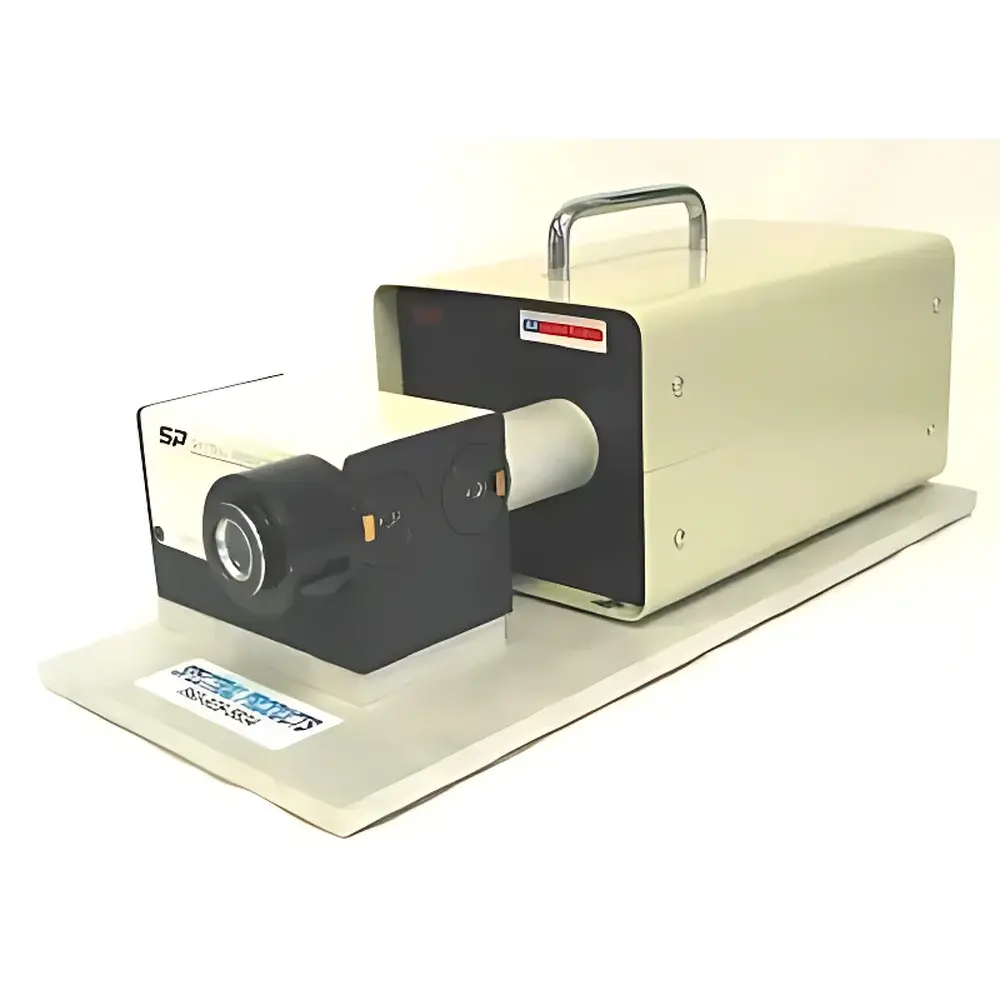
Spectral Products AST-D-030 Tunable Deuterium Lamp Monochromator Source
| Brand | Spectral Products / SpectroSystem |
|---|---|
| Origin | USA |
| Manufacturer Type | Authorized Distributor |
| Origin Category | Imported |
| Model | AST-D-030 |
| Component Category | Tunable UV Light Source |
| Monochromator | CM110 |
| f/# | 3.9 |
| Grating Configuration | Dual pre-installed gratings |
| Wavelength Range | 180–400 nm |
| Output Interface | RS-232 serial control |
| Scanning Modes | Bidirectional (nm, Å, cm⁻¹, eV) |
| Light Source | ASB-D-030 (30 W deuterium lamp) |
| Lamp Current | 300 ± 30 mA DC |
| Rated Lifetime | 1000 h (typical) |
| Fiber Coupling Options | AFCM-L-SM-SMA, AFCM-L-FC-FC, AFCM-L-CS-Ferrule (sold separately) |
| Filter Mount | AB202 |
| Compatible Filters | AB3XXX series (sold separately) |
Overview
The Spectral Products AST-D-030 is a precision-engineered tunable deep-ultraviolet (DUV) monochromatic light source designed for laboratory-grade spectroscopic applications requiring stable, narrowband output between 180 nm and 400 nm. Built around a 30 W deuterium arc lamp (model ASB-D-030), the system integrates a high-throughput Czerny-Turner monochromator (CM110, f/3.9) with dual pre-aligned diffraction gratings to enable rapid, repeatable wavelength selection across the spectral range. Unlike broadband or LED-based alternatives, the deuterium lamp provides continuous spectral emission with high radiance in the far-UV—critical for absorbance measurements, photodetector calibration, and photochemical actinometry where spectral purity and photon flux stability are essential. The optical architecture supports both free-space and fiber-coupled configurations, making it compatible with spectrometers, ellipsometers, fluorescence excitation setups, and custom optical benches.
Key Features
- Deep-UV spectral coverage from 180 nm to 400 nm with <1.5 nm typical bandwidth (FWHM) depending on grating and slit settings
- Bidirectional wavelength scanning via RS-232 interface, supporting user-defined units: nanometers (nm), angstroms (Å), wavenumbers (cm⁻¹), and photon energy (eV)
- Dual-grating turret allows seamless switching between resolution-optimized and throughput-optimized configurations without realignment
- Integrated lamp power supply delivers regulated DC current (300 ± 30 mA) to ensure stable arc discharge and minimize intensity drift over time
- Modular mechanical design permits field adaptation—including retrofitting of filter wheels, shutter assemblies, or collimating optics—without voiding calibration integrity
- Standard SMA-905 or FC/PC fiber coupling options (via AFCM-L series adapters) support integration into OEM systems or remote sampling probes
Sample Compatibility & Compliance
The AST-D-030 is routinely deployed in environments governed by ISO/IEC 17025, ASTM E275 (standard practice for ultraviolet-visible spectrophotometer verification), and USP (photometric absorption standards). Its calibrated spectral output enables traceable validation of UV-Vis detector linearity, stray-light performance, and wavelength accuracy per NIST-traceable reference materials (e.g., holmium oxide, didymium filters). The unit complies with FCC Part 15 Class A emissions limits and meets UL 61010-1 safety requirements for laboratory electrical equipment. No hazardous substance declarations (RoHS, REACH) apply to the core optical assembly; lamp replacement kits (ASB-D-030) are supplied with full material safety data sheets (MSDS) and disposal guidance aligned with EPA 40 CFR Part 261.
Software & Data Management
The AST-D-030 operates under Spectral Products’ proprietary SPControl software (Windows-compatible, .NET Framework 4.8+), which provides full command-line and GUI access to all scan parameters—including step size, dwell time, auto-zero baseline correction, and multi-scan averaging. Raw wavelength-intensity datasets export in ASCII CSV or HDF5 format for downstream analysis in MATLAB, Python (NumPy/Pandas), or Igor Pro. Audit trail functionality logs all parameter changes, lamp-on duration, and calibration events—supporting GLP/GMP documentation workflows. For integration into automated test platforms, the device exposes a documented SCPI-like command set over RS-232, enabling synchronization with motion controllers, data acquisition cards (e.g., National Instruments DAQmx), and LIMS systems compliant with FDA 21 CFR Part 11 electronic record requirements.
Applications
- Calibration and verification of UV-Vis spectrophotometers, diode array detectors, and CCD-based imaging spectrometers
- Quantitative determination of nucleic acid and protein concentration using 260 nm / 280 nm absorbance ratios
- Stray-light characterization of optical filters and monochromators via out-of-band rejection testing
- Photochemical kinetics studies involving UV-induced bond cleavage (e.g., NO₂ photolysis at 398 nm, ozone absorption at 254 nm)
- Development and validation of UV-curable resin formulations requiring precise irradiance dosimetry
- Testing quantum efficiency of solar-blind photomultiplier tubes and SiC photodiodes in the DUV region
FAQ
What is the typical spectral bandwidth (FWHM) achievable with the AST-D-030?
Bandwidth depends on selected grating groove density, entrance/exit slit width, and focal length; typical values range from 0.8 nm (with 1200 g/mm grating and 10 µm slits) to 3.2 nm (with 300 g/mm grating and 50 µm slits).
Can the AST-D-030 be operated in continuous-scan mode?
Yes—SPControl supports continuous raster scanning with programmable velocity and real-time intensity logging at up to 100 points per second.
Is lamp alignment required after replacement?
No—the ASB-D-030 lamp module features kinematic mounting and factory-aligned optical axis; replacement preserves collimation within ±0.15°.
Does the system include NIST-traceable wavelength calibration?
A factory calibration certificate (covering 180–400 nm at 1 nm intervals) is provided; optional recalibration services are available through Spectral Products’ ISO/IEC 17025-accredited lab.
Are there thermal management requirements for extended operation?
The unit incorporates forced-air cooling with thermally stabilized housing; ambient operating temperature must be maintained between 15 °C and 30 °C with ≤60% non-condensing relative humidity.




