
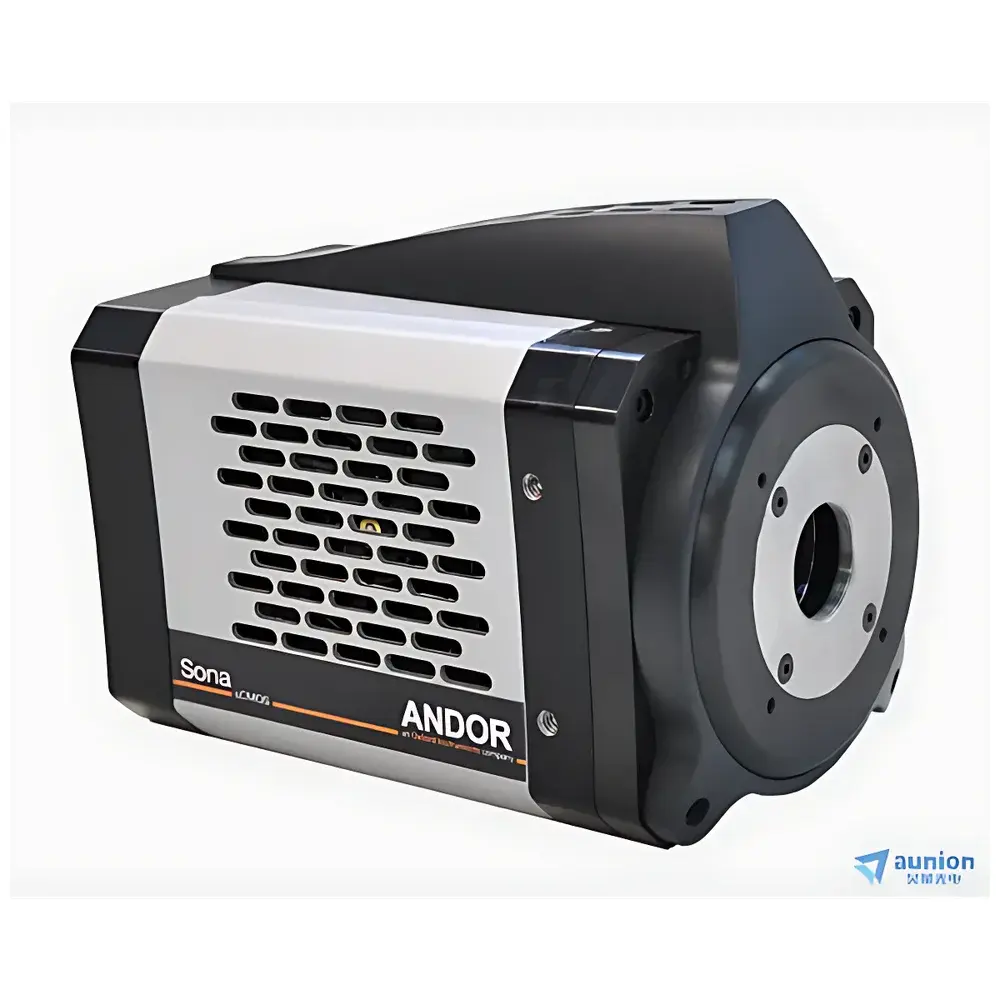
Andor Sona 4.2B-6 / 4.2B-11 / 2.0B-11 Back-Illuminated sCMOS Camera Platform
| Brand | Andor |
|---|---|
| Origin | UK (Manufactured in Belfast) |
| Sensor Type | Back-Illuminated sCMOS |
| Resolution | 2048 × 2048 (4.2 MP), 1400 × 1400 (2.0 MP) |
| Pixel Size | 6.5 µm (Sona 4.2B-6), 11 µm (Sona 4.2B-11 & Sona 2.0B-11) |
| Quantum Efficiency | Up to 95% @ 600 nm |
| Cooling | Thermoelectric to –45 °C |
| Read Noise | ≤1.6 e⁻ (median, 12-bit), ≤1.2 e⁻ (CMS mode) |
| Full-Frame Frame Rate | 43 fps (USB 3.0, 16-bit), 74 fps (CoaXPress, 16-bit) |
| Dynamic Range | Up to 53,000:1 |
| Interface | USB 3.0 and CoaXPress (optional) |
| Shutter Mode | Rolling Shutter |
| Pixel Well Depth | 55,000–85,000 e⁻ |
| Linearity | >99.7% |
| PRNU | <0.5% |
| Compliance | CE, RoHS, FDA 21 CFR Part 11 ready (via Andor Solis Software) |
Overview
The Andor Sona series represents a high-performance back-illuminated scientific CMOS (sCMOS) camera platform engineered for quantitative life science imaging. Leveraging advanced back-illuminated sensor architecture—specifically the GPixel GSENSE2020BSI (Sona 4.2B-6) and GPixel 400 (Sona 4.2B-11 / 2.0B-11)—the Sona cameras deliver exceptional photon detection efficiency across the visible to near-UV spectrum. With peak quantum efficiency (QE) reaching 95% at 600 nm and deep thermoelectric cooling to –45 °C, these cameras achieve ultra-low dark current (≤0.1 e⁻/pixel/sec) and sub-electron read noise—critical for low-light applications such as single-molecule fluorescence, calcium imaging, and time-lapse embryology. The Sona platform implements a dual-gain amplifier architecture to extend dynamic range without sacrificing sensitivity, enabling accurate quantification of both dim and bright signal regions within the same frame—a necessity for heterogeneous biological specimens like neuronal networks or tissue sections.
Key Features
- Back-illuminated sCMOS sensors with industry-leading QE (up to 95%) and optimized fill factor for maximum photon collection efficiency.
- Thermoelectric cooling to –45 °C, reducing dark current by >99% compared to uncooled operation—essential for long-exposure confocal, TIRF, or super-resolution modalities.
- Dual-amplifier readout architecture delivering simultaneous high-sensitivity and high-dynamic-range acquisition (up to 53,000:1), preserving linearity (>99.7%) and photon response non-uniformity (<0.5%) across the full 16-bit range.
- Flexible pixel formats: 6.5 µm pixels (Sona 4.2B-6) optimized for Nyquist-sampled resolution at 40×/60× magnifications; 11 µm pixels (Sona 4.2B-11, 2.0B-11) providing superior sensitivity at higher magnifications (e.g., 100× oil immersion) or wide-field applications requiring large FOV.
- High-speed acquisition: Up to 74 fps full-frame at 16-bit depth via CoaXPress interface; 43 fps via USB 3.0—enabling robust capture of rapid intracellular dynamics including vesicle trafficking, membrane potential changes, and mitotic progression.
- UltraVac™ vacuum-sealed sensor chamber eliminates condensation and thermal drift, ensuring long-term calibration stability and repeatable quantitative performance under extended acquisition protocols.
Sample Compatibility & Compliance
The Sona series is compatible with all major inverted and upright research-grade microscopes—including Nikon Ti2, Olympus IXplore, Zeiss Axio Observer, and Leica DMi8—via standard F-mount (Sona 4.2B-11) or C-mount (Sona 2.0B-11) interfaces. Optional couplers support seamless integration with custom optical paths, light-sheet systems, or macro-imaging setups. All models comply with CE and RoHS directives. When operated with Andor Solis v5.x or later, the system supports audit-trail logging, electronic signatures, and secure user access control—meeting core requirements of FDA 21 CFR Part 11 for regulated environments. Data integrity is further reinforced through hardware-level timestamping, frame-locked triggering, and deterministic exposure control—ensuring traceability for GLP/GMP-aligned workflows in preclinical imaging and biopharmaceutical development.
Software & Data Management
Andor Solis software provides native support for all Sona models, offering intuitive acquisition control, real-time histogram analysis, and multi-channel time-series registration. Advanced features include region-of-interest (ROI) streaming, hardware-triggered synchronization with lasers or shutters, and on-the-fly flat-field correction. For high-throughput applications, Solis integrates with Micro-Manager (open-source) and MATLAB via direct SDK access. Raw image data are saved in standardized TIFF or HDF5 formats with embedded metadata (exposure time, temperature, gain, lens ID), facilitating FAIR (Findable, Accessible, Interoperable, Reusable) data practices. Batch processing pipelines support background subtraction, drift correction, and intensity normalization—critical for longitudinal studies requiring cross-session comparability.
Applications
- Confocal & Spinning Disk Microscopy: High QE and low noise enable reduced laser power, minimizing phototoxicity during live-cell 3D time-lapse imaging.
- Super-Resolution Imaging (STORM/PALM): Sub-electron read noise and precise photon counting capability support single-molecule localization with nanometer precision.
- Light-Sheet Fluorescence Microscopy (LSFM): Large 32 mm diagonal FOV (Sona 4.2B-11) captures entire cleared embryos or organoids in single-shot volumetric acquisition.
- Electrophysiology-Integrated Imaging: Hardware-triggered synchronization ensures temporal fidelity between patch-clamp recordings and Ca²⁺ or voltage-sensitive dye signals.
- High-Content Screening (HCS): Fast frame rates and ROI streaming accelerate assay throughput while maintaining quantitative rigor across multi-well plate formats.
FAQ
What is the difference between Sona 4.2B-6 and Sona 4.2B-11?
The Sona 4.2B-6 uses a 6.5 µm pixel pitch optimized for Nyquist sampling at moderate magnifications (40×–60×), delivering higher spatial resolution per field of view. The Sona 4.2B-11 employs 11 µm pixels, increasing full-well capacity and sensitivity—ideal for low-light conditions or high-magnification objectives (e.g., 100× oil).
Is the Sona camera compatible with my existing microscope?
Yes—Sona 4.2B-11 ships with an F-mount adapter for Nikon Eclipse and similar large-port systems; Sona 2.0B-11 is natively C-mount for compatibility with Olympus, Zeiss, and Leica C-port configurations. Optional adapters support M42, T-thread, and custom mechanical interfaces.
Does the Sona platform support FDA 21 CFR Part 11 compliance?
When deployed with Andor Solis v5.5+ and configured with role-based user accounts, audit trails, and electronic signatures, the system satisfies key technical controls required for Part 11 adherence in regulated laboratories.
Can I acquire images at full resolution and maximum speed simultaneously?
Yes—Sona 4.2B-6 achieves 74 fps at full 2048 × 2048 resolution in 16-bit mode using the CoaXPress interface; USB 3.0 supports 43 fps at identical resolution and bit depth.
How does UltraVac™ improve long-term imaging stability?
By maintaining a permanent vacuum seal around the sensor die, UltraVac™ eliminates moisture-induced thermal gradients and prevents ice formation during extended cryo-cooling—preserving pixel-to-pixel gain uniformity over weeks-long acquisition campaigns.




