
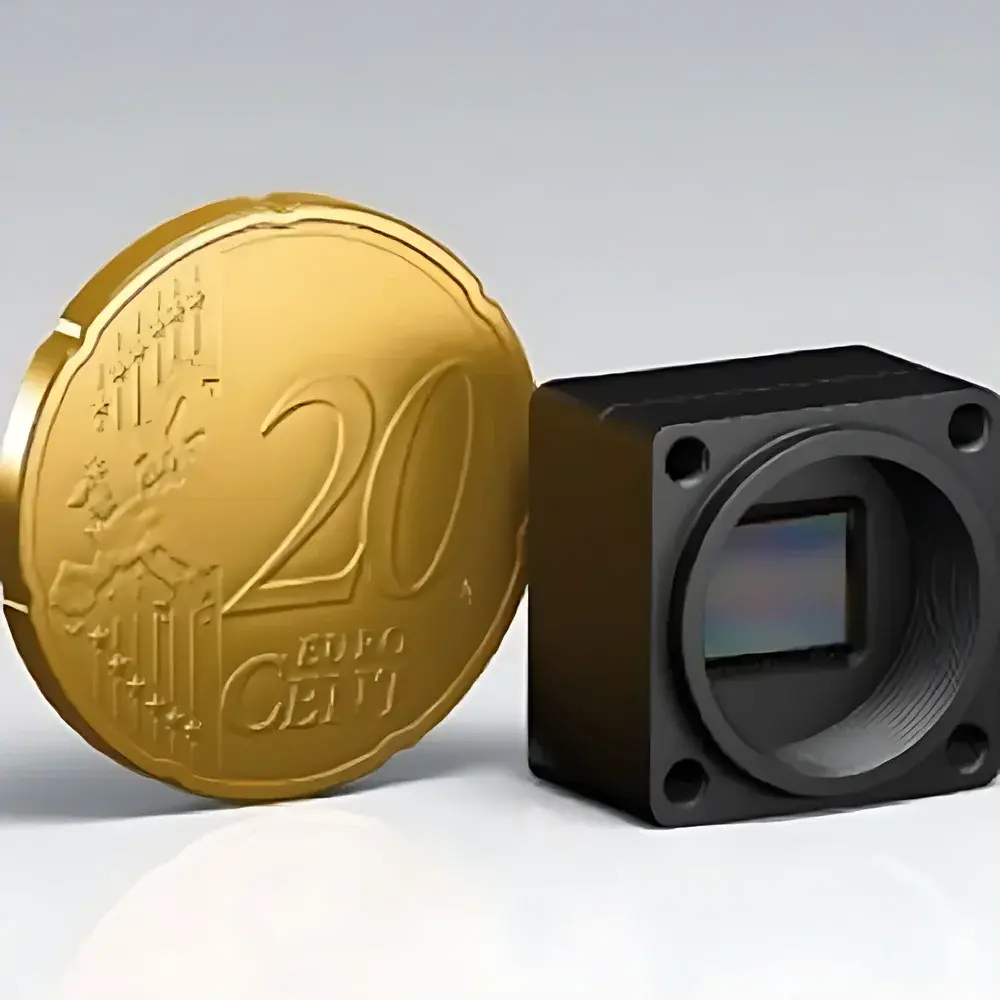
XIMEA xiMU MU9PM-MH Ultra-Compact USB 2.0 Monochrome Industrial Camera
| Brand | XIMEA |
|---|---|
| Origin | Germany |
| Model | MU9PM-MH |
| Sensor | ON Semiconductor MT9P031 (5 MP, 1/2.5", B/W CMOS) |
| Resolution | 2592 × 1944 pixels |
| Frame Rate | up to ~5 fps (USB 2.0, full resolution), higher with ROI or binning |
| Pixel Size | 2.2 µm |
| Bit Depth | 12-bit |
| Dynamic Range | ~60 dB |
| Full Well Capacity | 4900 e⁻ |
| On-chip Binning | 1×1, 2×2, 4×4, 6×6, 7×7 |
| SNR | ~38 dB |
| Gain Range | 18 dB |
| Exposure Range | 20 µs – 10 s |
| I/O | 2 GPIO inputs, 2 GPIO outputs |
| Power | 5 V via USB, typ. 0.9 W |
| Lens Mount | S-mount (M12), optional C-mount adapter |
| Dimensions | 15 × 15 × 8 mm |
| Weight | 5 g |
Overview
The XIMEA xiMU MU9PM-MH is an ultra-compact, industrial-grade monochrome USB 2.0 camera engineered for space-constrained embedded vision applications requiring high reliability, low power consumption, and seamless integration into automated systems. Based on the ON Semiconductor MT9P031 global-shutter CMOS sensor, it delivers 5 megapixel (2592 × 1944) resolution with true 12-bit digitization, enabling precise grayscale imaging in demanding optical metrology, medical endoscopy, and miniature robotics environments. Its measurement principle relies on photon-to-electron conversion within a pinned photodiode architecture, optimized for low noise, high dynamic range (~60 dB), and stable exposure control (20 µs – 10 s). Designed for GenICam-compliant host software, the camera operates without proprietary drivers—ensuring deterministic behavior in real-time inspection workflows governed by ISO/IEC 17025, ASTM E2714, or FDA 21 CFR Part 11–aligned validation protocols.
Key Features
- World’s smallest industrial USB 2.0 camera form factor (15 × 15 × 8 mm, 5 g), enabling integration into micro-robotic arms, intraoral dental scanners, and handheld ophthalmic devices where mechanical clearance is sub-5 mm.
- Robust all-metal housing with no sheet-metal covers—rated for continuous operation in vibration-prone industrial enclosures (IEC 60068-2-6 compliant mounting).
- Ultra-low power profile: typical consumption of 0.9 W at 5 V USB—reducing thermal load in sealed optics modules and extending battery life in portable diagnostic instruments.
- Industrial trigger support: hardware-synchronized acquisition via programmable GPIO (2 inputs, 2 outputs), compatible with PLC-based timing controllers and encoder-triggered motion capture.
- GenICam/GenTL v1.3 and xiAPI SDK support—ensuring interoperability with HALCON, OpenCV, MATLAB Image Acquisition Toolbox, and LabVIEW Vision Development Module across Windows, Linux, and macOS.
- Configurable on-sensor binning (1×1 to 7×7) and region-of-interest (ROI) readout—enabling frame rate optimization up to ~15 fps at reduced resolution while preserving signal integrity.
Sample Compatibility & Compliance
The MU9PM-MH supports optical coupling via standardized S-mount (M12) lenses, with optional C-mount adapters for legacy macro or telecentric optics used in PCB AOI and retinal imaging. Its 1/2.5″ sensor format ensures compatibility with high-NA miniature objectives (e.g., Navitar 12× zoom modules) and fiber-optic coherent bundles in endoscopic applications. The camera meets CE, FCC Class B, and RoHS directives. Firmware implements non-volatile register storage for persistent configuration (exposure, gain, trigger mode), supporting GLP/GMP audit trails when paired with xiSDK logging utilities. Calibration metadata—including sensor flat-field correction coefficients and pixel response non-uniformity (PRNU) maps—is embeddable in image headers per DICOM Supplement 145 and MIQE guidelines.
Software & Data Management
XIMEA’s xiAPI SDK provides deterministic, low-latency access to all camera registers and streaming buffers, with built-in support for multi-threaded acquisition, buffer pooling, and timestamp synchronization (IEEE 1588 PTP optional via external hardware). Image data is delivered in native Bayer or mono-packed formats; raw 12-bit streams are preserved end-to-end—critical for quantitative analysis in life science microscopy and materials defect classification. The SDK includes sample code for automated calibration routines (dark frame subtraction, gain normalization) and integrates with HDF5-based archiving pipelines compliant with NIH BRAIN Initiative data standards. All firmware updates are signed and validated, satisfying FDA software validation requirements under 21 CFR Part 11 for electronic records and signatures.
Applications
- Dental 3D intraoral scanning: integrated into handheld wand assemblies for sub-100 µm triangulation accuracy in CAD/CAM restorative workflows.
- Retinal and anterior-segment ophthalmic imaging: coupled with adaptive optics modules for high-resolution capillary visualization under low-light (<0.1 lux) conditions.
- Micro-robotic vision guidance: mounted on 6-DOF collaborative arms for real-time solder-joint inspection in SMT reflow monitoring.
- Embedded endoscopy: deployed in disposable capsule endoscopes and laparoscopic tool tips—leveraging its 5 g mass to minimize torque loading on articulating mechanisms.
- Inline pharmaceutical tablet inspection: synchronized with conveyor triggers for blister-pack defect detection at 200 mm/s line speeds.
- Quantitative histopathology: used in compact slide scanners for nuclear morphology analysis in digital pathology pipelines (CAP-accredited labs).
FAQ
Does the MU9PM-MH support hardware triggering with external encoders?
Yes—it features two opto-isolated GPIO inputs configurable as exposure trigger, frame start, or strobe sync signals, with ≤1 µs jitter under USB 2.0 isochronous transfer.
Is USB 3.0 or USB3.1 Gen 1 supported?
No—the MU9PM-MH is strictly a USB 2.0 device; for USB3.1 Gen 1 performance, refer to the xiMU MU120MC series (AR1820HS sensor variant).
Can the camera operate continuously at 40°C ambient temperature?
Yes—thermal characterization confirms stable operation up to 50°C case temperature with passive heatsinking; no active cooling required.
Is lens distortion correction available in firmware?
No—geometric correction must be applied in host software using calibration matrices generated via OpenCV’s calibrateCamera() or XiQ software suite.
What is the mean time between failures (MTBF) under continuous operation?
Based on accelerated life testing per Telcordia SR-332, MTBF exceeds 120,000 hours at 25°C ambient, with FIT rate < 8.3.
Related Products




