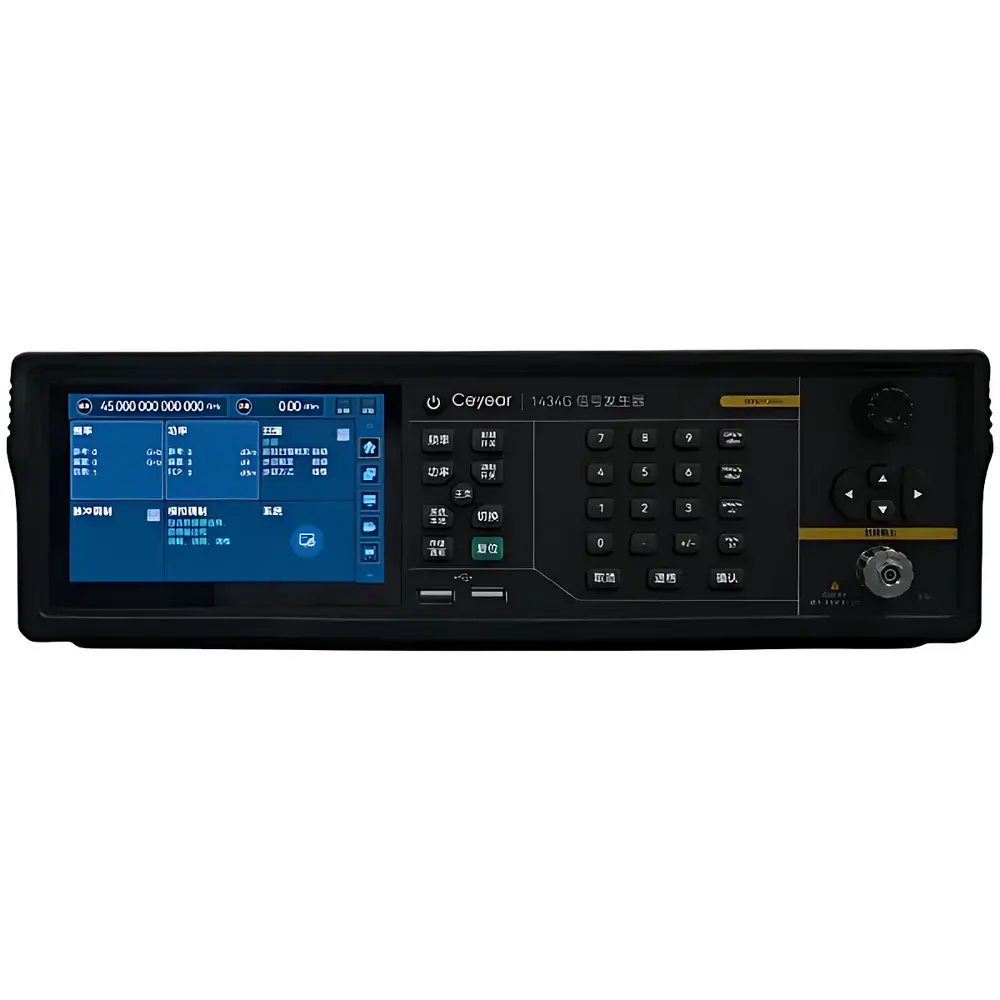
Auniontech AU-SG-3G/6G/20G/45G Economic Analog Signal Generator
| Brand | Auniontech |
|---|---|
| Frequency Range | 9 kHz to 3 GHz / 6 GHz / 20 GHz / 45 GHz |
| Output Power Range | –120 dBm to +25 dBm (typ. @2 GHz), +20 dBm (typ. @20 GHz), +16 dBm (typ. @45 GHz) |
| Power Accuracy | < ±0.5 dB (measured) |
| Phase Noise | ≤ –124 dBc/Hz @ 10 kHz offset (1 GHz carrier) |
| Harmonics | < –55 dBc @ 10 GHz (2nd harmonic, +10 dBm output) |
| Non-Harmonics | < –70 dBc @ 5 GHz |
| Modulation Types | AM, FM, PM, Pulse |
| Interfaces | USB 2.0, 10/100/1000BASE-T LAN |
| Remote Control | SCPI-compliant, browser-based web UI, Qt/C#/C++ example projects included |
| Form Factor | 2U rack-mountable chassis |
| Weight | 5.2 kg |
| Protection | Reverse power protection up to DC 50 V / AC 50 W (1 GHz) |
Overview
The Auniontech AU-SG-3G/6G/20G/45G is an economic analog signal generator engineered for precision RF and microwave test applications in R&D labs, educational institutions, and industrial quality assurance environments. Based on direct analog synthesis architecture, it delivers stable continuous-wave (CW) signals with minimal spurious content and high spectral purity across four configurable frequency tiers: 9 kHz–3 GHz, 9 kHz–6 GHz, 9 kHz–20 GHz, and 9 kHz–45 GHz. Unlike vector signal generators, this instrument emphasizes deterministic analog modulation fidelity and repeatability—making it ideal for characterizing receiver sensitivity, testing mixer linearity, validating filter roll-off, and performing EMI pre-compliance sweeps where phase-coherent complex waveforms are not required. Its compact 2U chassis integrates high-reliability electronic attenuators (standard on 3 GHz and 6 GHz models) and optional mechanical attenuators (for 20 GHz and 45 GHz variants), enabling a dynamic output range from –120 dBm to +25 dBm (at lower bands) with traceable power accuracy under ±0.5 dB.
Key Features
- Four scalable frequency options: 3 GHz, 6 GHz, 20 GHz, and 45 GHz maximum sweep capability—each calibrated per IEC 61000-4-3 and IEEE Std 1189 guidelines for RF immunity test source validation.
- Exceptional spectral integrity: measured single-sideband (SSB) phase noise of ≤ –124 dBc/Hz at 10 kHz offset from a 1 GHz carrier; non-harmonic spurs < –70 dBc at 5 GHz; harmonics suppressed to < –55 dBc at 10 GHz (output = +10 dBm).
- High-fidelity analog modulation suite: standard AM, FM, PM, and pulse modulation with user-definable depth, rate, and shape—fully compliant with MIL-STD-461G CS114 and DO-160G Section 20 requirements for conducted RF susceptibility testing.
- Robust front-end protection: integrated reverse-power protection rated for DC up to 50 V and AC up to 50 W (1 GHz), safeguarding against accidental DUT feedback during antenna or amplifier characterization.
- Cross-platform remote operation: embedded web server accessible via modern browsers (Chrome, Edge, Firefox); supports SCPI command logging and auto-generation of executable control templates for Qt, C#, and C++ development environments.
- Traceable power calibration workflow: native USB interface for real-time integration with external USB power meters (e.g., Keysight U2000 series); enables on-site power flatness correction and GLP-compliant calibration record generation.
Sample Compatibility & Compliance
The AU-SG series is designed for use with passive and active RF components including filters, amplifiers, mixers, antennas, and RFICs. It meets the essential electromagnetic compatibility (EMC) emission limits per CISPR 11 Class A and operates within ambient temperature ranges specified in IEC 60068-2-1 (cold) and IEC 60068-2-2 (dry heat). All models undergo factory verification against ISO/IEC 17025-accredited reference standards for frequency accuracy (±1 ppm aging stability), output level linearity, and modulation fidelity. While not certified for medical or aviation safety-critical systems, its performance aligns with typical laboratory-grade instrumentation requirements under ISO/IEC 17025 and ASTM E2889-13 for RF signal source validation.
Software & Data Management
The embedded firmware provides a secure, password-protected HTTP(S)-enabled web interface supporting TLS 1.2 encryption. All SCPI commands are fully compliant with IEEE 488.2 and SCPI-1999 standards, ensuring interoperability with LabVIEW, MATLAB Instrument Control Toolbox, and Python (PyVISA). Calibration data—including power vs. frequency tables, phase noise profiles, and harmonic distortion maps—is stored internally and exportable in CSV or XML format. Audit trails for all remote parameter changes are maintained with timestamped logs, supporting FDA 21 CFR Part 11 compliance when deployed in regulated QA/QC workflows. No proprietary software installation is required—only a standards-compliant browser and network connectivity.
Applications
- Receiver sensitivity and selectivity testing in wireless communication labs (Wi-Fi 6E, 5G NR FR1/FR2, Bluetooth LE).
- RF component characterization: insertion loss measurement of bandpass filters, gain compression analysis of LNA modules, and intermodulation distortion (IMD3) evaluation.
- EMI pre-compliance testing per CISPR 22/32 and FCC Part 15 Subpart B using swept-frequency CW stimuli.
- Education and training: hands-on instruction in RF fundamentals, modulation theory, spectrum analysis, and signal integrity principles.
- Production line functional testing of RF front-ends, where rapid, repeatable analog stimulus generation is prioritized over complex waveform synthesis.
FAQ
What frequency options are available, and how are they selected?
The AU-SG is offered in four fixed-band configurations: 3 GHz, 6 GHz, 20 GHz, and 45 GHz. Selection is hardware-defined at time of order; no field-upgrade path exists between bands due to fundamental differences in synthesizer architecture and filtering.
Is USB power meter integration supported out-of-the-box?
Yes—USB Type-B port accepts industry-standard USB power sensors (e.g., Keysight U2000, Rohde & Schwarz NRP series). The GUI automatically detects connected devices and applies real-time power compensation curves.
Does the instrument support external reference clock input?
No—internal OCXO (oven-controlled crystal oscillator) serves as the sole frequency reference. External 10 MHz reference input is not implemented in this economic-tier model.
Can modulation parameters be programmed remotely via LAN?
Yes—full SCPI command set includes dedicated syntax for AM depth, FM deviation, PM index, and pulse width/duty cycle, all controllable over TCP/IP socket or VXI-11.
What documentation is provided for regulatory compliance reporting?
Factory calibration certificates (traceable to NIM China), CE Declaration of Conformity, RoHS compliance statement, and full SCPI programming manual are delivered digitally and on USB drive with each unit.