
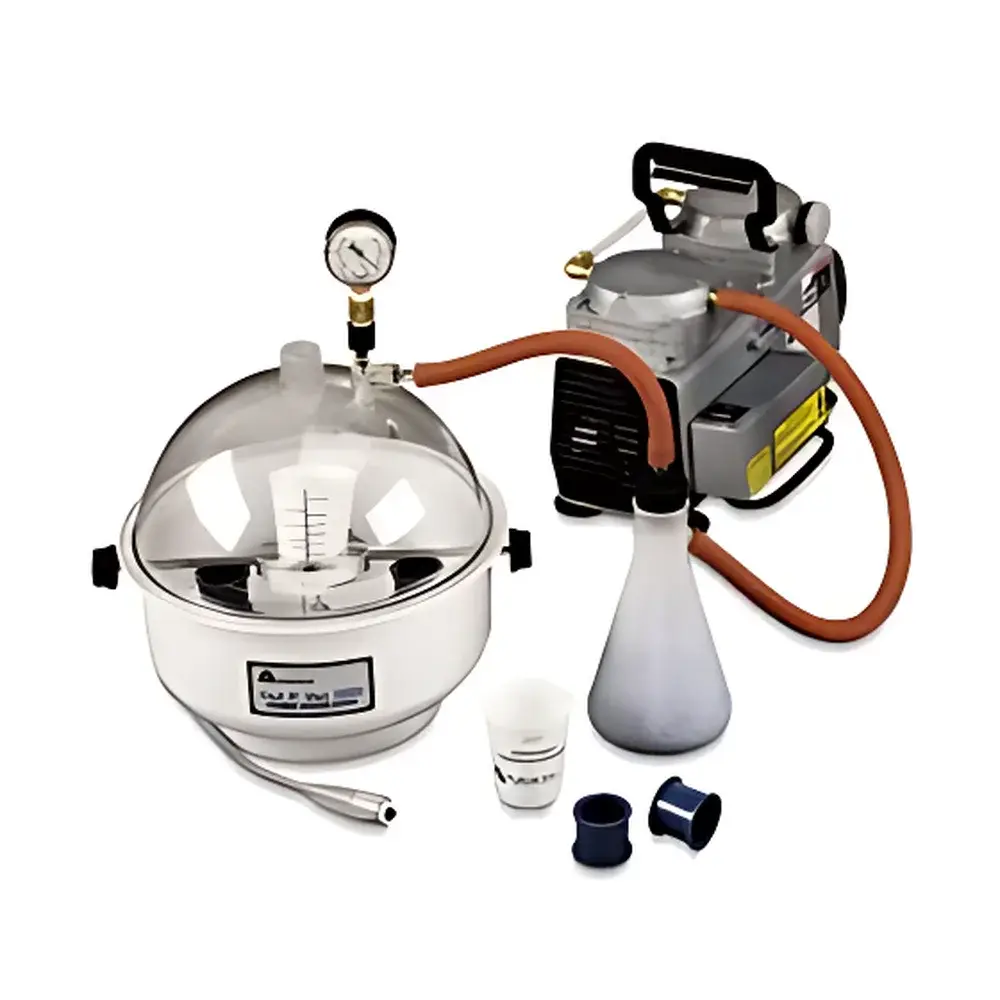
CAST N’VAC Series Vacuum Impregnation Press
| Brand | Buehler |
|---|---|
| Origin | USA |
| Model | CAST N'VAC |
| Type | Vacuum-Driven Specimen Mounting Press for Hot/Cold Mounting Resins |
| Application | Metallographic & Materialographic Sample Preparation |
Overview
The CAST N’VAC Series Vacuum Impregnation Press is a precision-engineered laboratory system designed for reliable, void-free embedding of porous or irregular specimens—particularly critical in metallography, petrography, electronics failure analysis, and composite material evaluation. Unlike conventional mounting presses that rely solely on mechanical pressure or thermal curing, the CAST N’VAC integrates a high-efficiency vacuum chamber with controlled resin infiltration dynamics to eliminate entrapped air from microstructural voids, cracks, and interstitial spaces prior to polymerization. This vacuum-assisted impregnation process follows ASTM E3-22 (Standard Guide for Preparation of Metallographic Specimens) and ISO 16478:2015 (Metallographic specimen preparation – Vacuum impregnation procedures), ensuring dimensional stability, edge retention, and reproducible cross-sectional integrity for subsequent grinding, polishing, and microscopic analysis.
Key Features
- Vacuum chamber constructed from optically clear, chemically resistant acrylic with integrated pressure relief valve and dual-stage vacuum gauge (0–760 Torr range), enabling real-time monitoring of evacuation depth and stabilization time.
- Modular platform design supports both single-specimen ring molds (standard 25 mm, 30 mm, and 32 mm diameters) and large-format multi-cavity trays (up to 100 × 100 mm footprint), accommodating diverse sample geometries—from fractured PCB sections to geological core fragments.
- Integrated high-capacity rotary vane vacuum pump (ultimate vacuum ≤ 50 mTorr, pumping speed ≥ 8 L/min), pre-wired for standard 120 V / 60 Hz North American power supply; no external compressed air or auxiliary cooling required.
- Ergonomic, front-access chamber door with silicone-sealed gasket and quarter-turn latch ensures rapid loading/unloading while maintaining vacuum integrity over extended dwell cycles (typical impregnation: 5–20 min, depending on resin viscosity and porosity).
- Non-porous stainless steel base plate and removable aluminum mold support tray facilitate solvent-based cleaning (e.g., acetone or xylene) and prevent resin buildup during repeated hot-mount (thermosetting epoxy/phenolic) or cold-mount (acrylic/methacrylate) workflows.
Sample Compatibility & Compliance
The CAST N’VAC accommodates specimens ranging from fine particulates (e.g., sintered powder metallurgy samples) to irregularly shaped components (e.g., turbine blade fragments, ceramic insulators, or corroded fasteners). It is compatible with all major thermosetting and thermoplastic mounting resins—including low-viscosity cold-mount acrylics (e.g., Buehler EpoxiCure 2), high-Tg phenolics, and conductive graphite-filled epoxies—without modification. The system conforms to ISO/IEC 17025:2017 requirements for equipment suitability in accredited testing laboratories and supports GLP-compliant documentation when paired with validated resin cure protocols and logbook traceability.
Software & Data Management
As a standalone electromechanical instrument, the CAST N’VAC operates without embedded firmware or proprietary software. However, its operational parameters—including vacuum hold duration, ambient temperature, and resin batch lot numbers—are intended to be recorded manually or integrated into laboratory information management systems (LIMS) via standardized SOP templates. For regulated environments subject to FDA 21 CFR Part 11, users may implement electronic audit trails using third-party digital logbooks that capture operator ID, timestamp, and vacuum decay rate verification per cycle—ensuring full traceability for QA/QC reporting and internal audits.
Applications
- Metallographic preparation of porous sintered metals, cast alloys with shrinkage porosity, or additive-manufactured (AM) parts exhibiting internal channel networks.
- Embedding fragile or friable materials—including coal briquettes, catalyst pellets, biological calcified tissues, and aged polymer composites—prior to sectioning without delamination.
- Failure analysis of electronic packages where void entrapment in underfill or molding compounds compromises SEM/EDS signal fidelity.
- Geological thin-section preparation for shale matrix characterization, where vacuum infiltration enhances epoxy penetration into nanoscale kerogen pores.
- Quality control in powder coating and thermal spray coating R&D, where interfacial adhesion assessment requires artifact-free cross-sections.
FAQ
Is the CAST N’VAC compatible with both hot-mount and cold-mount resins?
Yes—its vacuum chamber operates at ambient temperature and does not impose thermal constraints; compatibility depends solely on resin formulation and recommended impregnation conditions per manufacturer datasheets.
Can the system be used for vacuum-pressure impregnation (VPI) protocols?
No—the CAST N’VAC provides vacuum-only functionality; it lacks a pressurized gas inlet or sealed pressure vessel required for true VPI cycles.
What maintenance is required for long-term reliability?
Routine inspection of the vacuum seal gasket, periodic oil changes in the rotary vane pump (per OEM schedule), and cleaning of the chamber interior after each resin type change are sufficient to maintain performance over >10 years of typical lab use.
Is technical support still available for this discontinued series?
Buehler continues to provide legacy documentation, spare parts (e.g., vacuum gauges, mold rings, pump oil), and application engineering consultation through authorized global service partners.



