
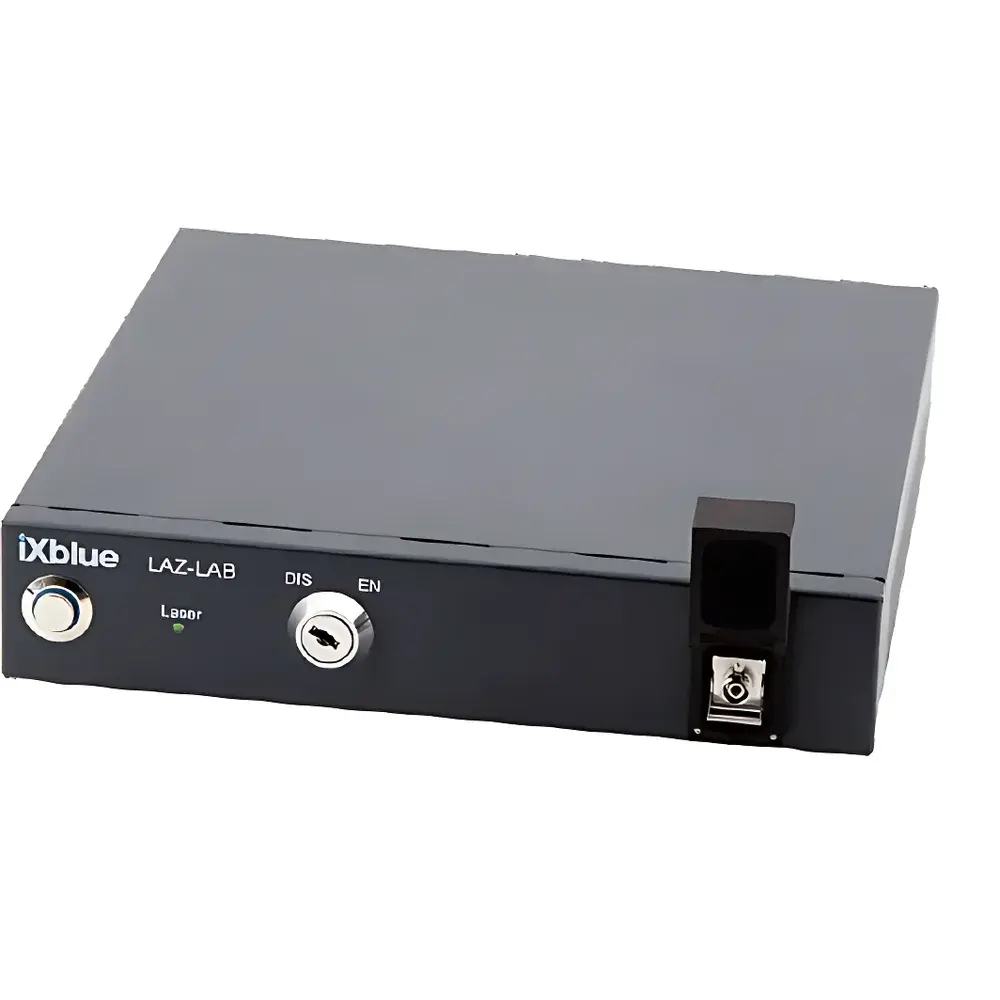
iXblue LAZ-LAB-NIR Near-Infrared Distributed Feedback (DFB) Laser
| Brand | iXblue |
|---|---|
| Origin | France |
| Manufacturer Type | Authorized Distributor |
| Import Status | Imported |
| Model | LAZ-LAB-NIR |
| Wavelength Range | 780–1080 nm |
| Output Type | Continuous-wave (CW), fiber-coupled |
| Laser Chip | Monolithic DFB semiconductor (InGaAsP/InP) |
| Package | Compact OEM module with integrated TEC and photodiode monitor |
| Control Interface | USB and analog voltage inputs |
| Software | LAZ-CONTROL GUI (Windows/Linux) |
| Compliance | CE, RoHS, IEC 60825-1 Class 1 |
Overview
The iXblue LAZ-LAB-NIR is a precision-engineered, fiber-coupled near-infrared distributed feedback (DFB) laser system designed for demanding optical modulation, sensing, and coherent signal generation applications. Operating on the fundamental principle of single-longitudinal-mode (SLM) emission via built-in Bragg grating feedback in an InGaAsP/InP semiconductor waveguide, the LAZ-LAB-NIR delivers exceptional spectral purity with intrinsic linewidths < 1 MHz (typ.), low relative intensity noise (RIN 20 dB). Its wavelength stability is actively maintained through integrated thermoelectric cooling (TEC) and real-time photodiode monitoring, enabling long-term drift < ±1 pm over 8 hours at constant ambient conditions. The system is optimized for direct integration with lithium niobate (LiNbO₃) electro-optic modulators—particularly iXblue’s own high-bandwidth phase and amplitude modulators—ensuring compatibility with critical operational thresholds including drive voltage requirements, optical power handling limits, and polarization alignment tolerances.
Key Features
- Wavelength selection across 780–1080 nm in discrete, factory-trimmed variants (e.g., 785 nm, 852 nm, 980 nm, 1064 nm), each individually characterized and certified
- Hermetically sealed, compact OEM package (120 × 80 × 30 mm) with FC/APC or PM-fiber output, supporting both free-space and polarization-maintaining fiber coupling
- Integrated digital control architecture with dual-loop stabilization: TEC temperature regulation (±0.01 °C) and automatic power control (APC) mode with < 0.5% RMS power fluctuation
- Simultaneous analog and USB 2.0 interface for seamless integration into automated test benches, lock-in detection systems, or FPGA-controlled optical setups
- Comprehensive safety compliance: IEC 60825-1 Class 1 certified (enclosed operation), with interlock-ready connector and embedded fault diagnostics (over-temperature, open-circuit, photodiode saturation)
Sample Compatibility & Compliance
The LAZ-LAB-NIR is specifically validated for use with commercial LiNbO₃ modulators from iXblue, Thorlabs, EOSPACE, and Photline, covering bandwidths up to 40 GHz. Its output polarization extinction ratio and low residual amplitude modulation (RAM < 0.05%) meet stringent requirements for carrier-suppressed double-sideband (CS-DSB) and optical single-sideband (OSSB) modulation schemes. All units undergo full environmental qualification per MIL-STD-810G for shock, vibration, and thermal cycling (−5 °C to +55 °C operating range). Documentation includes traceable calibration certificates aligned to NIST-traceable reference standards, and full conformity declarations for CE, RoHS, and REACH. For regulated environments (e.g., medical device R&D or aerospace photonics), the system supports optional audit-ready firmware logging compatible with GLP/GMP-aligned data integrity workflows.
Software & Data Management
The LAZ-CONTROL software suite provides deterministic, low-latency parameter control via a native C++ API (DLL and Python bindings included) and a graphical user interface supporting real-time monitoring of wavelength (via external wavemeter integration), output power, TEC current, and photodiode voltage. All control actions—including ramping sequences, setpoint sweeps, and trigger-synchronized power modulation—are timestamped with microsecond resolution and exportable in HDF5 or CSV format. Audit trail functionality records user identity, command history, and system state changes—fully compliant with FDA 21 CFR Part 11 requirements when deployed with network-authenticated login and electronic signature modules. Firmware updates are delivered via signed binary packages with SHA-256 verification.
Applications
- Coherent optical sensing: fiber Bragg grating (FBG) interrogation, interferometric fiber-optic gyroscopes (IFOGs), and distributed acoustic sensing (DAS) systems requiring narrow-linewidth, low-phase-noise sources
- Quantum optics infrastructure: pumping of atomic vapor cells (e.g., Rb, Cs D-lines), cavity-enhanced absorption spectroscopy, and squeezed light generation
- High-fidelity analog optical links: CATV transmission, microwave photonics signal processing, and RF-over-fiber distribution with spurious-free dynamic range > 110 dB·Hz²⁄³
- Modulator characterization labs: benchmarking EO coefficient, half-wave voltage (Vπ), and insertion loss under controlled bias and optical power conditions
- Industrial metrology: displacement measurement using heterodyne interferometry and absolute distance interferometry (ADI) protocols
FAQ
Is the LAZ-LAB-NIR suitable for use in ultra-stable interferometric setups requiring sub-kHz linewidth?
Yes—when operated in temperature-stabilized environments and paired with active frequency locking (e.g., using a high-finesse reference cavity), the LAZ-LAB-NIR achieves effective linewidths below 200 Hz under closed-loop control.
Can multiple LAZ-LAB-NIR units be synchronized for multi-wavelength interferometry?
Yes—the USB interface supports hardware-triggered start/stop commands with jitter < 100 ns, and the analog modulation input accepts TTL-sync signals for precise inter-unit phase alignment.
Does the system support custom wavelength options outside the standard 780–1080 nm range?
Custom wavelengths between 760 nm and 1100 nm are available under NRE agreement, subject to DFB chip availability and extended characterization lead time.
What is the maximum allowable back-reflection level at the fiber output?
The module is rated for < −40 dB optical return loss; higher reflections may induce instability and require integrated optical isolation (e.g., 30 dB isolator recommended for LiNbO₃ modulator interfaces).
Is remote headless operation supported without GUI dependency?
Yes—full command-line control is enabled via SCPI-like ASCII protocol over USB CDC ACM class, enabling deployment in Linux-based embedded controllers and LabVIEW Real-Time targets.




