
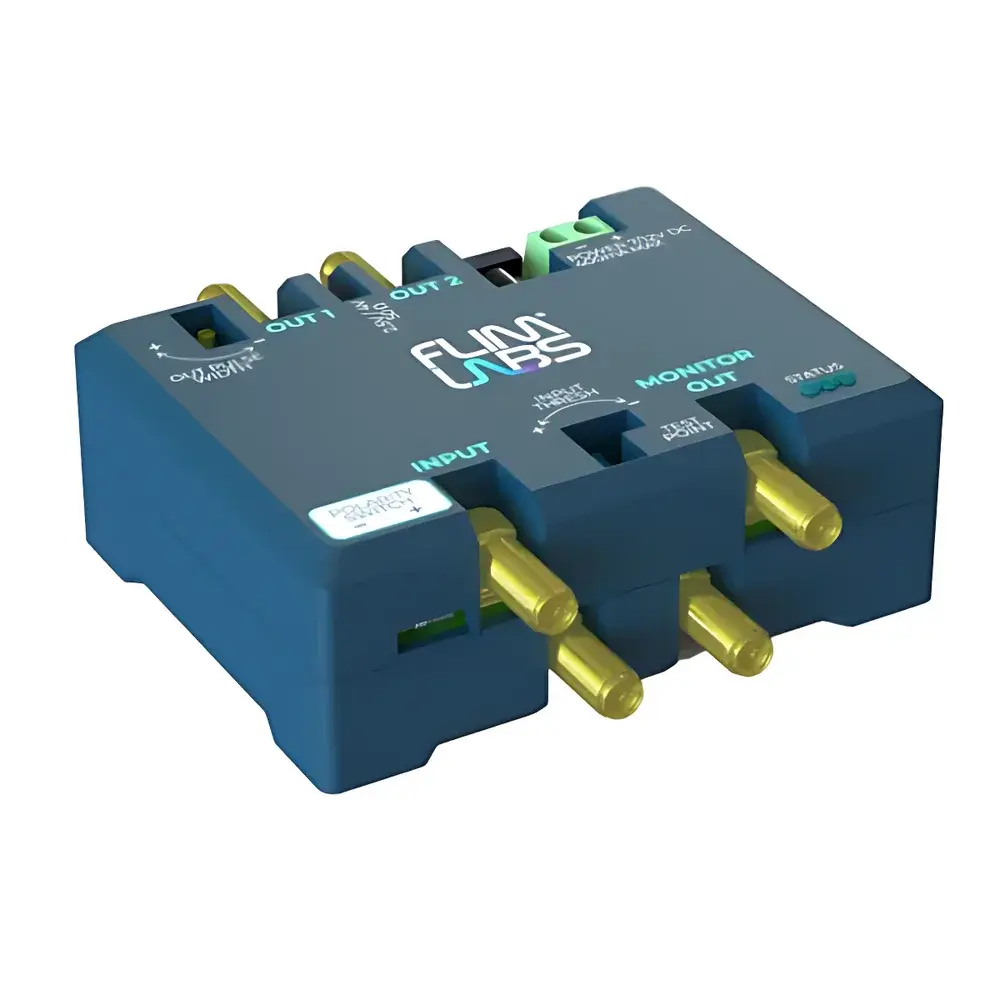
Auniontech TDC/TCSPC Constant-Fraction Discriminator (CFD) Module
| Brand | Auniontech |
|---|---|
| Origin | Shanghai, China |
| Model | TDC / TCSPC |
| Form Factor | Compact Single-Channel CFD Module |
| Dimensions | 85 × 70 × 30 mm |
| Weight | 100 g |
| Input Polarity | Selectable (Positive/Negative) |
| Input Impedance | 50 Ω |
| Min. Detectable Signal | ±100 mV |
| Max. Input Amplitude | 5 Vpp |
| Rise Time | <500 ps |
| Timing Jitter | <15 ps |
| Max. Repetition Rate | 140 MHz |
| Min. Input Pulse Width | 700 ps |
| Output Amplitude Options | 2.5 V or 4 V @ 50 Ω load |
| Output Pulse Width Tuning Range | 5–250 ns (via front-panel potentiometer) |
| Physical Delay Line | External selectable (1 ns per ~30 cm coaxial cable) |
| Power Supply | 8–12 V DC (recommended 9 V DC), ≤400 mA |
| Connector Type | SMA or SMB (customizable) |
| Compliance | Designed for integration into TCSPC, FLIM, and time-resolved spectroscopy systems compliant with ISO/IEC 17025 laboratory practices |
Overview
The Auniontech TDC/TCSPC Constant-Fraction Discriminator (CFD) Module is a precision timing electronics component engineered for high-fidelity time-stamping of fast analog pulses in time-correlated single-photon counting (TCSPC), fluorescence lifetime imaging microscopy (FLIM), ultrafast laser synchronization, and time-of-flight (ToF) applications. Unlike leading-edge discriminators—whose zero-crossing point shifts with signal amplitude—the CFD implements a constant-fraction triggering principle: it generates a trigger pulse at a fixed fraction (e.g., 50%) of the input pulse’s rising edge amplitude, thereby eliminating time walk error across varying pulse heights. This architecture ensures sub-15 ps timing jitter and maintains stable discrimination thresholds even for signals spanning ±100 mV to 5 Vpp. The module operates on a robust 9 V DC supply, integrates seamlessly into benchtop optical setups via its compact 85 × 70 × 30 mm footprint, and is optimized for direct coupling with photomultiplier tubes (PMTs), microchannel plate detectors (MCPs), and pulsed laser diodes.
Key Features
- Sub-15 ps timing jitter — Achieved through low-noise analog signal conditioning and precisely matched delay paths.
- Selectably polarized input stage — Front-panel toggle switch enables reliable triggering from either positive- or negative-going fast transients without external inverters.
- Dual independent outputs — Simultaneous 2.5 V and 4 V TTL-compatible logic outputs at 50 Ω impedance, supporting parallel routing to multiple time-to-digital converters (TDCs) or acquisition cards.
- Adjustable output pulse width — Front-panel potentiometer allows continuous tuning from 5 ns to 250 ns—critical for matching gate widths in gated detection or avoiding retriggering in high-repetition-rate regimes.
- Externally configurable physical delay line — Supports user-selected coaxial cable lengths (1 ns ≈ 30 cm RG-58) to align discriminator delay with measured input rise time (<500 ps), maximizing temporal alignment accuracy.
- Single-channel, rack-free design — Eliminates dependency on 19″ instrumentation racks; mounts directly onto optical tables or inside custom enclosures using M3 threaded holes.
Sample Compatibility & Compliance
This CFD module is designed for integration into research-grade and industrial time-resolved measurement platforms. It accepts analog inputs from standard photon-counting detectors (e.g., PMTs, SPADs, SiPMs) and synchronization sources (e.g., mode-locked lasers, Pockels cell drivers). Its 50 Ω input/output impedance, SMA/SMB connector compatibility, and ±100 mV minimum detectable threshold ensure interoperability with mainstream TCSPC hardware—including Becker & Hickl SPC series, PicoQuant HydraHarp, and Swabian Instruments Time Tagger ecosystems. While not certified as a standalone medical or safety device, the module adheres to electromagnetic compatibility (EMC) best practices for laboratory environments and supports traceable calibration workflows aligned with ISO/IEC 17025 requirements when deployed within validated TCSPC measurement chains.
Software & Data Management
As a hardware-level timing discriminator, the Auniontech CFD operates entirely in the analog domain and requires no embedded firmware, drivers, or host software. Its deterministic, zero-latency response makes it suitable for real-time, latency-critical applications where software-based triggering would introduce variable overhead. However, when integrated into TCSPC systems, the module’s stable trigger output enables high-fidelity timestamp acquisition under GLP/GMP-aligned data integrity protocols—particularly when paired with TDCs that support FDA 21 CFR Part 11-compliant audit trails, electronic signatures, and raw data immutability features. Calibration documentation—including jitter characterization reports and rise-time validation curves—is provided upon request to support laboratory quality management systems.
Applications
- Fluorescence lifetime imaging microscopy (FLIM) for cellular metabolism and protein interaction studies
- Time-resolved photoluminescence (TRPL) in semiconductor and perovskite thin-film characterization
- Ultrafast pump-probe spectroscopy requiring precise inter-pulse timing synchronization
- LIDAR and time-of-flight depth mapping with picosecond-level resolution
- Quantum optics experiments involving heralded single-photon detection and coincidence counting
- Calibration reference for evaluating timing performance of new detector technologies
FAQ
What is the primary advantage of a constant-fraction discriminator over a leading-edge discriminator?
It eliminates time walk—the variation in trigger timing caused by differences in input pulse amplitude—by triggering at a fixed fraction of the pulse’s rising edge, ensuring consistent time stamps across wide dynamic ranges.
Can this CFD be used with both PMT and SPAD outputs?
Yes—its ±100 mV sensitivity threshold and 5 Vpp input range accommodate typical analog outputs from both vacuum PMTs and active-quenched SPAD modules.
Is external power supply included?
No—the module requires an external 8–12 V DC source (9 V recommended); a regulated wall-mount adapter with 2.1/5.5 mm coaxial connector is advised for noise-sensitive TCSPC setups.
How is timing jitter characterized and verified?
Jitter is measured using a dual-channel oscilloscope in time-interval analyzer mode, comparing CFD output against a low-jitter reference clock; factory test reports include histograms and RMS values derived from ≥10⁶ trigger events.
Does the module support NIM or TTL logic levels?
The outputs are 50 Ω-terminated and deliver 2.5 V or 4 V into matched loads—compatible with standard TTL and most NIM-compatible inputs when impedance-matched via appropriate termination.





