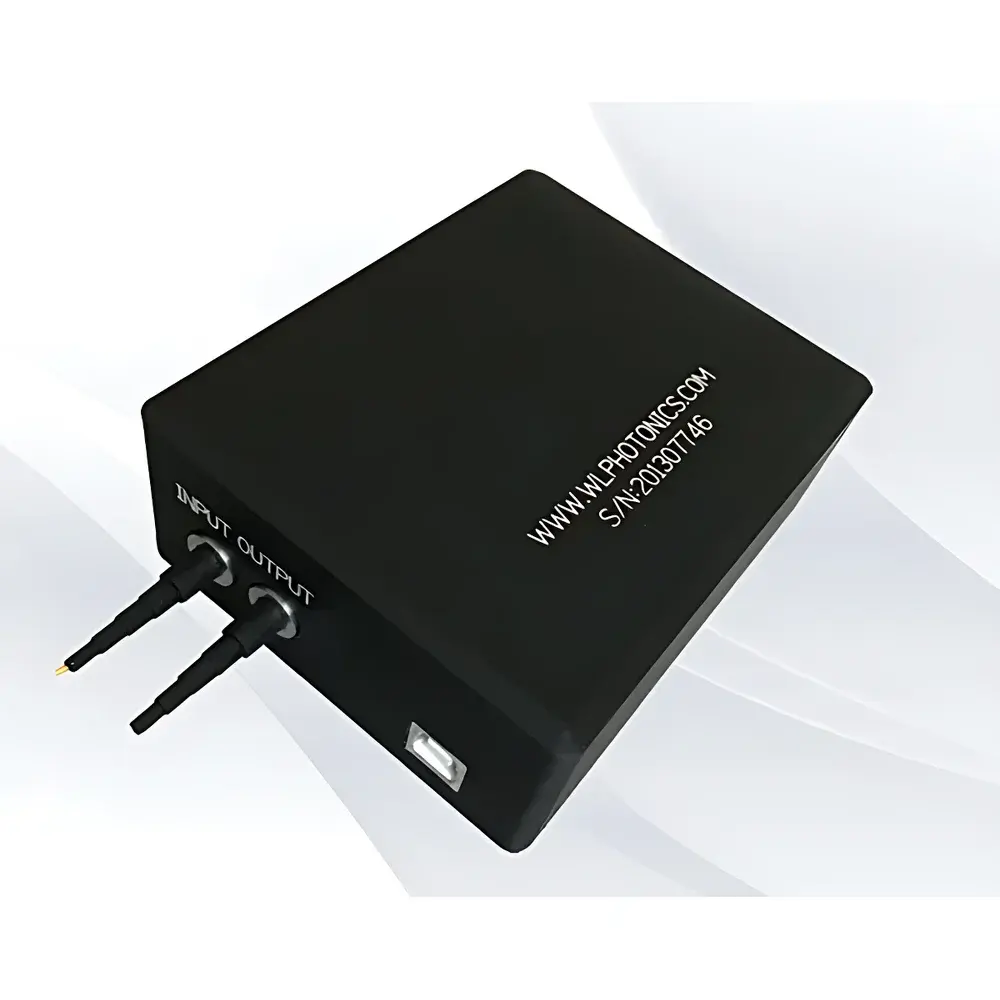
Auniontech WLTF-NM Series Gaussian-Shape Tunable Fiber-Optic Filter (780–1000 nm)
| Brand | Auniontech |
|---|---|
| Model | WLTF-NM (manual) / WLTF-NE (electro-optic) |
| Wavelength Range | 780–1000 nm |
| Center Wavelength Options | 810 nm, 880 nm, 940 nm (customizable within 810–960 nm) |
| Tuning Range | 60 nm or 120 nm |
| FWHM Bandwidth | 0.07–1.00 nm (selectable) |
| Insertion Loss | ≤3.5 dB |
| Polarization-Dependent Loss (PDL) | ≤0.30 dB |
| Wavelength Resolution | 0.02 nm (manual), 0.001 nm (electro-optic) |
| Optical Power Handling | 300 mW |
| Return Loss | >45 dB |
| Extinction Ratio | ≥20 dB |
| Group Delay Ripple | <0.1 ps/nm |
| Weight | <0.5 kg |
Overview
The Auniontech WLTF-NM and WLTF-NE series are high-precision, Gaussian-shaped tunable fiber-optic bandpass filters engineered for demanding spectral control applications in the near-infrared (NIR) range from 780 nm to 1000 nm. These devices operate on free-space optical principles incorporating diffraction gratings and precision collimation optics to achieve a smooth, near-Gaussian spectral transmission profile—critical for minimizing sideband distortion and ensuring high-fidelity spectral selection. As two-port, fiber-pigtailed components, they accept broadband input light and isolate a narrow, user-defined passband whose center wavelength is continuously tunable across up to 120 nm. The filter architecture delivers exceptional wavelength stability, low polarization sensitivity, and minimal group delay variation—making it suitable for time-sensitive and coherence-critical experiments including ultrafast pulse shaping, quantum interference measurements, and high-resolution spectroscopic interrogation.
Key Features
- Gaussian-shaped passband with smooth spectral edges and high sideband suppression (>20 dB typical)
- Wide tuning range: up to 120 nm (e.g., 810–930 nm or 880–1000 nm), configurable per application requirements
- Narrow and selectable FWHM bandwidths from 0.07 nm to 1.00 nm—enabling both high-resolution filtering and broader spectral slicing
- Low insertion loss (≤3.5 dB max) and polarization-dependent loss (≤0.30 dB), supporting high-throughput optical systems
- High optical power handling capacity of 300 mW (CW), compatible with amplified spontaneous emission (ASE) sources and tunable laser diodes
- Sub-picosecond group delay uniformity (<0.1 ps/nm), essential for dispersion-sensitive applications such as chirped pulse amplification and coherent control
- Two platform variants: WLTF-NM (micrometer-driven manual tuning) and WLTF-NE (piezo- or motorized electro-optic actuation) for automated integration
- Wavelength resolution down to 0.001 nm (WLTF-NE-S/P) with repeatability better than ±0.005 nm over repeated tuning cycles
Sample Compatibility & Compliance
The WLTF series supports standard single-mode (SMF-28) and polarization-maintaining (PM) fiber pigtails (FC/APC or FC/PC connectors optional). Its optical design ensures compatibility with common NIR light sources—including superluminescent diodes (SLDs), Ti:sapphire oscillators, fiber amplifiers, and external cavity diode lasers (ECDLs). All units comply with IEC 61300-2-4 (fiber optic connector durability) and IEC 61300-2-1 (tensile load testing) standards. While not certified for medical or industrial safety classes, the device meets general laboratory-grade electromagnetic compatibility (EMC) expectations per EN 61326-1 when used with appropriate driver electronics. For regulated environments (e.g., GLP/GMP-compliant optical test benches), the WLTF-NE variant supports optional digital interface logging (RS-232/USB) for audit-trail-capable wavelength tracking.
Software & Data Management
The WLTF-NE series integrates seamlessly with third-party control environments via ASCII-based serial command sets (RS-232 or USB-Virtual COM). Aboard firmware enables absolute position reporting, closed-loop wavelength calibration, and programmable sweep sequences. Optional LabVIEW™, Python (PySerial), and MATLAB® drivers are provided for rapid system integration. All tuning data—including timestamped center wavelength, FWHM setting, and actuator voltage—can be logged in CSV format for traceability. No proprietary software installation is required; configuration is performed through lightweight CLI or GUI wrappers developed by end users. For ISO/IEC 17025-accredited labs, optional firmware upgrade paths support 21 CFR Part 11–compliant electronic signatures and user-access-level authentication.
Applications
- Suppression of ASE noise in fiber amplifiers and broadband sources prior to spectral analysis or interferometric detection
- Wavelength-selective excitation and readout in atomic physics setups (e.g., Rb/Dy/Yb vapor cells operating near 780 nm, 852 nm, or 976 nm)
- Dynamic channel selection and drift compensation in coarse WDM systems operating in the O- and E-bands
- Real-time spectral shaping of femtosecond pulses using Fourier-domain pulse shapers
- Interrogation of fiber Bragg grating (FBG) sensor arrays in structural health monitoring and distributed temperature sensing
- Seed source line narrowing and linewidth stabilization for tunable fiber lasers and optical parametric oscillators (OPOs)
- Calibration reference generation in metrology-grade spectrometers requiring known Gaussian-line profiles
FAQ
What is the difference between WLTF-NM and WLTF-NE models?
The WLTF-NM uses a calibrated micrometer for manual tuning, offering simplicity and cost efficiency. The WLTF-NE employs piezoelectric or stepper-motor actuation for computer-controlled, repeatable, and high-resolution tuning—ideal for automated test systems.
Can this filter be used with polarization-sensitive setups?
Yes—both SM and PM fiber versions are available. The PM variant maintains polarization extinction ratio ≥20 dB across the full tuning range and minimizes polarization mode coupling.
Is thermal drift compensated in these filters?
No active thermal stabilization is built-in; however, mechanical design and low-thermal-expansion materials ensure wavelength drift <±0.01 nm over 1°C ambient change (typical). For sub-pm stability, external temperature control of the housing is recommended.
Does the filter support custom center wavelengths outside the standard 810/880/940 nm options?
Yes—custom center wavelengths between 780 nm and 1000 nm can be factory-aligned and verified, subject to minimum order quantity and lead time.
What is the maximum optical power density the filter can handle without damage?
The device is rated for 300 mW continuous-wave power at the input port. For pulsed operation, peak power must remain below 1 kW to avoid nonlinear effects or coating damage—consult application engineering for pulse-width–dependent derating.