
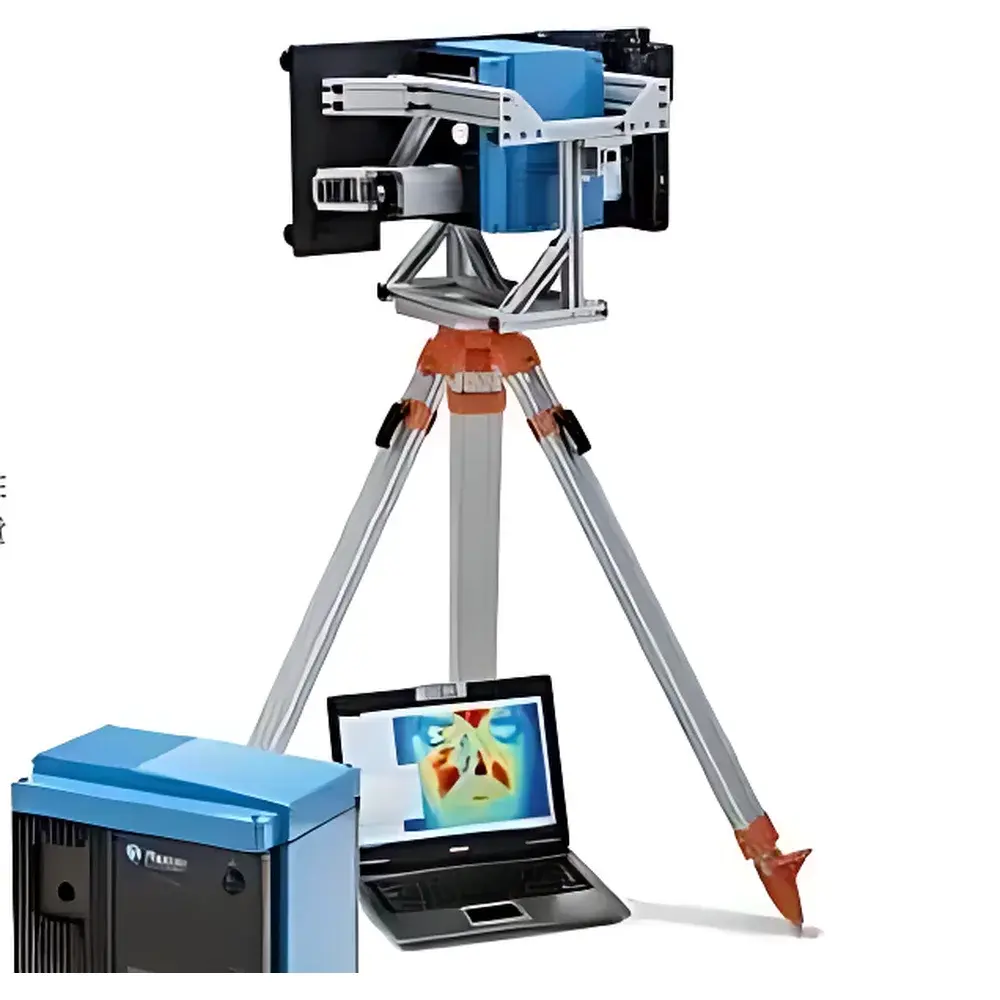
Photon etc HI Series Hyperspectral Imaging System (400–2300 nm)
| Origin | Canada |
|---|---|
| Manufacturer Type | Authorized Distributor |
| Origin Category | Imported |
| Model | HI Series |
| Price | Upon Request |
| Spectral Range | 400–1000 nm (VIS-NIR) and 1000–2300 nm (SWIR) |
| Spectral Resolution | 2 nm (VIS-NIR), 4 nm (SWIR) |
| Spectral Sampling Width | ≥0.1 nm (VIS-NIR), ≥0.2 nm (SWIR) |
| Detector Type | CCD (VIS-NIR), MCT (SWIR) |
| Pixel Size | 6.45 µm × 6.45 µm (CCD), 30 µm (MCT) |
| Dynamic Range | 14-bit |
| Frame Rate | 13.5 fps (VIS-NIR), up to 346 fps (SWIR) |
| Filter Technology | Volume Bragg Grating (VBG) Tunable Filter |
| Data Format | FITS, TIFF, PNG, JPG, CSV, PDF, SVG |
| Software | PHySpec™ with C++ SDK |
| Power Supply | 24 V DC |
| Dimensions | 305 mm × 610 mm × 270 mm |
| Weight | 20 kg |
| Power Consumption | ≤20 W (VIS-NIR), ≤25 W (SWIR) |
| Operating Temperature | 10–40 °C |
| Storage Temperature | 0–50 °C |
Overview
The Photon etc HI Series Hyperspectral Imaging System is a statically configured, non-scanning hyperspectral imager engineered for laboratory and field-deployable spectral analysis across the full 400–2300 nm range. Unlike push-broom or whisk-broom scanning systems, the HI Series employs a patented Volume Bragg Grating (VBG) tunable filter architecture—enabling true snapshot spectral acquisition without mechanical translation of either the sample or optical components. This solid-state design eliminates motion-induced artifacts, ensures high spatial-spectral registration fidelity, and supports real-time spectral cube generation at frame rates up to 346 fps in the SWIR band. The system operates on the principle of wavelength-selective transmission through a thermally stabilized VBG element, delivering high non-polarized throughput (>60%), minimal spectral distortion, and wavelength-invariant optical performance—critical for quantitative reflectance, transmittance, and fluorescence mapping applications under controlled or variable illumination conditions.
Key Features
- Two integrated spectral bands: 400–1000 nm (VIS-NIR) with CCD detector and 1000–2300 nm (SWIR) with liquid-nitrogen-cooled MCT detector
- Continuous, software-controlled spectral tuning with step resolution down to 0.1 nm (VIS-NIR) and 0.2 nm (SWIR)
- No slit, no moving parts—eliminates alignment drift and enables robust operation in vibration-prone environments
- High optical throughput (>60% non-polarized transmission) and uniform spectral response across full range
- Non-dispersive architecture: spectral resolution remains constant regardless of selected wavelength
- Modular hardware interface supporting synchronized external triggering, illumination control, and stage integration
- Thermally stabilized VBG filter core ensuring long-term calibration stability and repeatability
Sample Compatibility & Compliance
The HI Series accommodates diverse sample geometries—from micro-scale biological sections on glass slides to macro-scale industrial components and outdoor terrain targets—without requiring physical contact or vacuum enclosure. Its wide spectral coverage supports material identification based on electronic (VIS), vibrational overtone (NIR), and fundamental molecular absorption (SWIR) signatures. The system complies with ISO/IEC 17025 guidelines for analytical instrument validation and supports traceable calibration via NIST-traceable reflectance standards. Data acquisition workflows are compatible with GLP and GMP environments when paired with PHySpec™’s audit-trail-enabled mode, meeting foundational requirements for FDA 21 CFR Part 11 compliance (electronic records and signatures) when deployed with appropriate IT infrastructure and procedural controls.
Software & Data Management
PHySpec™ is a native Windows application (compatible with Windows 10/11) providing full instrument control, real-time spectral cube visualization, region-of-interest (ROI) extraction, and multivariate analysis (MVA) tools including PCA, PLS-DA, and spectral unmixing. All acquired data are stored in FITS format—the astronomical standard ensuring metadata-rich, self-documenting files suitable for archival and inter-laboratory exchange. Export options include TIFF (for publication-grade imagery), CSV (for statistical analysis), and SVG/PDF (for spectral plot reporting). A comprehensive C++ SDK enables integration into custom automation pipelines, LIMS interfaces, or AI-driven classification frameworks. Raw sensor data retain full 14-bit dynamic range throughout processing, preserving low-signal fidelity essential for weak fluorescence or low-reflectance target detection.
Applications
- Forensic Science: Non-destructive examination of ink aging, latent fingerprint enhancement, accelerant residue mapping, and document authenticity verification
- Geoscience & Remote Sensing: Mineralogical mapping, lithological classification, and vegetation stress assessment using diagnostic absorption features in SWIR
- Pharmaceutical QA/QC: Spatially resolved quantification of active pharmaceutical ingredient (API) distribution in tablet cross-sections
- Agricultural Monitoring: Early detection of fungal infection, nitrogen deficiency, and water stress via chlorophyll and cellulose absorption indices
- Food Safety: Detection of surface contaminants (e.g., fecal matter, mold), pesticide residues, and adulteration in produce and meat products
- Materials Science: Defect localization in semiconductor wafers, fiber orientation analysis in composites, and thin-film thickness profiling
- Cultural Heritage: Pigment identification, underdrawing revelation, and varnish degradation assessment in paintings and manuscripts
- Environmental Analysis: Quantitative mapping of hydrocarbon contamination in soil, chlorophyll-a concentration in water bodies, and atmospheric aerosol composition
FAQ
Does the HI Series require external calibration sources?
Yes—routine radiometric and spectral calibration is recommended using NIST-traceable reflectance standards (e.g., Spectralon®) and mercury-argon lamp sources. PHySpec™ includes automated calibration routines supporting both relative reflectance and absolute radiance modes.
Can the VIS-NIR and SWIR modules be operated simultaneously?
No—optical path separation requires sequential acquisition; however, co-registration is achieved via shared XYZ stage control and sub-pixel geometric correction in PHySpec™.
Is real-time spectral classification supported?
Yes—PHySpec™ supports GPU-accelerated spectral library matching and supervised classification models trained on user-defined ground-truth ROIs.
What environmental conditions affect SWIR detector performance?
The MCT detector requires stable thermal management; ambient temperature fluctuations >±2°C/hour may induce baseline drift. Operation within the specified 10–40°C range with adequate ventilation ensures optimal dark current stability.
How is data integrity ensured during long-duration acquisitions?
PHySpec™ implements cyclic redundancy checks (CRC) on all saved FITS headers and supports optional checksum-verified network transfer protocols for centralized data repositories.
Related Products





