
Auniontech Lambda Fibers Tapered Optical Fiber Probe
| Brand | Auniontech |
|---|---|
| Origin | Shanghai, China |
| Manufacturer Type | Authorized Distributor |
| Product Category | Tapered Optical Fiber Probe |
| Component Type | Fiber Collimator |
| Model | Lambda Fibers / Lambda-Plus Fibers |
| Compliance | ISO 10110 (optical surface specifications), RoHS-compliant materials |
| Optical Interface | FC/PC or SMA-905 (customizable) |
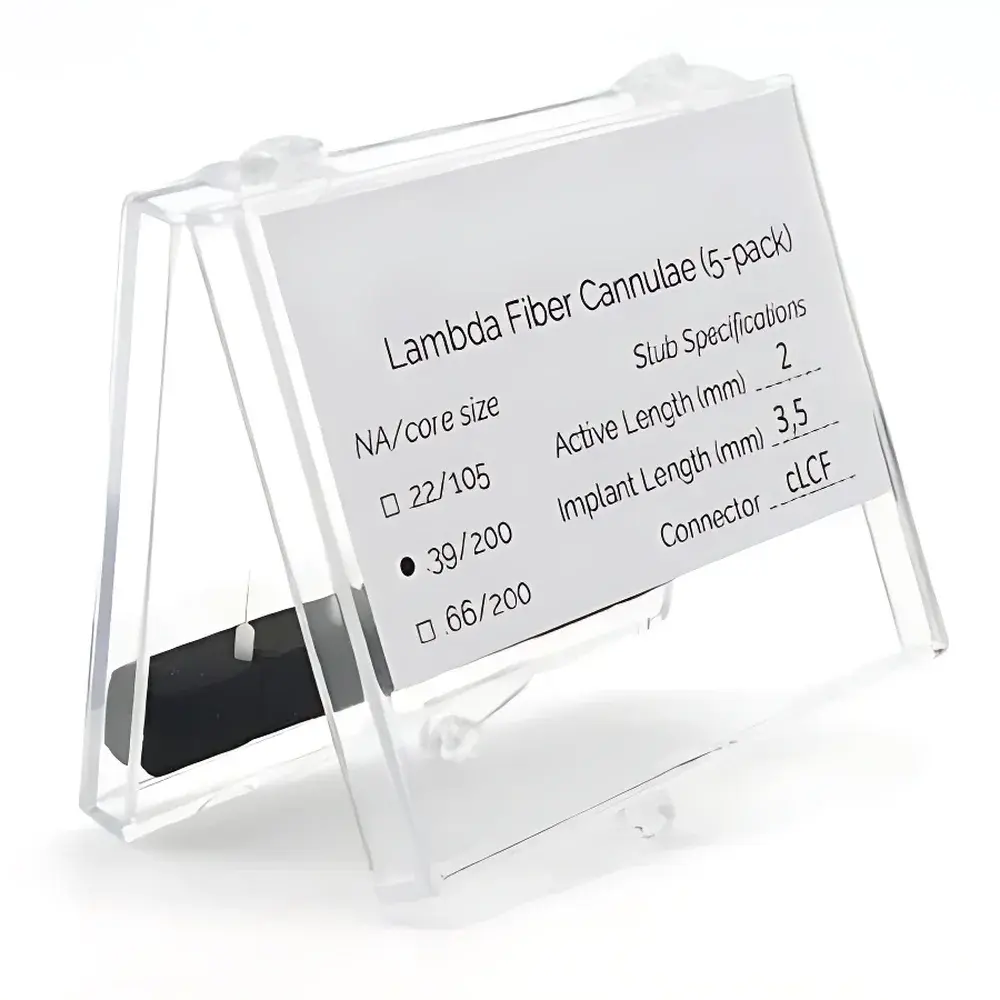
| Core/Cladding Diameter Options | 22/105 µm, 39/200 µm, 66/200 µm |
| Taper Tip Diameter | <1 µm |
| Taper Length | Several millimeters |
| Numerical Aperture (NA) | Matched to source coupling optics (0.12–0.22 typical) |
| Active Emission Length | Defined by excitation mode profile and taper geometry |
| Surface Roughness (taper region) | <5 nm RMS (Lambda-Plus grade) |
Overview
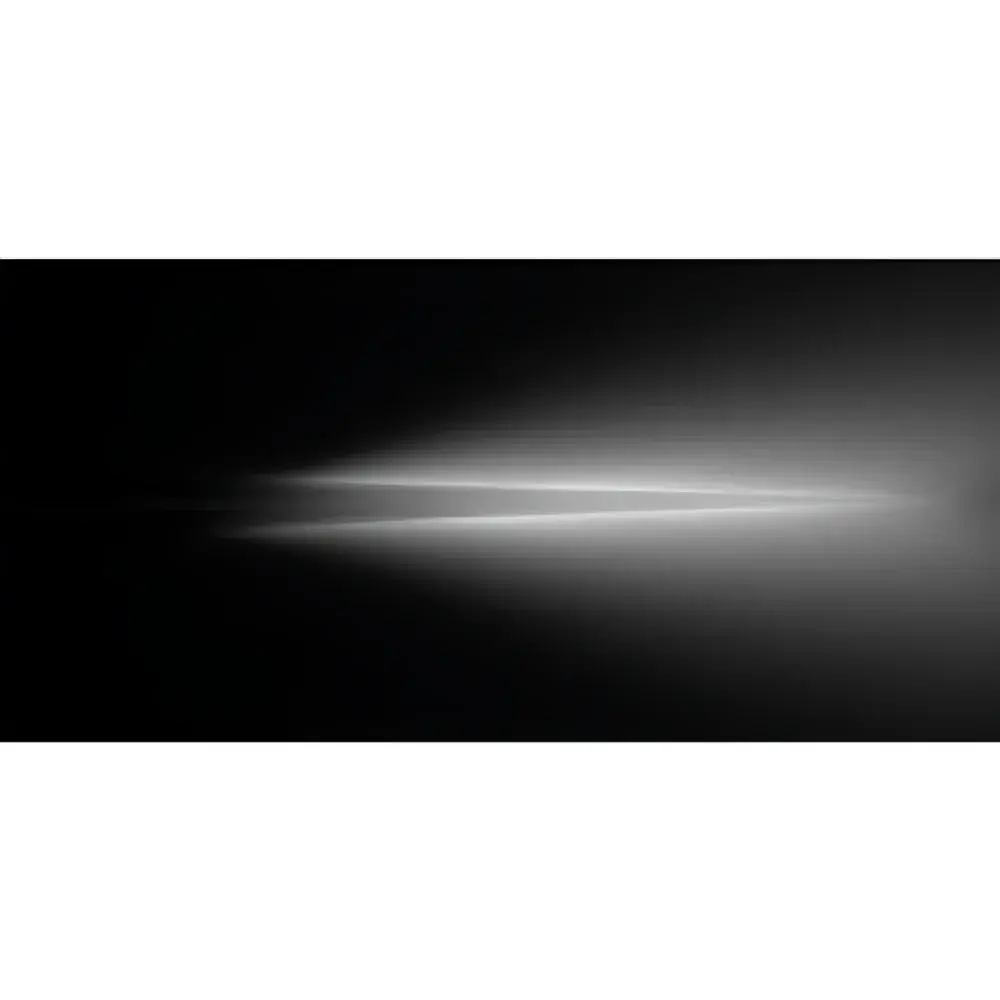
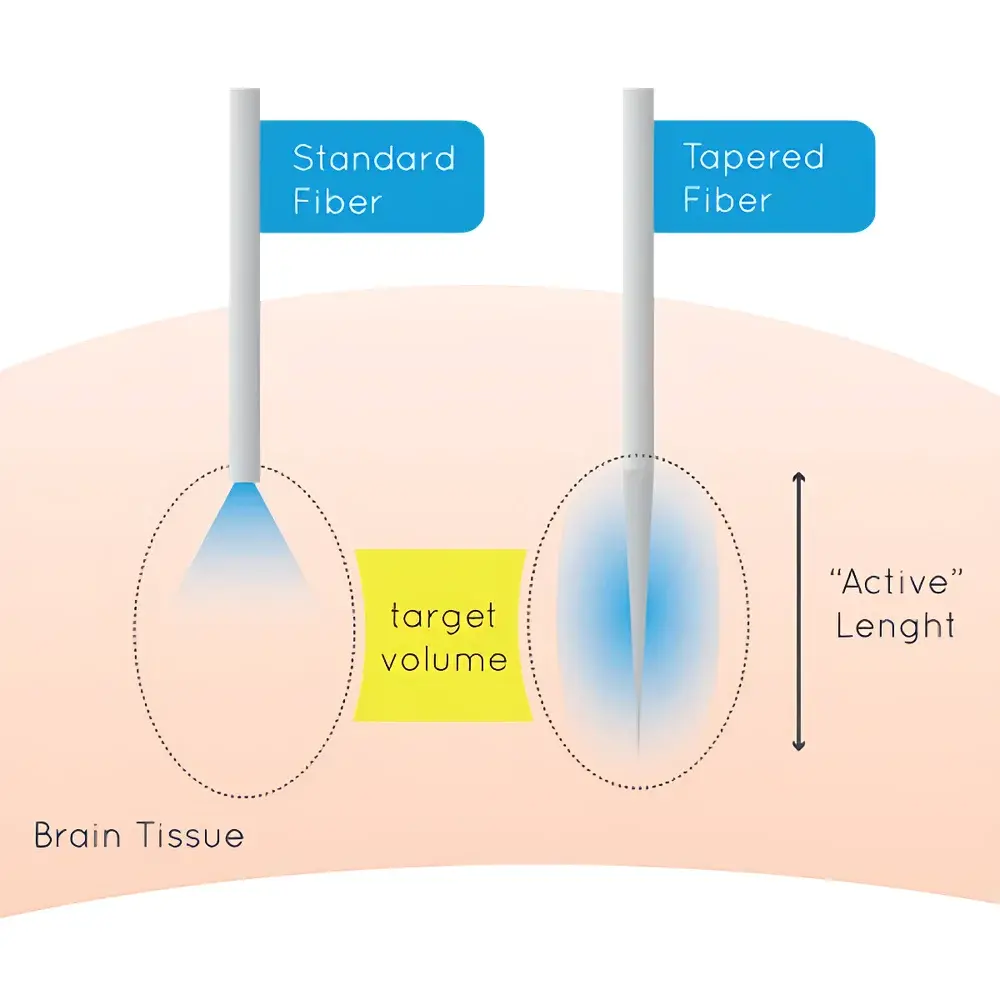
The Auniontech Lambda Fibers Tapered Optical Fiber Probe is an engineered optical interface component designed for high-precision spatially resolved photostimulation and fluorescence collection in deep-tissue neuroscience applications. Unlike conventional cleaved or lensed fibers, the probe features a monolithic, sub-micron tip taper fabricated via controlled thermal drawing and etching—enabling adiabatic mode transformation along the transition from uniform core to nanoscale apex. Its operational principle relies on controlled modal redistribution: when broadband or high-NA light is coupled into the proximal end, guided modes progressively radiate outward across the tapered region due to local effective index reduction. This yields volumetric illumination with axial confinement defined not by physical length alone, but by the interplay between input angular spectrum, fiber dispersion, and taper profile. The Lambda-Plus variant further refines this behavior through tight geometric tolerances (<±2% on taper ratio and length), ensuring batch-to-batch reproducibility essential for longitudinal in vivo studies under GLP-aligned experimental protocols.
Key Features
- Sub-1 µm apex diameter with smooth, low-scatter surface finish (RMS roughness <5 nm for Lambda-Plus grade)
- Controlled taper length (2–8 mm range, configurable per application requirement)
- Multiple core/cladding configurations available: 22/105 µm, 39/200 µm, and 66/200 µm—each with calibrated coefficient A for active area estimation
- Mode-selective emission: spatial restriction of output to discrete taper segments via angle-resolved input coupling (e.g., using adjustable collimated beam incidence)
- Bi-directional functionality: equally optimized for both targeted light delivery and depth-resolved photon collection in fiber photometry
- Compatible with standard FC/PC or SMA-905 terminations; custom connectorization and biocompatible polymer jacketing (e.g., Parylene-C coating) available upon request
- Thermally stable silica-glass construction suitable for chronic implantation and repeated sterilization cycles
Sample Compatibility & Compliance
The Lambda Fibers probe is validated for use in murine, rat, and non-human primate neurophysiology preparations. Its mechanical robustness and optical stability meet requirements for stereotactic insertion into cortical, hippocampal, and subcortical targets without tip fracture or mode degradation. All probes are manufactured using ISO 10110–compliant polishing processes and undergo 100% inspection for surface defects and transmission uniformity. Materials comply with EU RoHS Directive 2011/65/EU. While not a medical device, the probe supports experimental workflows aligned with FDA 21 CFR Part 11–capable data acquisition systems when integrated with validated photometry hardware and LightSpread software for tissue scattering modeling. Documentation packages include traceable calibration reports and material declarations for institutional biosafety and IACUC review.
Software & Data Management
LightSpread—a MATLAB-based simulation toolkit provided by Auniontech upon request—models photon propagation from Lambda Fibers within heterogeneous biological media (e.g., mouse brain parenchyma). It incorporates Mie scattering theory, empirical absorption coefficients, and user-defined taper geometry to estimate lateral spread, axial decay, and effective illumination volume. Output includes spatial power density maps (mW/mm²) and comparative simulations across fiber types. Raw photometry signals acquired via Lambda Fibers are compatible with open-source analysis pipelines (e.g., CaImAn, Suite2p) and commercial platforms (Prairie View, NeuroPlex). Audit trails for probe usage—including batch ID, implant date, and taper characterization metrics—can be logged in LIMS-compatible formats to support GLP/GMP-aligned preclinical study documentation.
Applications
- Multi-site optogenetic neuromodulation: simultaneous activation of distributed neuronal ensembles within a single brain region using mode-selective excitation
- Depth-resolved fiber photometry: selective collection of GCaMP or jRGECO1a fluorescence from defined laminar zones without physical repositioning
- Chronic in vivo imaging: long-term (>6 months) optical access with minimal glial scarring due to reduced cross-sectional footprint at the tip
- Combined stimulation/sensing: real-time closed-loop control where emitted light triggers activity-dependent fluorescence, captured through the same probe
- Peripheral nerve interfacing: high-resolution photoactivation of dorsal root ganglia or vagal afferents with sub-fascicular spatial precision
- Microendoscopic integration: coupling with gradient-index (GRIN) lenses for hybrid wide-field + point-source illumination architectures
FAQ
How is the effective emission length determined?
The effective emission length depends on the angular spectrum of the injected light and the taper’s local mode cutoff condition—not solely on physical geometry. It is empirically calibrated per batch using near-field scanning optical microscopy (NSOM) and confirmed via tissue phantom measurements.
What is the difference between Lambda Fibers and Lambda-Plus Fibers?
Lambda-Plus Fibers feature tighter manufacturing tolerances on taper ratio (±1.5%), length (±0.2 mm), and apex symmetry—ensuring consistent emission profiles across implants and enabling quantitative cross-animal comparison in peer-reviewed studies.
Can Lambda Fibers be reused after implantation?
Sterilization via ethanol immersion and UV-C exposure is validated for up to three cycles; however, mechanical integrity post-explant must be verified via optical transmission testing before reuse.
Is LightSpread software compatible with Windows, macOS, and Linux?
Yes—LightSpread requires MATLAB R2019b or later and runs natively on all three operating systems; standalone compiled versions (Windows only) are available for lab computers without MATLAB licenses.
Do you provide implantation guides or surgical templates?
Auniontech supplies digital STL files for 3D-printed stereotaxic holders and depth-stop adapters compatible with standard Kopf and Stoelting frames; these are included with Lambda-Plus orders fulfilling academic research contracts.





