
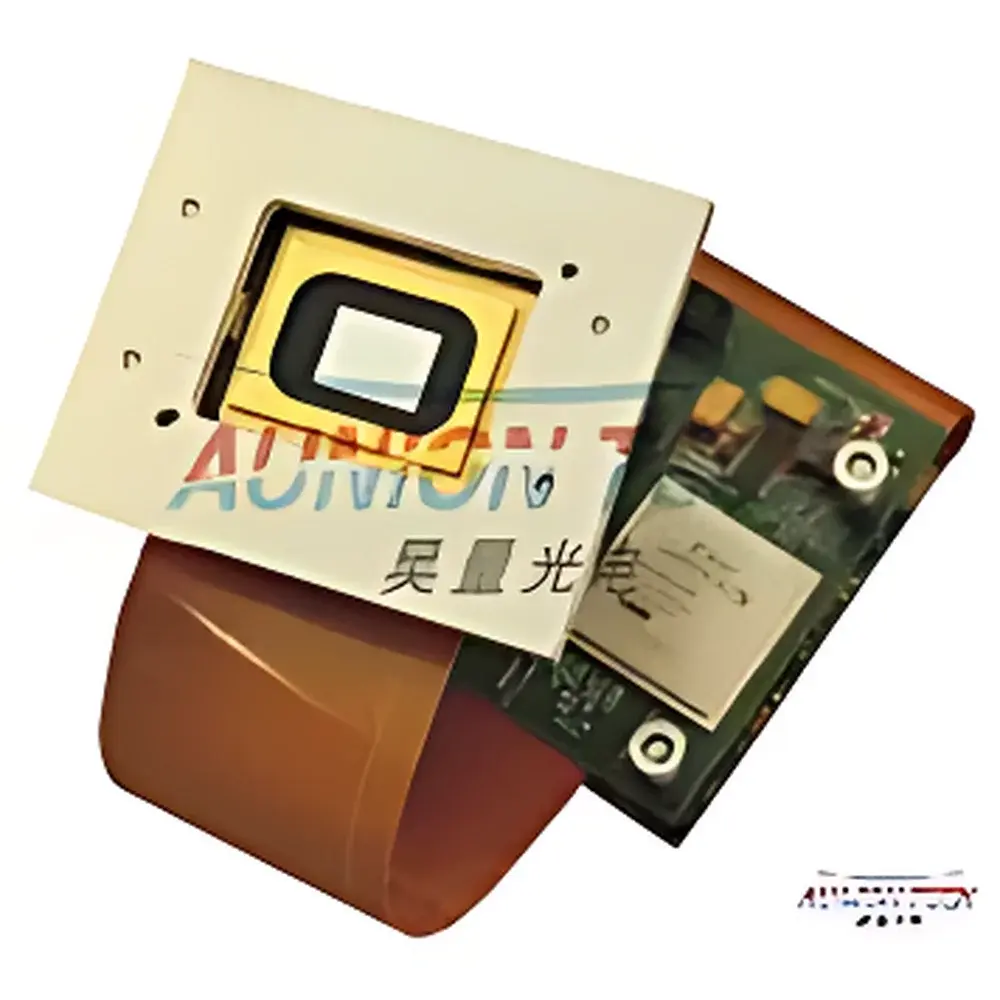
Auniontech V-Series Ultra-High-Speed DMD Spatial Light Modulator
| Brand | Auniontech |
|---|---|
| Origin | USA |
| Manufacturer Type | Authorized Distributor |
| Product Category | Imported Optical Component |
| Model | V-Series |
| Component Type | Optical Element |
| Chipset | Texas Instruments DLP Discovery 4100 |
| Interface | USB 3.0 |
| On-Chip Memory | 64 Gbit |
| Max 1-bit Frame Rate | 22.727 kHz (V-9601: 16.393 kHz) |
| Resolution Options | 1024 × 768 (XGA), 1920 × 1080 (1080p), 1920 × 1200 (WUXGA) |
| Micromirror Pitch | 13.7 µm (V-7000/V-7001), 10.8 µm (V-9501/V-9601) |
| Wavelength Range | 350–2500 nm |
| Max Optical Power Handling (Cooled Package) | 60 W |
| Control Software | ALP-4.3 SDK |
| API Support | C++, .NET, LabVIEW, MATLAB DLLs |
| Compliance | USB 3.0 Class, RoHS, CE |
Overview
The Auniontech V-Series Ultra-High-Speed DMD Spatial Light Modulator is a precision optical instrument engineered for dynamic wavefront shaping, patterned illumination, and high-throughput optical encoding in demanding research and industrial environments. Based on the Texas Instruments DLP Discovery 4100 chipset, this device leverages digital micromirror device (DMD) architecture—a bistable MEMS technology—to achieve deterministic, binary amplitude modulation at microsecond-scale switching speeds. Unlike liquid-crystal-based SLMs, DMDs operate via electrostatic actuation of aluminum micromirrors (tilted ±12°), delivering exceptional temporal stability, polarization insensitivity, and broadband spectral response from deep UV (350 nm) to short-wave infrared (2500 nm). The V-Series integrates a Virtex-7 FPGA-based controller with native USB 3.0 connectivity and up to 64 Gbit on-device memory—enabling sustained 1-bit pattern streaming at up to 22.727 kHz—making it uniquely suited for time-critical applications such as maskless lithography, real-time structured illumination, and single-pixel imaging.
Key Features
- Ultra-high-speed operation: 22.727 kHz (1-bit) frame rate on V-7000/V-7001; up to 16.393 kHz on WUXGA-resolution V-9601
- Multiple resolution configurations: XGA (1024 × 768), Full HD (1920 × 1080), and WUXGA (1920 × 1200) DMD arrays
- Broadband optical compatibility: Optimized for 350–2500 nm spectral range; cooled A-type package rated for continuous 60 W optical load
- Dedicated ALP-4.3 control firmware with low-latency USB 3.0 interface and hardware-accelerated pattern sequencing
- Open-source demo software with full C++/MATLAB/LabVIEW/.NET API support—including source code for custom firmware extension
- Scalable multi-unit synchronization: Single host PC can concurrently manage multiple V-Series modules with deterministic inter-device timing
- High-reproducibility micromirror array: 13.7 µm (XGA) or 10.8 µm (1080p/WUXGA) pitch; >99.99% mirror yield and <10 ns rise/fall time
Sample Compatibility & Compliance
The V-Series supports both reflective and projection-based optical architectures without requiring polarization conditioning. Its aluminum-coated micromirrors maintain >85% reflectivity across UV-VIS-NIR bands, enabling direct integration into laser scanning systems, confocal platforms, and interferometric setups. All models comply with IEC 61000-6-3 (EMC emission), RoHS Directive 2011/65/EU, and CE marking requirements for laboratory instrumentation. For regulated environments—including ISO 13485-certified medical device development or GLP-compliant optical assay validation—the ALP-4.3 SDK provides audit-ready logging, timestamped frame metadata, and deterministic execution tracing compatible with FDA 21 CFR Part 11 electronic record controls when deployed with validated host software.
Software & Data Management
Control is implemented via the ALP-4.3 Software Development Kit, distributed as a platform-agnostic Windows DLL with documented function calls for pattern upload, exposure timing, bit-depth configuration, and multi-DMD synchronization. The SDK includes a GUI-based demonstration application with scriptable macro support, real-time frame counter, and memory-mapped buffer access for zero-copy data ingestion. Pattern sequences may be preloaded into on-board 64 Gbit memory for autonomous playback—critical for embedded or latency-constrained applications. All ALP-4.3 logs are stored in HDF5 format with embedded EXIF-like metadata (timestamp, exposure duration, bit depth, DMD address map), ensuring traceability in publication-grade experimental workflows. MATLAB toolboxes and LabVIEW VIs are provided with full source, enabling seamless integration into existing data acquisition pipelines.
Applications
- Maskless photolithography: Pixel-accurate pattern projection for rapid prototyping of microfluidic devices and PCB masters
- Structured illumination microscopy (SIM): High-duty-cycle sinusoidal grating projection for super-resolution imaging beyond the diffraction limit
- Single-pixel compressive imaging: Real-time Hadamard or Walsh-Hadamard matrix projection for photon-efficient 3D reconstruction
- Adaptive optics beam shaping: Dynamic correction of wavefront aberrations in multiphoton excitation or laser material processing
- 3D scanning and fringe projection: Phase-shifted sinusoidal pattern generation for sub-micron topographic metrology
- Holographic display research: Binary hologram encoding with kHz-level update rates for dynamic diffractive optics evaluation
- UV-curable 3D printing: High-power, pulsed DMD illumination synchronized with galvo-scanned resin exposure
FAQ
What DLP chipset does the V-Series use?
The V-Series is built exclusively on the Texas Instruments DLP Discovery 4100 chipset, supporting dual-LVDS data interfaces and 50 Gbps internal bandwidth.
Is cooling required for continuous operation?
Yes—models configured with the A-type thermally managed package are rated for up to 60 W optical power loading; uncooled operation is limited to ≤5 W average power.
Can multiple V-Series units be synchronized?
Yes—ALP-4.3 supports hardware-triggered frame alignment across up to 8 independent units using shared TTL sync signals and programmable delay offsets.
What bit depths are supported, and how do they affect frame rate?
1-bit (binary): max 22.727 kHz; 6-bit: ~1091 Hz (V-7000); 8-bit: ~290 Hz (V-7000)—rates scale inversely with bit depth due to internal PWM timing constraints.
Is the ALP-4.3 SDK compatible with Linux or macOS?
No—the ALP-4.3 SDK is Windows-only; however, users may deploy virtualized Windows environments or containerized solutions with USB passthrough for cross-platform integration.
Does the V-Series support arbitrary grayscale patterns?
Grayscale is implemented via temporal dithering (PWM) within the ALP-4.3 firmware; true analog intensity control is not supported due to the intrinsic binary nature of DMD micromirrors.





