
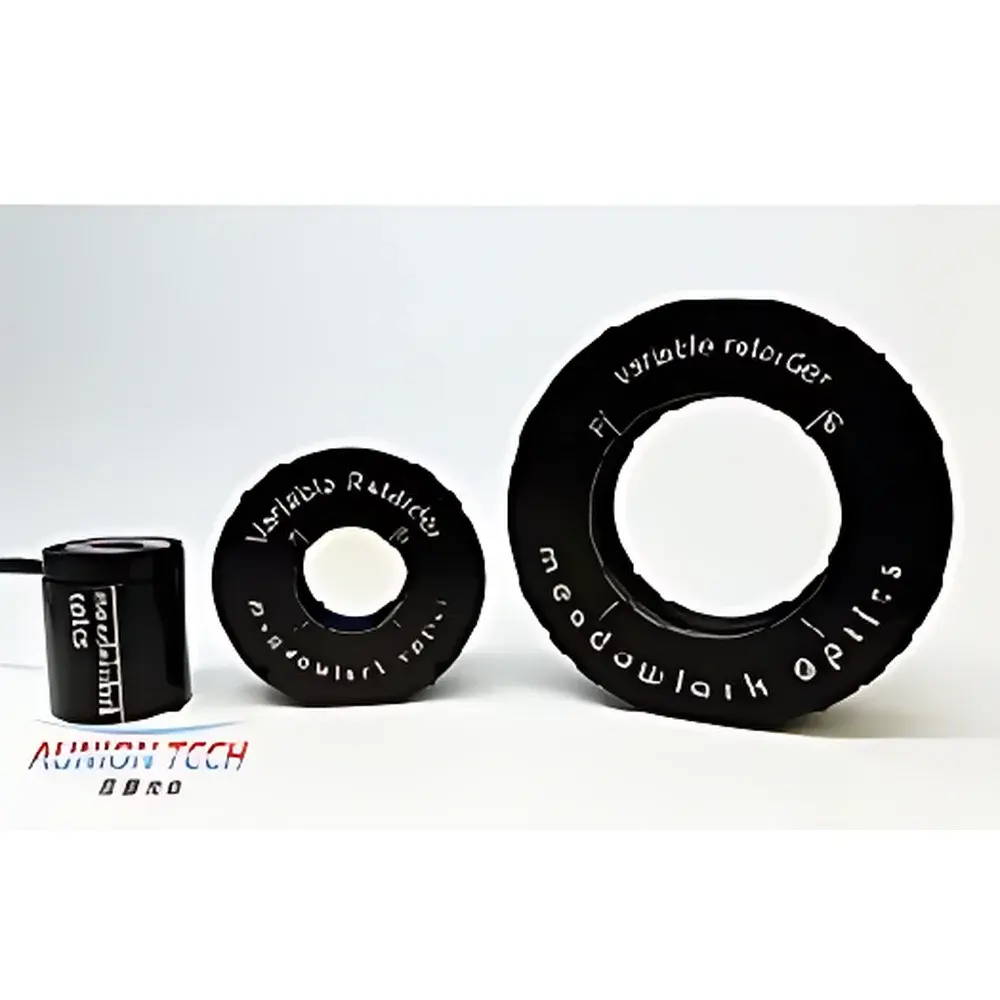
Meadowlark Optics LCVR-200 Ultra-Fast Liquid Crystal Variable Retarder (True Zero-Order, Broadband Half-Wave)
| Origin | USA |
|---|---|
| Manufacturer Type | Authorized Distributor |
| Origin Category | Imported |
| Model | LCVR-200 Series |
| Price Range | USD 4,200 – 14,000 |
| Component Category | Optical Element |
| Aperture Options | Ø9 mm / Ø17 mm / Ø40 mm |
| Wavelength Ranges | 450–700 nm |
| Response Time | <200 µs (Rise/Fall, λ/2 ↔ 0) |
| Drive Signal | AC square wave, 2 kHz, 0–10 V<sub>RMS</sub>, zero DC bias |
| Temperature Stability Option | Available (thermally regulated housing) |
| Retardation Range | 0 to λ/2 (continuously adjustable) |
| Waveplate Order | True zero-order |
| Coating | Broadband anti-reflection (BBAR), specified per wavelength band |
| Uniformity | <λ/20 peak-to-valley over clear aperture |
| Transmission Loss | <3% per surface (including AR coating) |
| Operating Temperature | 15–50 °C (standard) |
Overview
The Meadowlark Optics LCVR-200 is an ultra-fast, true zero-order liquid crystal variable retarder engineered for precision polarization control in demanding optical systems. It operates on the principle of electrically induced birefringence in nematic liquid crystal (LC) media: when a voltage-controlled AC field is applied across a homogeneously aligned LC cell, the molecular director reorients, modulating the phase retardation between orthogonal polarization components of a linearly polarized incident beam. Unlike mechanical waveplates or piezoelectric devices, the LCVR-200 contains no moving parts—enabling microsecond-scale switching (<200 µs rise/fall time) without mechanical wear, vibration, or hysteresis. Its true zero-order architecture ensures minimal wavelength-dependent dispersion and high retardation fidelity across broad spectral bands (450–1700 nm), making it suitable for ultrafast laser diagnostics, adaptive optics, ellipsometry, quantum optics experiments, and polarization-resolved spectroscopy where dynamic, repeatable, and drift-free retardation control is essential.
Key Features
- Sub-200 µs electro-optic response time—among the fastest commercially available LC-based retarders
- True zero-order design for broadband performance with low chromatic dispersion and high retardation accuracy
- Four standard AR-coated wavelength bands: 450–700 nm, 650–950 nm, 900–1250 nm, and 1200–1700 nm
- Three aperture options: Ø9 mm, Ø17 mm, and Ø40 mm—each with <λ/20 PV wavefront uniformity over the clear aperture
- Thermally stabilized variants available for long-term operational stability under ambient fluctuations
- Zero-DC-bias AC drive requirement (2 kHz square wave, 0–10 VRMS) prevents ion accumulation and extends device lifetime
- Low insertion loss (1000:1 typical)
- No moving parts—immune to mechanical shock, acoustic noise, and alignment drift
Sample Compatibility & Compliance
The LCVR-200 is compatible with collimated or mildly focused beams (NA < 0.1) and supports both free-space and fiber-coupled integration via kinematic mounts or custom flanges. It complies with ISO 10110-7 (optical component surface quality) and meets RoHS Directive 2011/65/EU for hazardous substance restrictions. While not certified as medical or aerospace-grade hardware, its design adheres to GLP-aligned calibration traceability protocols; retardation calibration data is supplied with each unit (NIST-traceable reference at central wavelength). For applications requiring regulatory documentation (e.g., FDA-regulated instrumentation or ISO 13485 environments), optional IQ/OQ documentation packages—including test reports, environmental stress validation, and controller firmware audit logs—are available upon request.
Software & Data Management
Meadowlark Optics provides native LabVIEW™ drivers and Python API support (via PyVISA) for seamless integration into automated test benches and custom control architectures. The included LCVR Controller (single- or quad-channel variants) features programmable voltage ramp profiles, real-time feedback monitoring (via integrated photodiode reference channel on select models), and non-volatile memory for up to 16 user-defined retardation presets. All controllers log timestamped operation records compliant with 21 CFR Part 11 requirements when paired with validated software environments—supporting electronic signatures, audit trails, and role-based access control. Firmware updates are delivered via signed binary packages with SHA-256 verification to ensure integrity and version traceability.
Applications
- Ultrafast polarization gating in pump-probe spectroscopy and THz time-domain systems
- Dynamic Stokes polarimetry and Mueller matrix imaging
- Adaptive nulling interferometry in astronomical coronagraphy
- Real-time compensation of birefringence in high-NA microscope objectives
- Polarization-encoded quantum key distribution (QKD) setups
- Calibration standards for rotating analyzer ellipsometers (RAE) and spectroscopic ellipsometers (SE)
- Active polarization filtering in hyperspectral imaging and lidar signal conditioning
FAQ
What is the maximum recommended optical power density for continuous-wave operation?
For standard LCVR-200 units, the damage threshold is ≤100 mW/cm² at 532 nm (CW, TEM₀₀, 1/e² diameter > 2 mm). Higher-power variants with thermally managed substrates are available for up to 500 mW/cm² under controlled cooling conditions.
Can the LCVR-200 be used with pulsed lasers?
Yes—provided pulse energy remains below 10 µJ per pulse (for <100 fs pulses) and average power does not exceed the CW limit. Thermal lensing and electro-optic saturation must be evaluated per application; we recommend pulse-width-dependent characterization for sub-10-ps regimes.
Is vacuum compatibility supported?
Standard units are rated for ambient air operation only. Vacuum-compatible versions (with outgassing-tested adhesives and metal-sealed housings) can be ordered as custom configurations—subject to additional lead time and qualification testing.
How is retardation calibrated and verified?
Each unit ships with a factory-measured retardation-vs-voltage curve at its designated center wavelength, acquired using a NIST-traceable photoelastic modulator (PEM)-based null ellipsometer. Calibration uncertainty is ±0.005λ (k=2) over the full 0–λ/2 range.
Do you offer OEM integration support?
Yes—Meadowlark Optics provides mechanical drawings (STEP/IGES), electrical interface schematics, thermal management guidelines, and firmware SDKs for embedded controller integration. Custom aperture shapes, mounting interfaces, and multi-element arrays are available under NDA.



