
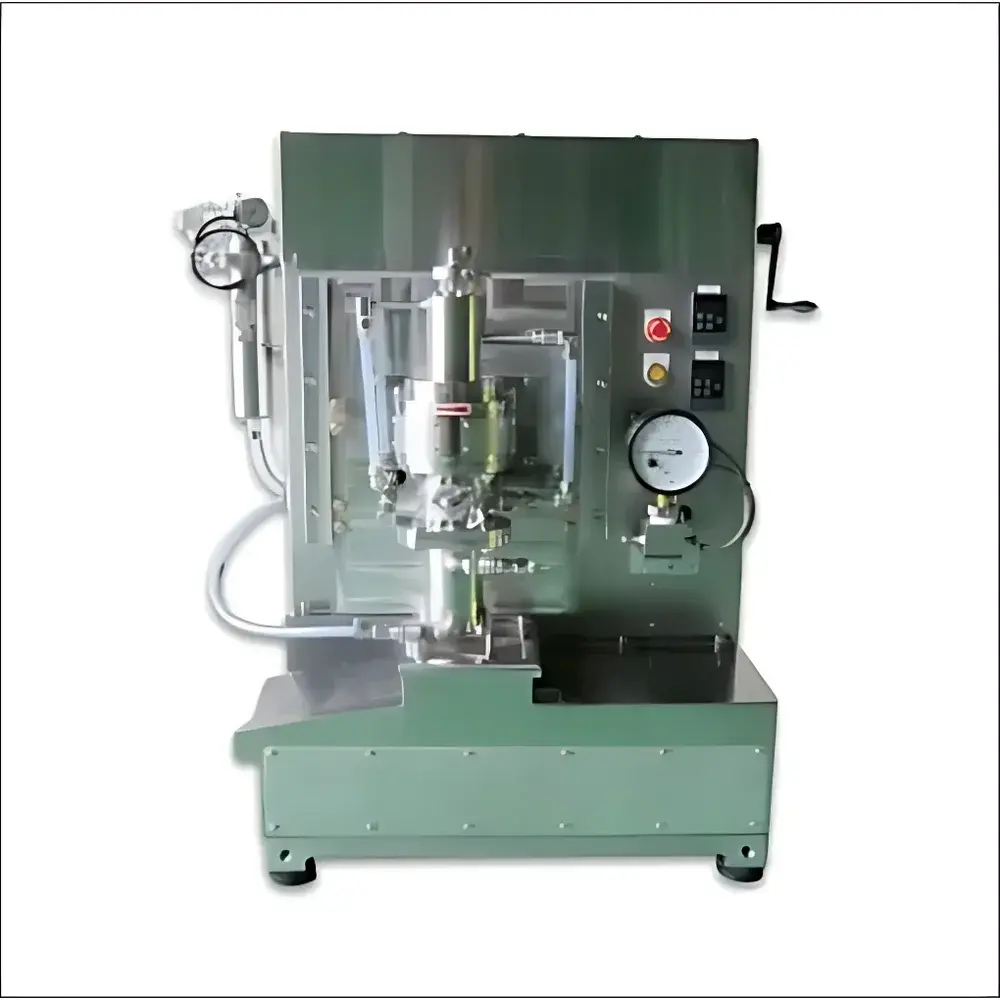
Dual Apex Mill / DAM – HM&M Dual-Axis Wet Bead Mill
| Brand | HM&M |
|---|---|
| Origin | Japan |
| Model | DAM Series |
| Instrument Type | Wet Bead Mill |
| Sample Suitability | Hard & Brittle Materials |
| Feed Particle Size | >10 µm |
| Final Output Particle Size | <10 µm (down to 20 nm) |
| Batch Processing Volume | 60 mL |
| Bead Size Range | Φ15 µm – Φ1 mm |
| Bead Separator Tip Speed | 6–12 m/s |
| Agitator Tip Speed | 2–12 m/s |
| Compliance | Designed for GLP-compliant R&D environments |
Overview
The Dual Apex Mill (DAM) is a high-precision, dual-axis wet bead mill engineered by HM&M (Japan) for laboratory-scale nanoscale dispersion and micron-level comminution of hard, brittle, or crystalline materials. Unlike conventional co-axial bead mills—where agitator and bead separator share a single drive axis—the DAM employs fully independent motor-driven agitator and centrifugal bead separation systems. This architectural distinction resolves the fundamental trade-off between low-shear dispersion (required to preserve crystal integrity in functional nanoparticles) and efficient bead retention (which demands high centrifugal force). By decoupling rotational control, the DAM enables simultaneous low-tip-speed agitation (as low as 2 m/s) for minimal mechanical stress on sensitive nanostructures—such as barium titanate (BaTiO₃), titanium dioxide (TiO₂), indium tin oxide (ITO), or pigment crystals—while maintaining high-speed bead separation (up to 12 m/s tip velocity) to prevent media leakage even with sub-50 µm beads. The system operates on the principle of shear-dominated attrition within a confined chamber, where kinetic energy transfer from precisely controlled bead motion induces controlled fracture and deagglomeration without thermal degradation or phase transformation.
Key Features
- Dual-axis independent drive architecture: Separates agitator rotation (2–12 m/s tip speed) from centrifugal bead separator rotation (6–12 m/s), eliminating bead loss at low-agitation conditions.
- Ultra-fine bead compatibility: Validated for use with ceramic or zirconia beads as small as Φ15 µm—enabling stable processing down to 20 nm median particle size (D₅₀) with high reproducibility.
- Multi-regime processing capability: Adjustable agitator speed allows seamless transition between gentle nanodispersion (low-speed mode) and aggressive micron grinding (high-speed mode) within a single instrument.
- Modular chamber design: Chemically resistant wetted parts (e.g., alumina ceramics, PTFE seals) ensure compatibility with aqueous, organic, and polar solvent-based slurries across pH 2–12.
- Scalable platform: Four standard configurations (DAM-015 to DAM-10) support internal volumes from 0.15 L to 10 L, all sharing identical core kinematics and control logic for method transfer.
Sample Compatibility & Compliance
The DAM is routinely deployed for dispersion and size reduction of advanced functional materials including dielectric ceramics (BaTiO₃), conductive nanomaterials (Ag, Cu, ITO), photocatalysts (TiO₂, g-C₃N₄), quantum dot suspensions, and high-refractive-index pigments. It accommodates feed materials with initial particle sizes >10 µm and achieves final D₉₀ values consistently below 10 µm—with verified D₅₀ performance reaching 20–300 nm depending on formulation, bead selection, and residence time. All models conform to JIS B 8741 (Japanese Industrial Standard for bead mills) and incorporate safety interlocks compliant with IEC 61000-6-2/6-4 (EMC immunity/emission). For regulated laboratories, optional audit-trail-enabled firmware supports 21 CFR Part 11-compliant electronic records when integrated with validated LIMS or ELN platforms.
Software & Data Management
The DAM series utilizes an embedded industrial PLC-based controller with real-time monitoring of agitator torque, separator current draw, slurry temperature (±0.5 °C), and total processing time. Optional Ethernet/IP or Modbus TCP connectivity enables integration into centralized lab automation systems. Raw operational logs—including speed profiles, energy consumption per batch (kWh/L), and thermal drift history—are exportable in CSV format for post-processing. While no proprietary GUI is bundled, HM&M provides documented API endpoints for third-party software development (e.g., Python-based process optimization scripts or MATLAB-based rheological correlation modeling). All firmware updates undergo ISO 13485-aligned validation protocols prior to release.
Applications
- Electroceramic R&D: Dispersing BaTiO₃ nanoparticles for MLCC ink formulation without lattice distortion.
- Battery electrode development: Homogenizing Si/C composite slurries while preserving solid-electrolyte interphase (SEI)-friendly surface chemistry.
- Optical coating preparation: Achieving narrow PSD (PDI <0.15) in TiO₂ dispersions for anti-reflective multilayer stacks.
- Pharmaceutical nanosuspensions: Stabilizing poorly water-soluble APIs (e.g., fenofibrate) using Φ30 µm yttria-stabilized zirconia beads under GMP-aligned SOPs.
- Functional pigment engineering: Deagglomerating high-chroma organic pigments without chromophore cleavage or hue shift.
FAQ
What bead materials are compatible with the DAM?
Zirconia (Y-TZP), silicon carbide, alumina, and stainless steel beads ranging from Φ15 µm to Φ1 mm are supported. Bead density and hardness must be selected to match slurry viscosity and target particle hardness (e.g., Y-TZP recommended for TiO₂; SiC for SiC powders).
Can the DAM be used for continuous processing?
No—the DAM is designed exclusively for batch-mode operation. For continuous nanodispersion, HM&M recommends the Wide Separator Apex Mill (WSAM) series, which features integrated feed/pump manifolds and flow-rate synchronized bead retention.
Is cleaning validation supported?
Yes. The chamber geometry permits full CIP (clean-in-place) using ultrasonic-assisted solvent flushes. HM&M supplies swab-testing protocols and residue limits aligned with ICH Q5C for cross-contamination assessment.
How is temperature rise controlled during extended runs?
All DAM models include jacketed milling chambers with integrated PT100 sensors and external chiller interface (−10 °C to +40 °C range). Real-time thermal feedback adjusts agitator duty cycle to maintain ΔT <3 °C over 60-min cycles.
Does HM&M provide application-specific method development?
Yes. HM&M’s Application Engineering Group offers remote and on-site DOE (Design of Experiments) support—including bead sizing, energy input optimization, and stability testing—for new material systems under NDA.
Related Products



