
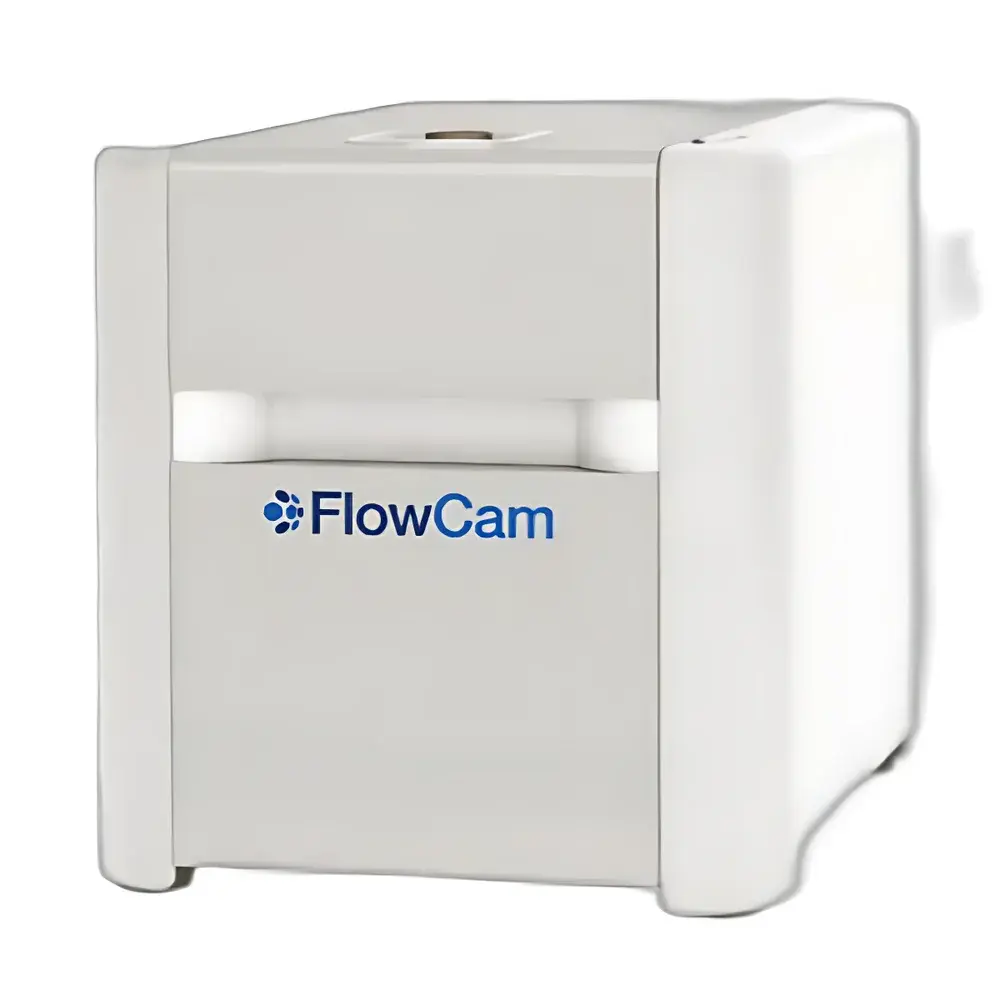
FlowCam 8000 Cyano Dynamic Imaging Particle Analyzer with Fluorescence Capability for Algal Classification
| Key | Brand: FlowCam |
|---|---|
| Origin | Japan |
| Model | FlowCam 8000 Cyano |
| Particle Size Range | 2 µm – 1 mm |
| Magnification Options | 2X (~20X), 4X (~40X), 10X (~100X), 20X (~200X) |
| Field of View (FOV) | 50–600 µm (configurable per objective) |
| Minimum Sample Volume | 100 µL |
| Flow Rate Range | 0.02–10 mL/min |
| Camera | 1920×1200-pixel monochrome or color CMOS, up to 100 fps |
| Fluorescence Excitation | 633 nm laser |
| Emission Filters | 700/10 BP (chlorophyll), 650/10 BP (phycocyanin/anterior pigments) |
| Software | VisualSpreadsheet 6 with 21 CFR Part 11 compliance option & VisualAI™ AI classification module |
| Dimensions | 36 × 43 × 38 cm |
| Weight | 27 kg (operational), 43 kg (shipping) |
| Power | ≤115 W |
Overview
The FlowCam 8000 Cyano is a high-resolution dynamic imaging particle analyzer engineered for orthogonal, image-based characterization of suspended particles across pharmaceutical, environmental, and biotechnological applications. Unlike light obscuration or static microscopy, FlowCam employs flow-through imaging cytometry: particles in liquid suspension are hydrodynamically focused and imaged in real time as they traverse a precision optical flow cell. Each particle is captured as a full-field, high-fidelity digital micrograph—preserving morphological integrity without fixation, staining, or drying. The system integrates a motorized zoom turret, auto-focus optics, and synchronized fluidics to enable consistent, statistically robust analysis across the 2 µm to 1 mm size range. Its core architecture supports both brightfield and fluorescence-triggered acquisition, with dedicated 633 nm excitation and dual-bandpass emission filters optimized for chlorophyll-a (700/10 nm) and phycocyanin-like pigments (650/10 nm), making it uniquely suited for automated cyanobacterial and phytoplankton identification in complex aqueous matrices.
Key Features
- Real-time, non-destructive imaging of individual particles at up to 100 frames per second, delivering >10,000 particle images per minute with pixel-level resolution.
- Four interchangeable high-NA objectives (2X, 4X, 10X, 20X) paired with matched flow cells (FOV: 50–600 µm), enabling seamless coverage from submicron aggregates to visible zooplankton.
- Integrated 633 nm diode laser and dual-channel fluorescence detection for selective excitation and spectral discrimination of photosynthetic pigments—critical for HAB monitoring and algal strain verification.
- Automated fluid handling via precision syringe pumps (0.5–12.5 mL volumes), supporting programmable flow rates from 0.02 to 10 mL/min to optimize dwell time and image clarity per particle size class.
- VisualAI™—a vendor-agnostic, transfer-learning-based AI classification engine—trained on validated biological and pharmaceutical particle libraries to autonomously distinguish protein aggregates, silicone oil droplets, cellulose fibers, diatoms, cyanobacteria (e.g., Microcystis, Anabaena), and dinoflagellates without manual thresholding.
- Fully compliant with regulatory data integrity standards: optional 21 CFR Part 11 software package includes electronic signatures, audit trails, role-based access control, and secure data archiving.
Sample Compatibility & Compliance
The FlowCam 8000 Cyano accepts aqueous suspensions, buffer-diluted biologics, filtered environmental water (fresh, marine, wastewater), cell culture supernatants, vaccine formulations, and dispersed particulates—including heat-sensitive proteins, fragile algae, and fragile polymeric microparticles. It requires no centrifugation, filtration, or derivatization, preserving native morphology and aggregation state. The instrument complies with ASTM D7500-22 (Standard Practice for Imaging Particle Analysis), ISO 13322-2:2013 (Particle size analysis — Image analysis methods — Part 2: Dynamic image analysis), and USP as a recommended orthogonal method for subvisible particle assessment in parenteral drug products. Its design supports GLP and GMP environments through traceable calibration protocols, instrument qualification documentation (IQ/OQ/PQ), and raw image retention—ensuring full chain-of-custody for regulatory submissions.
Software & Data Management
VisualSpreadsheet 6 serves as the unified platform for method development, acquisition, and multivariate image analytics. It computes over 40 morphometric descriptors—including area, aspect ratio, circularity (Hu & standard), convexity, roughness, biovolume (ABD & ESD), and RGB-intensity gradients—enabling granular differentiation between amorphous debris, crystalline excipients, microbial contaminants, and viable algal cells. Users can apply Boolean logic filters (e.g., “circularity > 0.8 AND red/green ratio > 2.1”) to isolate target populations, generate batch-comparative histograms, export CSV/Excel reports, or feed classified subsets into PCA or t-SNE visualizations. All processing steps are logged with timestamps, operator IDs, and parameter versions. The optional 21 CFR Part 11 module enforces electronic signature workflows, prevents unauthorized data deletion, and maintains immutable audit trails for FDA, EMA, or PMDA inspections.
Applications
In biopharmaceutical development, the FlowCam 8000 Cyano supports USP -aligned subvisible particle profiling for monoclonal antibodies, viral vectors, and mRNA-LNPs—quantifying silicone oil, glass delamination fragments, proteinaceous aggregates, and host-cell debris across stability studies and purification process validation. In environmental science, it replaces labor-intensive Utermöhl chamber counts by automating enumeration and taxonomic classification of phytoplankton communities, detecting early-stage harmful algal blooms (HABs), and tracking microplastic morphotypes in drinking water sources. Industrial applications span CMP slurry uniformity testing, toner particle sphericity analysis, food-grade starch granule morphology, and ceramic green-body defect mapping. Its low sample consumption (≥100 µL), rapid turnaround (<5 min/run), and reproducible inter-laboratory performance make it indispensable for QC labs requiring orthogonal verification beyond light obscuration or laser diffraction.
FAQ
What distinguishes FlowCam Cyano from standard FlowCam models?
The Cyano variant integrates a 633 nm laser and dual-band fluorescence detection optimized for chlorophyll and phycobiliprotein emission—enabling automated, pigment-based classification of cyanobacteria and eukaryotic algae without manual gating.
Can FlowCam analyze opaque or highly scattering samples?
Yes—its transmitted brightfield illumination and high dynamic-range CMOS sensor accommodate particles with low contrast or heterogeneous refractive indices; optional darkfield and polarized modules further extend capability.
Is VisualAI™ training required for new particle classes?
No—VisualAI™ ships pre-trained on >200 validated particle categories; users may also import custom reference libraries and retrain models using their own annotated image sets.
How does FlowCam ensure data integrity for regulated submissions?
With the 21 CFR Part 11 software option, all acquisitions, analyses, and exports are timestamped, signed, and archived with tamper-evident audit logs—fully satisfying ALCOA+ principles (Attributable, Legible, Contemporaneous, Original, Accurate).
What maintenance is required for long-term operational reliability?
Annual optical alignment verification and pump calibration are recommended; flow cells are autoclavable or solvent-cleanable, and the solid-state laser has a rated lifetime exceeding 10,000 hours.



