
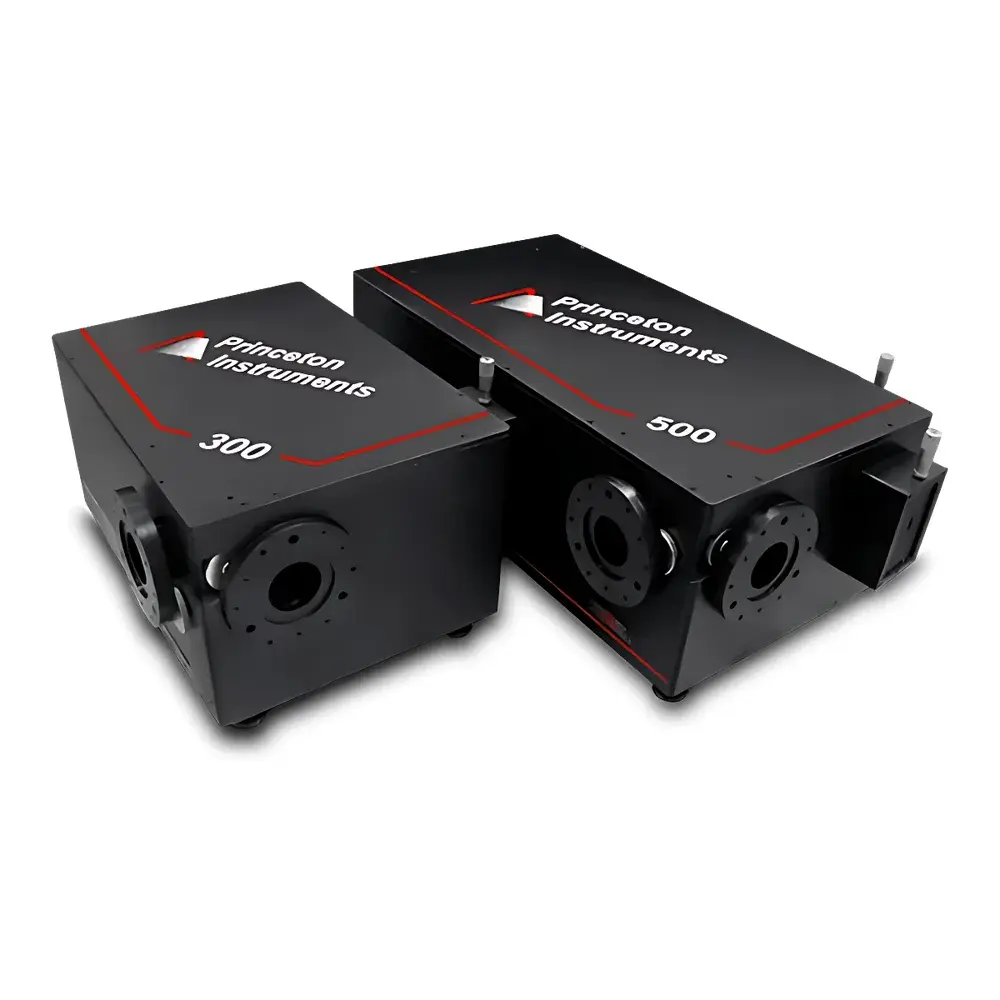
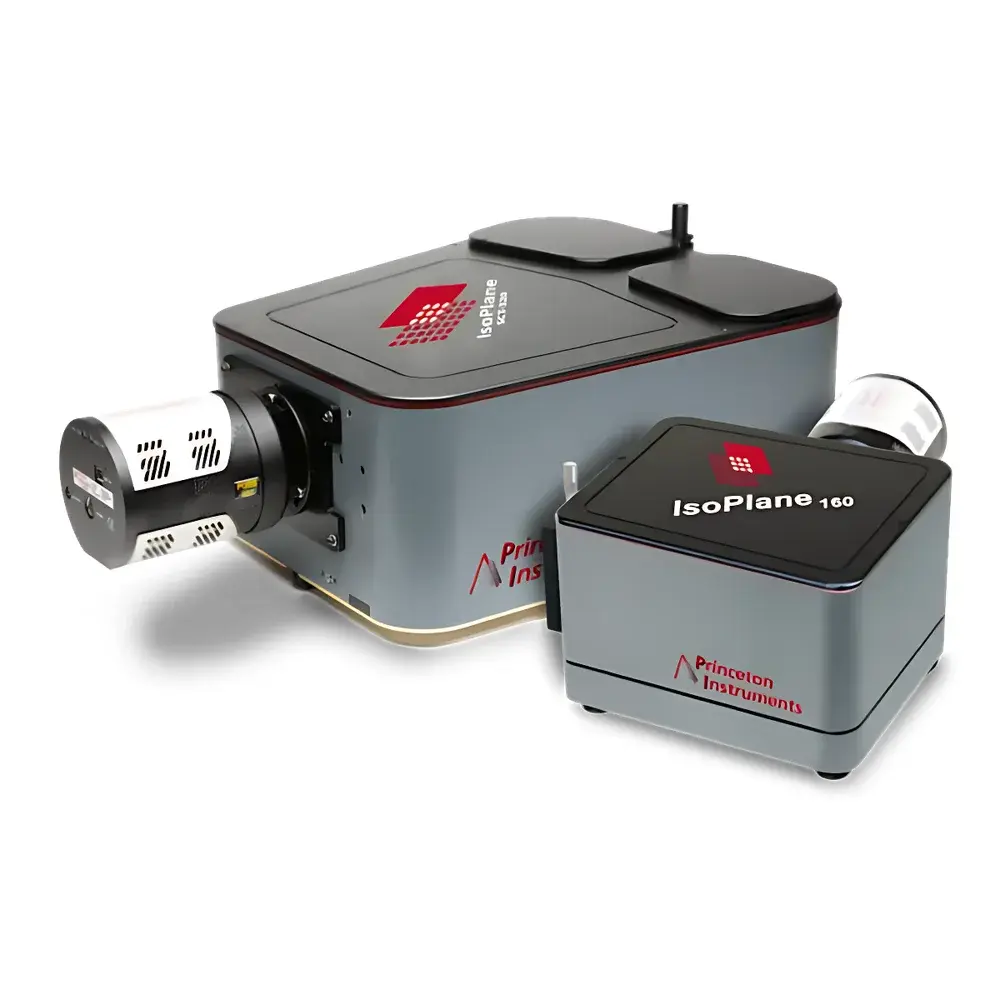
Teledyne Princeton Instruments SpectraPro HRS & IsoPlane Series Imaging Spectrographs
| Brand | Teledyne Princeton Instruments |
|---|---|
| Origin | USA |
| Product Type | Research-Grade Imaging Spectrograph |
| Optical Design | Czerny-Turner (SpectraPro HRS), Schmidt-Czerny-Turner (IsoPlane) |
| Focal Length Options | 150–750 mm (HRS), 160–320 mm (IsoPlane) |
| Spectral Range | 193–1400 nm (UV-VIS-NIR-MIR) |
| Resolution | 0.05–0.4 nm (dependent on model & grating) |
| Pixel Dispersion | 1.03–4.17 nm/mm |
| Entrance Slit Compatibility | Standard motorized slits (10–200 µm) |
| Detector Interface | USB 3.0, RS-232 |
| Grating Mount | Motorized 3-position turret (HRS & IsoPlane) |
| Wavelength Accuracy | ±0.2 nm (IntelliCal-corrected) |
| Aberration Correction | Astigmatism-corrected (IsoPlane), Astigmatism-reduced (HRS) |
| Coating Options | Acton #1900 enhanced Al (193–1200 nm), protected Ag (250–1400 nm), Au (800–1600 nm) |
| Software Platform | LightField v8+ with IntelliCal, ResXtreme, LabVIEW® & MATLAB® SDKs |
| Compliance | GLP/GMP-ready audit trail, FDA 21 CFR Part 11–compatible metadata logging |
Overview
The Teledyne Princeton Instruments SpectraPro HRS and IsoPlane Series are high-performance, research-grade imaging spectrographs engineered for quantitative spectral analysis across scientific, industrial, and OEM applications. Built upon rigorously validated optical architectures—Czerny-Turner for the SpectraPro HRS line and a patented Schmidt-Czerny-Turner design for the IsoPlane platform—both series deliver diffraction-limited performance with minimized optical aberrations across wide spectral bands (193–1400 nm). The core measurement principle relies on spatial dispersion of polychromatic light via ruled or holographic diffraction gratings, followed by high-fidelity imaging onto scientific-grade CCD, sCMOS, or EMCCD detectors. Unlike conventional scanning monochromators, these systems capture full spectra in parallel, enabling shot-noise-limited detection, high temporal resolution, and multi-channel fiber bundle compatibility. Their modular construction supports interchangeable gratings, motorized slits, and dual-output configurations—making them suitable for simultaneous multi-detector operation, Raman mapping, time-resolved PL, and LIBS plasma diagnostics.
Key Features
- Astigmatism-corrected optical path (IsoPlane) or astigmatism-reduced design (SpectraPro HRS), ensuring <100 µm residual astigmatism across the entire focal plane—critical for multi-fiber array coupling and hyperspectral imaging.
- ResXtreme spectral deconvolution engine (standard on all HRS models): improves peak intensity and spectral resolution by up to 60%, enhances pixel-to-pixel spectral uniformity, and increases effective SNR without hardware modification.
- Motorized triple-grating turret with auto-alignment optics and sub-0.02 nm grating positioning repeatability—enabling rapid, software-selectable configuration across UV, VIS, NIR, and MIR regions.
- IntelliCal wavelength and intensity calibration system: employs dual Hg/Ne-Ar lamp sources for traceable, NIST-referenced wavelength accuracy (±0.2 nm) and hardware-specific relative intensity correction—including etaloning compensation for back-illuminated sensors.
- Acton #1900 enhanced aluminum and optional protected silver/gold coatings deliver >90% average reflectivity from 193 nm through 1400 nm, maximizing photon throughput and minimizing stray light.
- AccuDrive™ initialization protocol: performs automated grating identification, slit alignment, and optical centering at power-up—ensuring consistent wavelength reproducibility (<±0.01 nm) across instrument lifetime and thermal cycles.
Sample Compatibility & Compliance
The SpectraPro HRS and IsoPlane spectrographs interface seamlessly with standard optical fiber bundles (up to 100 channels), free-space input couplers, microscopes, and vacuum-compatible sample chambers. They support front-illuminated, back-illuminated, deep-depletion, and electron-multiplying CCD formats—including 22 mm tall sensors for full焦平面 utilization. All models comply with ISO/IEC 17025 documentation requirements for metrological traceability and are routinely deployed in GLP- and GMP-regulated environments. LightField software generates compliant audit trails, electronic signatures, and FDA 21 CFR Part 11–enabled metadata—including detector temperature, grating ID, slit width, integration time, and calibration timestamp—for full experimental reproducibility and regulatory submission readiness.
Software & Data Management
LightField v8+ serves as the unified control and analysis environment for both spectrograph families. Its embedded mathematical engine enables real-time spectral fitting (Gaussian/Lorentzian deconvolution), background subtraction, spectral stitching, and pixel-binned ROI extraction. Hardware control—including grating selection, slit actuation, shutter timing, and detector synchronization—is fully scriptable via Python API or integrated into LabVIEW® and MATLAB® workflows using native SDKs. IntelliCal calibration data is stored in vendor-neutral HDF5 format with embedded SI-traceable units and uncertainty estimates. Export options include CSV, FITS, and vendor-agnostic spectral libraries compatible with Thermo Fisher OMNIC, Horiba Labspec, and Bruker OPUS platforms.
Applications
These spectrographs are deployed in peer-reviewed research and industrial QA/QC settings requiring high fidelity and reproducibility. Key use cases include: confocal and tip-enhanced Raman spectroscopy (TERS); low-frequency Raman (<50 cm⁻¹) of 2D materials; time-resolved photoluminescence decay profiling; LIBS plasma emission analysis for geological and metallurgical composition; multi-channel fluorescence lifetime imaging (FLIM); extinction spectroscopy of plasmonic nanoparticles; hyperspectral mapping of semiconductor wafers; and Fourier-transform imaging spectroscopy (FTIS) hybrid configurations. Their dual-port architecture also supports pump-probe spectral splitting and reference-beam normalization in ultrafast laser laboratories.
FAQ
What distinguishes the IsoPlane’s Schmidt-Czerny-Turner design from conventional Czerny-Turner spectrographs?
The IsoPlane eliminates astigmatism across the full focal plane by replacing the spherical collimating mirror with an aspheric Schmidt corrector plate—enabling diffraction-limited imaging at every wavelength position, essential for multi-fiber and spatially resolved spectroscopy.
Can the SpectraPro HRS operate simultaneously with two detectors?
Yes—the dual-output port allows concurrent mounting of two array detectors (e.g., UV-optimized CCD + NIR-optimized InGaAs), with independent wavelength calibration and real-time spectral registration in LightField.
Is IntelliCal compatible with third-party light sources?
IntelliCal requires its certified Hg/Ne-Ar dual-lamp module for primary wavelength calibration; however, users may perform secondary intensity calibration using custom broadband sources via LightField’s user-defined reference workflow.
How is spectral resolution defined and verified for these instruments?
Resolution is specified as full-width-at-half-maximum (FWHM) of the instrumental line profile measured using a 10 µm slit and 1200 g/mm grating at 546.1 nm; values are traceably validated per ASTM E275 and ISO 14785 protocols using calibrated mercury lines.
Do these systems support vacuum or purged operation?
Yes—optional vacuum flange kits (CF-35 or CF-63) and purge gas ports (N₂ or dry air) are available for UV-enhanced operation below 200 nm or moisture-sensitive NIR measurements.



