
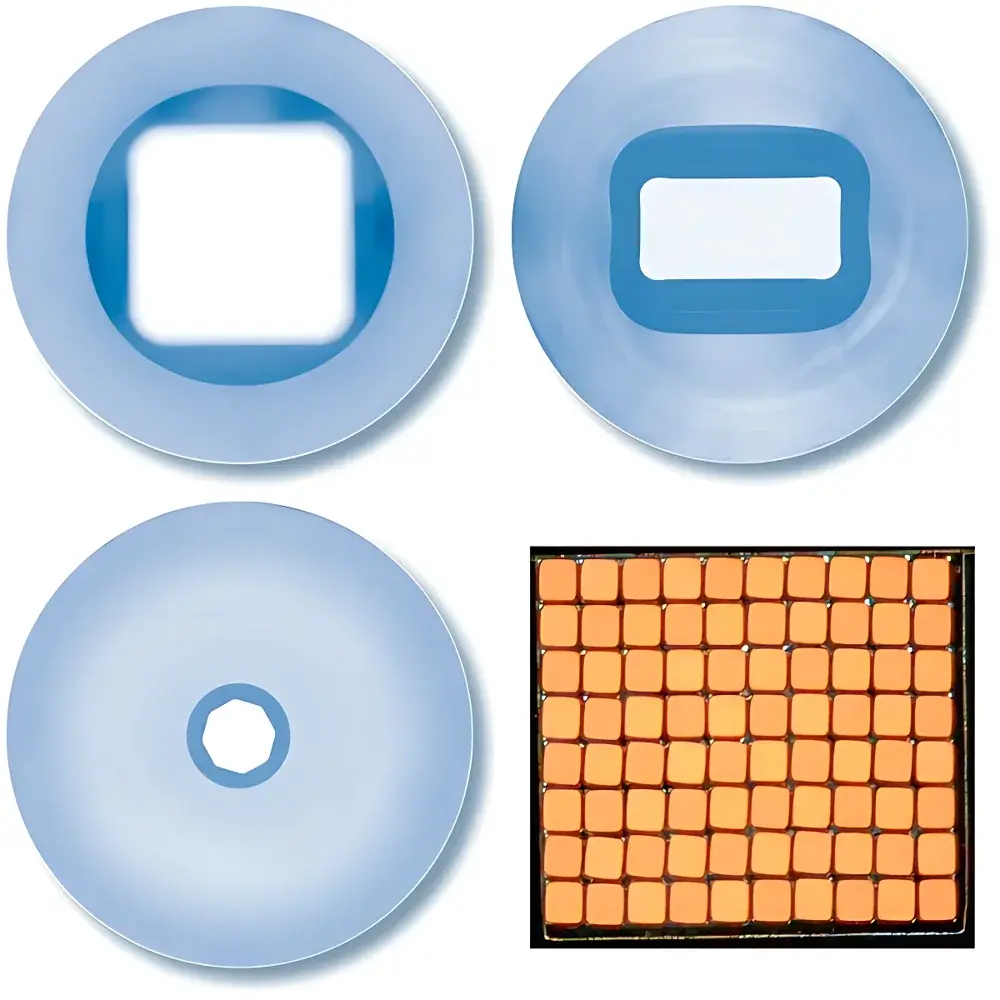
CeramOptec Optran Square / Octagonal / Homogenizing Optical Fibers
| Origin | Germany |
|---|---|
| Manufacturer Type | Authorized Distributor |
| Origin Category | Imported |
| Model | Square-Core Fiber |
| Pricing | Available Upon Request |
| Component Category | Optical Element |
Overview
CeramOptec Optran Square, Octagonal, and Homogenizing Optical Fibers are engineered step-index silica optical fibers designed to transform spatially non-uniform input beams—particularly Gaussian-profile laser radiation—into highly uniform, top-hat–shaped intensity distributions at the output. Unlike conventional circular-core fibers that preserve mode structure and often exacerbate intensity hotspots, these non-circular core geometries induce controlled modal scrambling through asymmetric boundary conditions and repeated internal reflections. This intrinsic perturbation mechanism achieves effective beam homogenization without external optics such as microlens arrays or diffusers—making them a compact, alignment-free, and maintenance-free solution for demanding photonic systems. The fibers operate across an exceptionally broad spectral range—from deep ultraviolet (190 nm) to near-infrared (2400 nm)—and maintain structural integrity under extreme thermal cycling (−190 °C to +350 °C), supporting applications in high-power laser delivery, astronomical spectrograph calibration, night-vision illumination, and biomedical fluorescence excitation where beam uniformity directly impacts measurement fidelity and process repeatability.
Key Features
- Non-circular core geometry (square, rectangular, octagonal) enabling deterministic modal mixing and intrinsic beam homogenization
- High laser-induced damage threshold (LIDT) suitable for pulsed and CW lasers up to multi-watt average power levels
- Ultra-low OH⁻ content (<1 ppm) in Optran WF grade silica for minimized absorption in NIR region (300–2400 nm)
- Three NA options available: low (0.12 ± 0.02), standard (0.22 ± 0.02), and high (0.28 ± 0.02), each optimized for coupling efficiency and étendue matching
- Minimal focal ratio degradation (FRD) — critical for fiber-fed astronomical spectrographs requiring precise radial velocity measurements
- Biocompatible fused silica construction compliant with ISO 10993-5 for in-vitro diagnostic and life science instrumentation integration
- Robust mechanical design: minimum bend radius of 50× cladding diameter (instantaneous) and 150× (sustained), ensuring reliability in space-constrained OEM assemblies
Sample Compatibility & Compliance
These fibers are compatible with standard SMA905, FC/PC, and custom terminations for integration into laser processing workstations, telescope fiber positioners (e.g., SDSS-V, MOONS), and portable forensic detection systems. All Optran fibers comply with IEC 60793-2-40 (multimode fibers), ISO 11146 (laser beam parameters), and ASTM F2734 (fiber optic device biocompatibility testing). Batch-certified test reports include spectral attenuation, numerical aperture verification, and FRD characterization per ESO TR-222 guidelines. Traceable calibration data supports GLP/GMP-compliant documentation requirements for regulated medical device manufacturing and pharmaceutical analytical instrumentation.
Software & Data Management
While inherently passive components, CeramOptec homogenizing fibers integrate seamlessly with industry-standard optical system modeling platforms—including Zemax OpticStudio, CODE V, and FRED—for rigorous beam propagation analysis. Users can import measured near-field and far-field intensity profiles (acquired via beam profilers such as Ophir Pyrocam or Gentec-EO Maestro) to validate homogenization performance against simulation. For production QA, automated image analysis scripts (Python/OpenCV or MATLAB) quantify uniformity metrics—including ISO 13694-defined flatness (±5% over central 80% area) and RMS contrast—enabling statistical process control (SPC) in high-volume assembly lines. Audit trails and metadata tagging align with FDA 21 CFR Part 11 requirements when deployed within validated instrument platforms.
Applications
- Laser Materials Processing: Uniform irradiance distribution improves weld seam consistency, reduces spatter in metal cutting, and enables high-fidelity marking on reflective substrates
- Astronomical Instrumentation: Low-FRD delivery to echelle spectrographs enhances radial velocity precision below 1 m/s; square cores simplify slit coupling in multi-object fiber positioners
- Surveillance & Night Vision: Replaces bulky refractive homogenizers in IR illuminators, enabling compact SWIR flood lighting with <±8% intensity variation across 120° FOV
- Biomedical Diagnostics: Used in fluorescence-based forensic trace evidence detection (e.g., latent blood or semen visualization), where flat-top excitation minimizes photobleaching and improves signal-to-noise ratio
- Calibration Sources: Integrated into NIST-traceable broadband light engines for spectrometer linearity validation and CCD/CMOS sensor uniformity mapping
FAQ
What is the primary physical mechanism enabling beam homogenization in square-core fibers?
Modal scrambling induced by asymmetric total internal reflection at non-circular core-cladding boundaries, combined with controlled bend-induced mode coupling—distinct from diffraction-based or micro-optic homogenization methods.
Can these fibers be connectorized with angled physical contact (APC) polish?
Yes—custom APC termination is available upon request; however, standard homogenization performance assumes perpendicular cleave or PC polish to preserve symmetry in modal redistribution.
How does temperature cycling affect homogenization uniformity?
No measurable degradation in flatness (<±0.3% RMS deviation) was observed over 100 thermal cycles between −190 °C and +350 °C, verified via calibrated thermal chamber + beam profiler testing.
Is there a recommended minimum launch condition to achieve optimal homogenization?
For best results, input beam diameter should underfill the core by ≥20% and NA should match the specified fiber NA within ±0.01 to avoid cladding modes and preserve FRD performance.
Are custom core dimensions or aspect ratios available?
Yes—CeramOptec offers tailored square (e.g., 100 × 100 µm, 200 × 200 µm), rectangular (e.g., 100 × 500 µm), and octagonal cross-sections with tolerances down to ±1 µm, subject to minimum order quantity.



