
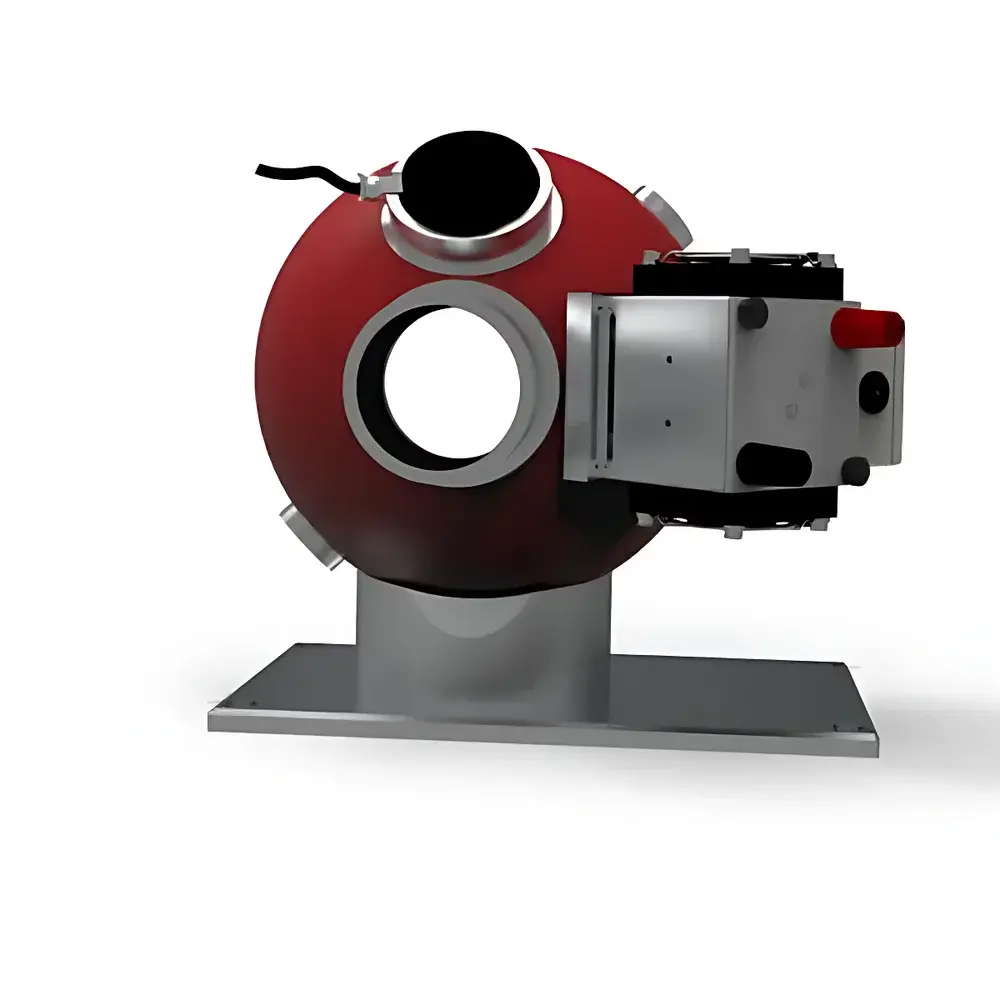
Gigahertz-Optik ISS-17-VAM Integrating Sphere Uniform Light Source with Continuous Spectral Emission
| Brand | Gigahertz-Optik |
|---|---|
| Origin | Germany |
| Model | ISS-17-VAM |
| Sphere Diameter | 170 mm |
| Output Port Diameter | 50 mm |
| Coating | BaSO₄ |
| Light Source | 100 W Tungsten-Halogen Lamp (2856 K & 3100 K) |
| Spectral Range | 380–800 nm |
| Luminance Range | 3–7,500 cd/m² @ 2856 K |
| Calibration | NIST-traceable spectral radiance, luminance, and CCT |
| Compliance | ISO/IEC 17025 accredited calibration certificate provided |
| Control | Motorized variable aperture (VAM), integrated monitor detector for real-time CCT and luminance feedback |
| Optional Diffuser Window | For enhanced spatial uniformity |
| Spectral Stability | Maintained via dual-CCT lamp operation and thermal management |
Overview
The Gigahertz-Optik ISS-17-VAM Integrating Sphere Uniform Light Source is an engineered optical reference system designed for high-fidelity photometric and radiometric calibration of imaging sensors, spectroradiometers, camera modules, and non-imaging light measurement devices. It operates on the principle of diffuse multiple-scattering within a highly reflective BaSO₄-coated spherical cavity, generating spatially uniform, Lambertian exitance across its 50 mm output port. Unlike broadband LED-based sources, this system employs a stabilized 100 W tungsten-halogen lamp—delivering continuous spectral emission from 380 nm to 800 nm—with precisely controlled color temperature (CCT) selection between 2856 K (standard illuminant A) and 3100 K. The integration of a motorized variable aperture (VAM) enables continuous, repeatable luminance adjustment while preserving spectral shape and CCT stability—a critical requirement for dynamic range testing, MTF evaluation, and ISO 12233-compliant sensor characterization.
Key Features
- 170 mm integrating sphere with ultra-high-reflectance (>97% avg.) BaSO₄ coating for optimal spatial uniformity (±0.2% over central 80% of port area, per CIE 127:2019)
- Motorized variable aperture (VAM) enabling precise, software-controllable luminance modulation without spectral shift or CCT drift
- Dual-CCT lamp configuration (2856 K and 3100 K) with automatic switching and real-time monitoring via integrated spectrally flat silicon photodiode and thermopile-based CCT detector
- NIST-traceable, ISO/IEC 17025-accredited calibration for spectral radiance (W·sr⁻¹·m⁻²·nm⁻¹), photopic luminance (cd·m⁻²), and correlated color temperature (K)
- UMPA-2.0-xx baffle tube mounted at port to suppress stray light and lateral irradiation, ensuring compliance with CIE-recommended measurement geometry
- Optional quartz diffuser window for improved angular homogeneity—particularly beneficial for wide-field-of-view (FOV) and fisheye lens calibration
- Embedded analog/digital I/O interface supporting LabVIEW, Python, and MATLAB control; compatible with Gigahertz-Optik’s X1-4 and BTS256 spectroradiometer platforms
Sample Compatibility & Compliance
The ISS-17-VAM supports calibration of diverse optical receivers including CMOS/CCD image sensors, scientific cameras, photometric goniometers, handheld lux meters, and fiber-coupled spectrometers. Its output uniformity and spectral stability meet requirements defined in ISO 15739 (electronic still picture imaging — noise measurements), ISO 17321-1 (color rendering index), and ASTM E308 (computing CIE colors). All calibrations are performed in accordance with DIN EN ISO/IEC 17025 by Gigahertz-Optik’s DAkkS-accredited laboratory. Each unit ships with a full calibration certificate referencing national standards maintained at PTB (Physikalisch-Technische Bundesanstalt, Germany), ensuring traceability to SI units. The system is compliant with GLP documentation standards and supports audit-ready electronic calibration records when integrated with Gigahertz-Optik’s BTS256-LED software suite.
Software & Data Management
Control and data acquisition are managed through Gigahertz-Optik’s proprietary BTS256-LED software (v5.2+), which provides synchronized readout of luminance, CCT, and spectral power distribution (SPD) in real time. The software logs timestamped measurement sequences with metadata (aperture position, lamp hours, ambient temperature), enabling full traceability for ISO 9001 and FDA 21 CFR Part 11–compliant environments. Raw spectral data is exportable in CSV and JDX formats; luminance/CCT trends can be visualized as time-series plots with statistical summaries (mean, std dev, min/max). Remote operation is supported via Ethernet (TCP/IP) or USB 2.0, and API libraries (DLL, .NET, Python bindings) allow integration into custom test automation frameworks such as NI TestStand or Keysight PathWave.
Applications
- Dynamic range and linearity verification of automotive ADAS cameras and surround-view systems
- ISO 12233 slanted-edge MTF measurement under controlled, spectrally stable illumination
- Calibration of hyperspectral imagers and push-broom scanners requiring uniform spectral radiance
- Validation of photometric response functions in smartphone camera modules per IEEE P2020 standards
- Reference source for spectral mismatch correction in solar simulator characterization
- Training and validation of AI-based low-light image enhancement algorithms using ground-truth luminance maps
FAQ
What spectral range is covered by the ISS-17-VAM, and how is it validated?
The ISS-17-VAM delivers continuous emission from 380 nm to 800 nm. Its spectral radiance is calibrated using a PTB-traceable double-monochromator spectroradiometer (BTS256-LED + UVA-370 probe), with uncertainty < ±1.8% (k=2) across the visible band.
Can the system maintain constant CCT while varying luminance?
Yes—by coupling the motorized aperture with closed-loop feedback from the integrated CCT monitor detector, the system achieves CCT stability better than ±15 K over the full luminance range.
Is the calibration certificate valid internationally?
Yes—the DAkkS-accredited certificate (No. D-K-17025-0012) is recognized under the ILAC MRA framework and accepted by regulatory bodies in the EU, US, Japan, and South Korea.
How is lamp aging compensated during long-term use?
The system includes lamp-hour logging and automated recalibration prompts; users may schedule periodic re-calibration at Gigahertz-Optik’s lab or perform in-situ relative checks using the built-in reference detector.
Does the ISS-17-VAM support automated test sequences for production environments?
Yes—it integrates natively with industrial PLCs via Modbus TCP and supports trigger-based exposure synchronization for high-throughput sensor testing lines.




