Liquid Instruments Moku:Lab Lock-in Amplifier
| Brand | Liquid Instruments |
|---|---|
| Origin | Australia |
| Model | Moku:Lab |
| Frequency Range | DC–200 MHz |
| Dynamic Reserve | Up to 100 dB |
| Demodulation Modes | Dual-phase (X/Y, R/θ) |
| Input Gain Options | −20 dB / 0 dB / +24 dB / +48 dB |
| Input Impedance | 50 Ω / 1 MΩ |
| Time Constant Range | 40 ns – 0.6 s |
| Filter Roll-off | 6 dB/octave or 12 dB/octave |
| Phase Accuracy | ±0.001° |
| Frequency Resolution | 3.55 µHz |
| Sampling Rate (Oscilloscope Mode) | up to 500 MSa/s |
| Data Logging Rate | up to 1 MSa/s |
| Internal LO Output | up to 200 MHz, adjustable amplitude |
Overview
The Liquid Instruments Moku:Lab Lock-in Amplifier is a high-precision, FPGA-based digital lock-in amplifier engineered for ultra-low-noise signal recovery in demanding scientific and engineering applications. Operating on the principle of synchronous demodulation, it isolates periodic signals buried in noise by multiplying the input with a phase-locked reference and applying low-pass filtering to extract DC components proportional to signal amplitude and phase. Unlike analog lock-in amplifiers, Moku:Lab implements all signal processing digitally within a reconfigurable hardware platform—enabling real-time computation, deterministic latency, and immunity to drift or component aging. Its DC–200 MHz frequency range supports applications from sub-millihertz modulation (e.g., slow thermal or mechanical dynamics) to RF-domain measurements (e.g., laser heterodyne detection), while its 100 dB dynamic reserve ensures reliable detection of signals as low as nanovolts in the presence of millivolt-level interference. Designed for laboratory-grade reproducibility, the instrument adheres to metrological best practices in gain linearity, phase stability, and timing coherence across all integrated instruments.
Key Features
- Dual-phase demodulation (X, Y, R, θ) with independent reference tracking and phase-shift control
- FPGA-accelerated real-time processing enabling deterministic signal path latency (<1 µs)
- Configurable low-pass filters with selectable roll-off slopes (6 or 12 dB/octave) and time constants from 40 ns to 0.6 s
- Built-in PID controller for closed-loop stabilization (e.g., laser frequency locking, cavity resonance control)
- Integrated dual-channel oscilloscope (500 MSa/s real-time sampling) and data logger (1 MSa/s continuous streaming)
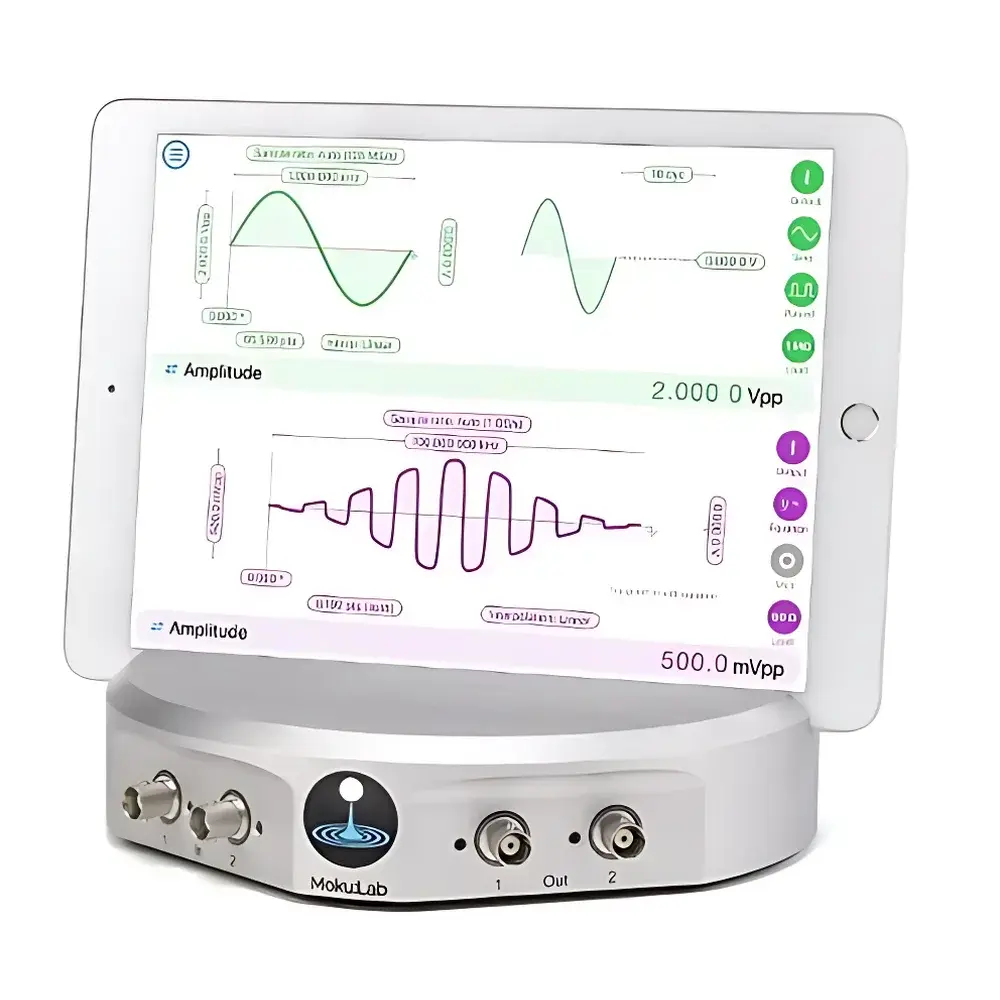
- Graphical signal flow interface allowing drag-and-drop configuration of virtual instruments and internal probe points
- Internal local oscillator (LO) with 200 MHz maximum output frequency, programmable amplitude, and harmonic suppression
- Support for external reference synchronization, PLL mode, and multi-harmonic detection up to the 10th order
Sample Compatibility & Compliance
Moku:Lab interfaces seamlessly with photodetectors, piezoelectric transducers, RF antennas, cryogenic sensors, and other low-output transducers common in quantum optics, condensed matter physics, and precision metrology. Its 50 Ω / 1 MΩ switchable input impedance accommodates both high-frequency RF sources and high-impedance voltage outputs from preamplifiers or MEMS devices. The instrument complies with IEC 61000-4 electromagnetic compatibility standards and meets CE/FCC Class B emissions limits for laboratory deployment. While not certified for medical or industrial safety-critical use, its architecture supports GLP/GMP-aligned workflows through audit-trail-capable software logging, timestamped parameter snapshots, and exportable metadata-enriched HDF5 datasets—facilitating traceability in regulated research environments such as those governed by ISO/IEC 17025.
Software & Data Management
The Moku:Lab web-based GUI provides instrument control via any modern browser over Ethernet or Wi-Fi, eliminating driver dependencies and enabling remote access from Linux, macOS, or Windows hosts. All configurations—including filter settings, gain stages, reference source selection, and PID parameters—are saved as human-readable JSON files, supporting version control and collaborative experiment replication. Real-time data streams are accessible via Python API (moku-python), MATLAB Instrument Control Toolbox, or LabVIEW drivers, allowing integration into custom automation pipelines. Exported measurement data includes calibrated units, timestamps synchronized to GPS-disciplined oscillators (optional), and full instrument state metadata—ensuring FAIR (Findable, Accessible, Interoperable, Reusable) data principles. Firmware updates are delivered over-the-air and preserve user calibration history without requiring recalibration.
Applications
- Time-domain thermoreflectance (TDTR) and pump-probe spectroscopy for thermal conductivity mapping
- Laser frequency stabilization using Pound-Drever-Hall or FM spectroscopy techniques
- Atomic force microscopy (AFM) phase imaging and cantilever resonance tracking
- Gas-phase harmonic detection in photoacoustic or cavity-enhanced absorption spectroscopy
- Quantum sensing with NV centers or superconducting qubits requiring sub-microradian phase resolution
- Electrochemical impedance spectroscopy (EIS) at frequencies up to 200 MHz
- Optomechanical displacement metrology with diffusing targets (e.g., biological tissue, rough surfaces)
- Teaching laboratories for RC/RL circuit characterization, interferometry, and signal-to-noise ratio optimization
FAQ
What reference sources does the lock-in amplifier support?
It accepts internal LO (user-defined frequency/phase), external TTL or sine-wave references, and PLL-synchronized references derived from input signals—enabling autonomous operation in feedback loops.
Can multiple Moku:Lab instruments be synchronized?
Yes—via 10 MHz reference clock distribution or PPS-triggered acquisition, ensuring phase-coherent measurements across distributed sensor arrays.
Is the instrument suitable for compliance testing under FDA 21 CFR Part 11?
While not formally validated for Part 11, its audit-log functionality, electronic signature support via third-party identity providers, and immutable dataset export meet foundational requirements for electronic records in regulated labs.
How does the digital gain setting affect noise performance?
Digital gain applied pre-filtering increases both signal and quantization noise equally; optimal SNR is achieved by matching analog input gain to maximize ADC utilization without clipping, then applying digital gain only for display scaling.
Does the device support harmonic detection beyond fundamental frequency?
Yes—up to the 10th harmonic with independent X/Y demodulation per harmonic, enabling simultaneous measurement of nonlinear response functions in materials characterization.