
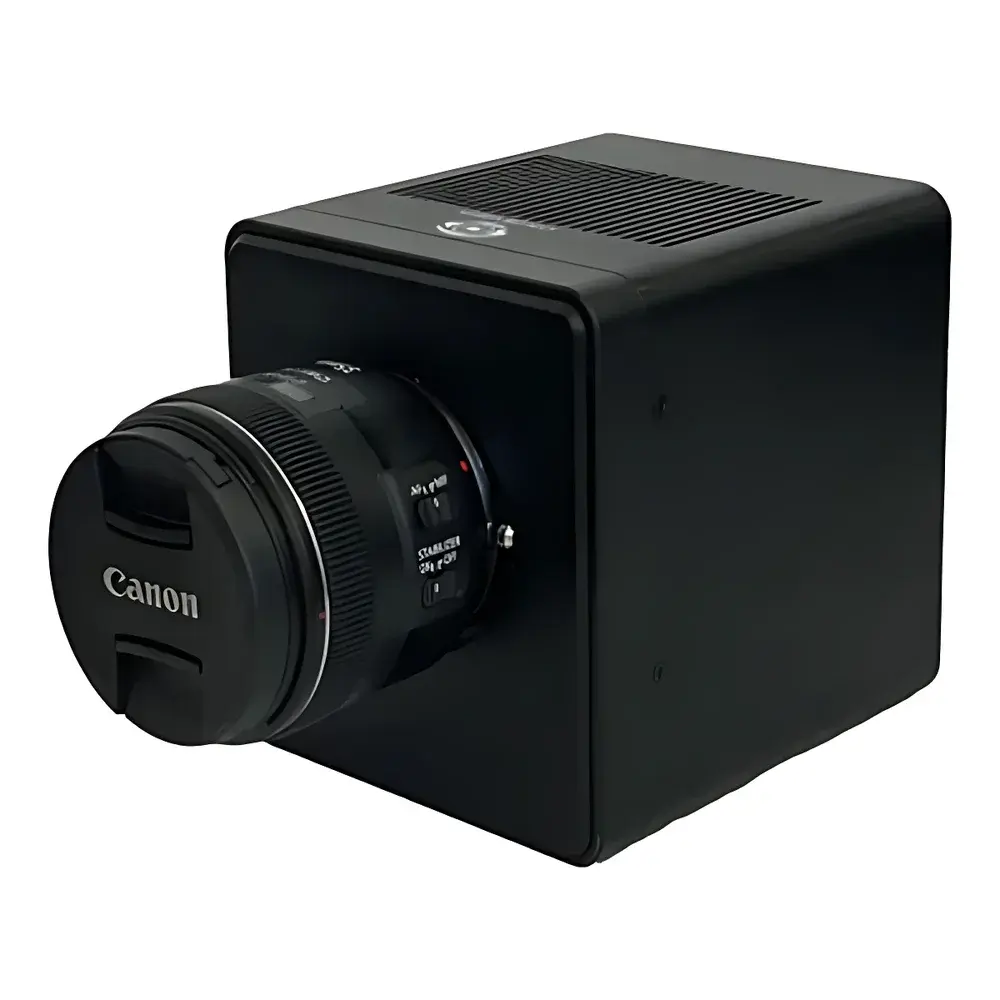
Auniontech AU-Series Imaging Photometer and Colorimeter
| Brand | Auniontech |
|---|---|
| Origin | Shanghai, China |
| Sensor Type | Back-illuminated CMOS |
| Resolution | 20–61 MP (5520×3680 to 9576×6388) |
| Cooling | Dual-stage thermoelectric (TEC) |
| Luminance Range | 0.0001–10⁷ cd/m² |
| Exposure Time | 0.1 ms–300 s |
| Luminance Accuracy | ±3% |
| Chromaticity Accuracy (x,y) | ±0.003 |
| Luminance Repeatability | ±0.05% |
| Chromaticity Repeatability | ±0.0001 |
| Synchronization | Auto-sync to input refresh rate |
| Interface | USB 3.0 |
| Software | Phaos Dedicated Measurement Suite |
| Compliance | CIE 1931 XYZ color matching function (calibrated), ISO/CIE-compliant photometric and colorimetric measurement protocols |
Overview
The Auniontech AU-Series Imaging Photometer and Colorimeter is a high-speed, production-optimized optical measurement instrument engineered for spatially resolved luminance and chromaticity characterization of emissive and reflective surfaces. Unlike scanning-based photometers, the AU-Series employs a single-shot imaging architecture based on back-illuminated CMOS sensors with factory-calibrated CIE 1931 XYZ tristimulus filter arrays. This enables full-field acquisition of photometric (cd/m²) and colorimetric (CIE x,y or u’v’) data across resolutions up to 61 megapixels (9576 × 6388), delivering sub-pixel spatial detail without mechanical scanning artifacts. The system integrates dual-stage thermoelectric cooling to suppress dark current noise—critical for low-luminance grayscale evaluation of OLED, Micro-LED, and LCD panels. While the AU-Series utilizes Bayer-pattern sensor interpolation with post-factory spectral correction (rather than physically deposited precision XYZ filters), its calibration workflow ensures traceable accuracy suitable for manufacturing process control and pass/fail uniformity screening per ISO 9241-307 and IEC 62341-6-3 standards.
Key Features
- Single-acquisition imaging architecture eliminates frame-to-frame misregistration and accelerates throughput—ideal for inline production testing of BLU modules, display panels, and automotive HMI components.
- Back-illuminated CMOS sensors with resolutions spanning 20 MP (5520 × 3680), 26 MP (6200 × 4200), and 61 MP (9576 × 6388), optimized for signal-to-noise ratio across luminance ranges from 0.0001 to 10⁷ cd/m².
- Dual-stage thermoelectric cooling maintains sensor temperature stability within ±0.1°C, reducing thermal drift and enabling reliable low-light measurements down to 10⁻⁴ cd/m²—essential for evaluating black-level performance in HDR displays.
- User-initiated calibration routines support field recalibration using NIST-traceable reference sources, preserving measurement integrity across environmental shifts and long-term deployment.
- Real-time auto-synchronization to external video timing signals (e.g., HDMI, LVDS, eDP) ensures precise capture at defined vertical blanking intervals—minimizing temporal aliasing in pulsed or PWM-driven displays.
- Phaos software provides pseudo-color mapping, region-of-interest (ROI) masking, histogram analysis, and automated uniformity metrics (e.g., max/min ratio, Δu’v’, luminance standard deviation) compliant with VESA DisplayHDR and ISO 13406-2 reporting formats.
Sample Compatibility & Compliance
The AU-Series supports planar and mildly curved emissive samples including LCD, OLED, QD-LCD, Micro-LED, and Mini-LED modules; backlight units (BLUs); automotive instrument clusters; AR/VR microdisplays; illuminated keyboards; and general lighting fixtures. Its optical design accommodates working distances from 150 mm to 2 m (lens-dependent), with optional telecentric or wide-angle optics available for specialized FOV requirements. All models conform to fundamental photometric definitions per CIE Publication No. 127 and colorimetric principles outlined in CIE 15:2018. Measurement traceability aligns with ISO/IEC 17025 requirements when operated with certified calibration sources and documented procedures. The system supports audit-ready data logging—including timestamped raw frames, calibration metadata, and user-defined test parameters—facilitating GLP/GMP documentation workflows where required.
Software & Data Management
Phaos software is a dedicated Windows-based application supporting real-time preview, batch measurement scripting, and export of calibrated radiometric (W/sr·m²), photometric (cd/m²), and colorimetric (CIE XYZ, xyY, u’v’, L*a*b*) datasets in CSV, HDF5, and TIFF formats. Each exported file embeds EXIF-like metadata: exposure time, gain setting, sensor temperature, calibration ID, and user-defined sample ID. Version-controlled calibration profiles are stored separately and applied non-destructively during post-processing. For integration into automated test environments, Phaos exposes a COM interface and TCP/IP command set compatible with LabVIEW, Python (via pywin32), and MATLAB. Audit trails record all user actions—including calibration updates, ROI modifications, and report generation—with timestamps and operator IDs, satisfying FDA 21 CFR Part 11 electronic record requirements when deployed on validated systems.
Applications
- Production-line verification of luminance and chromaticity uniformity across FPDs, meeting VESA DisplayHDR and JEITA CP-3420 specifications.
- Quantitative Mura defect detection via localized ΔL* and Δu’v’ deviation maps, referenced against user-defined thresholds.
- BLU homogeneity assessment—including hot-spot identification, edge leakage quantification, and angular luminance distribution (Lambertian fit).
- Automotive display validation per ISO 15008:2017 for legibility under daylight and nighttime ambient conditions.
- AR/VR near-eye display characterization: modulation transfer function (MTF) coupling with luminance mapping for perceptual quality modeling.
- General lighting evaluation per IES LM-79 and EN 13032-1, including spatial CCT distribution and glare index (UGR) estimation.
FAQ
How does the AU-Series differ from the AUT-Series in terms of colorimetric accuracy?
The AU-Series uses interpolated Bayer-filter data corrected via software-based spectral weighting, achieving ±0.003 in CIE x,y coordinates. The AUT-Series employs physically deposited narrowband XYZ filters, yielding tighter spectral match and higher absolute color fidelity—making it preferred for R&D-grade characterization.
Can the AU-Series measure pulsed or PWM-driven displays?
Yes. The auto-synchronization feature locks exposure timing to the display’s vertical sync signal, ensuring consistent phase alignment across frames—even for frequencies up to 240 Hz.
Is NIST-traceable calibration provided with shipment?
Each unit ships with a factory calibration certificate referencing NIST-traceable standards. Optional annual recalibration services include updated certificates with uncertainty budgets per ISO/IEC 17025.
What is the minimum measurable luminance with dual-stage cooling enabled?
At 300 s exposure and optimal gain settings, the system achieves a practical noise floor of ≈3×10⁻⁵ cd/m²—sufficient for measuring OLED black levels and display residual emission.
Does Phaos software support custom report templates?
Yes. Users may define HTML or PDF report layouts with embedded charts, pass/fail logic, and corporate branding—exportable programmatically or via GUI.




