
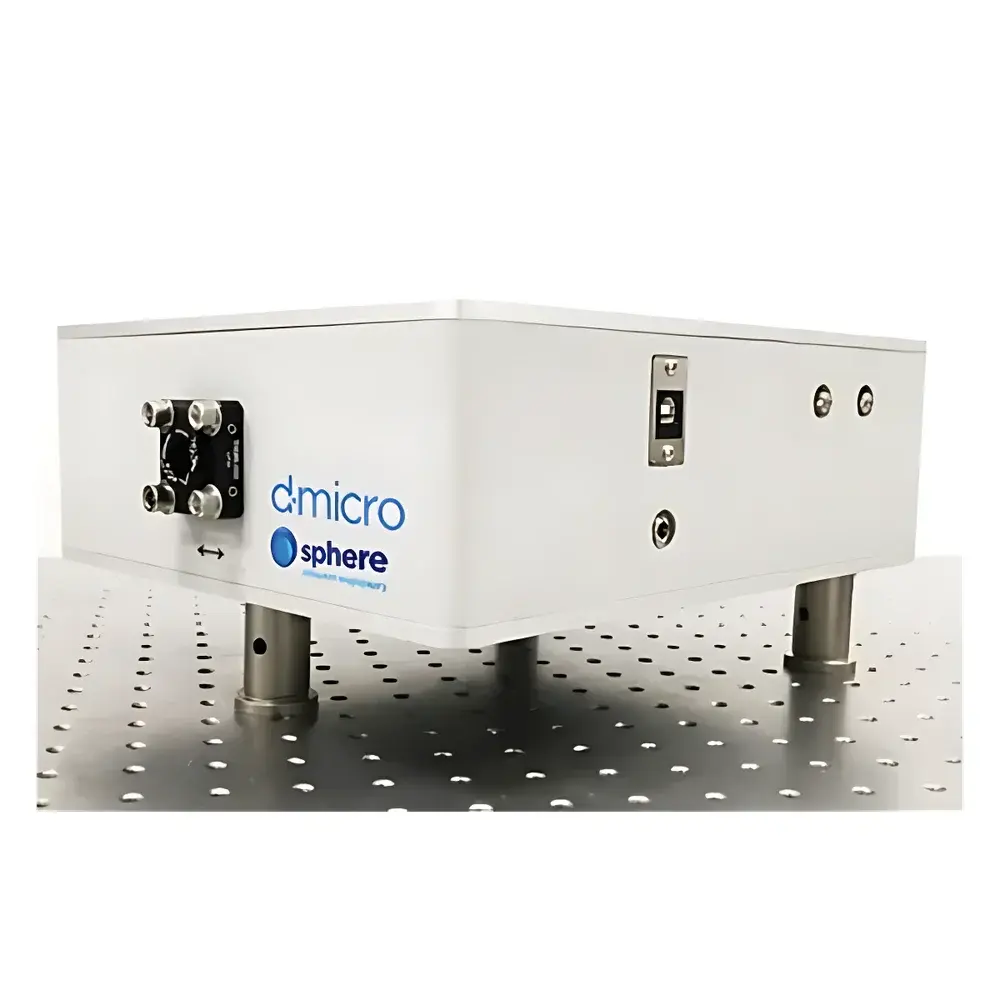
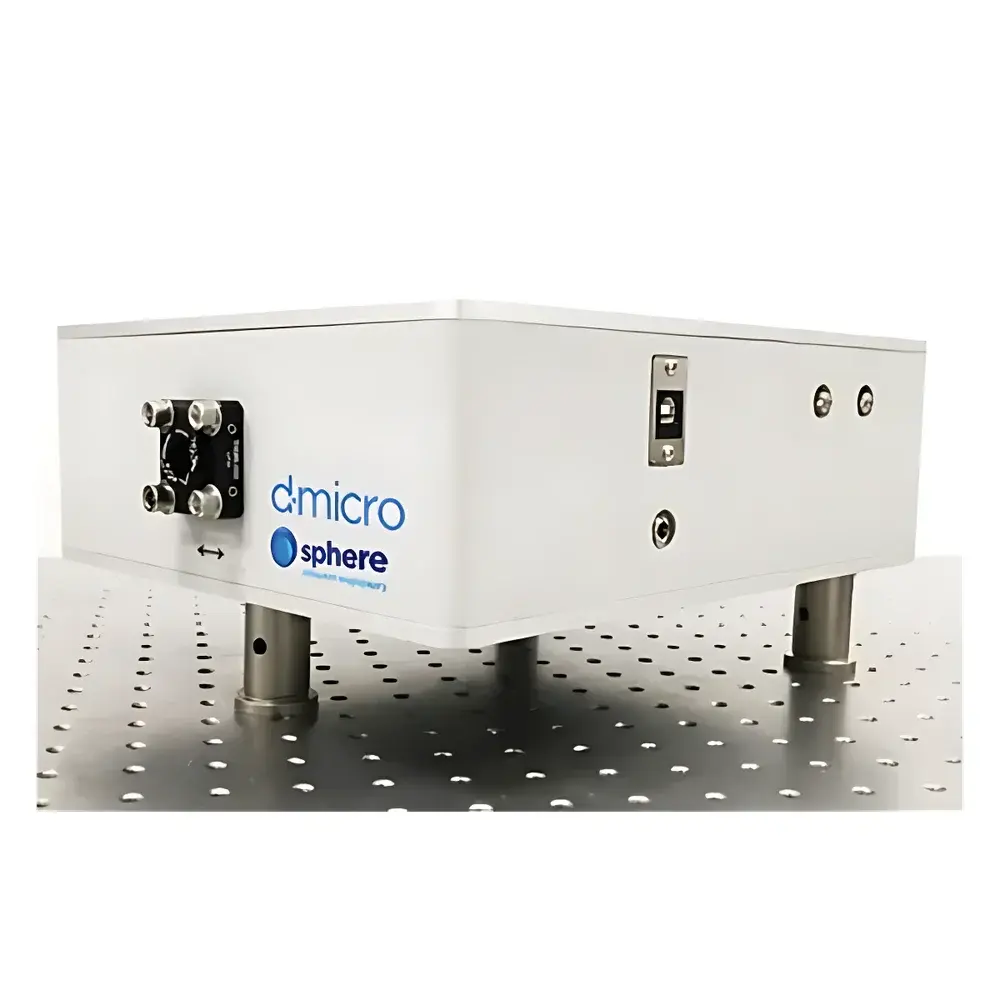
Auniontech d-micro Multiphoton Imaging Pulse Compression and Measurement Module
| Brand | Auniontech |
|---|---|
| Model | d-micro |
| Type | Integrated Dispersion Compensation & Femtosecond Pulse Characterization Module |
| Wavelength Range | 600–1100 nm (d-micro U), 700–1400 nm (d-micro S & d-micro LP NIR), 1500–1700 nm (d-micro LP NIR) |
| Transform-Limited Pulse Width Range | 5–20 fs (U), 2.5–60 fs (S), 80–140 fs (LP), 60–200 fs (LP NIR) |
| Adjustable Second-Order Dispersion Compensation | 0–4,000 fs² (U), 20–8,000 fs² (S), 0–300,000 fs² (LP), 0–20,000 fs² (LP NIR) |
| Repetition Rate Compatibility | ≥1 kHz |
| Input Polarization Requirement | Linear |
| Maximum Input Beam Diameter | 5 mm |
| Minimum Pulse Energy | >100 pJ @ 80 MHz / >1 pJ @ 1 kHz |
| Compressor Module Dimensions (W×L×H) | 300 × 250 × 100 mm |
| Pulse Measurement Head Dimensions | Ø25.4 × 85 mm |
| Origin | Shanghai, China |
Overview
The Auniontech d-micro Multiphoton Imaging Pulse Compression and Measurement Module is an integrated optical instrumentation platform engineered for precision dispersion management and real-time femtosecond pulse characterization in multiphoton microscopy (MPM) systems. It operates on the principle of spectral phase control via adjustable grating-based or prism-based compressors, combined with single-shot autocorrelation or frequency-resolved optical gating (FROG)-compatible measurement heads. Unlike conventional standalone compressors or diagnostic tools, the d-micro unifies pre-compensation of system-induced group delay dispersion (GDD) and direct in-situ pulse width verification at the sample plane—enabling closed-loop optimization of temporal pulse fidelity. This architecture addresses a fundamental limitation in nonlinear bioimaging: the cumulative positive dispersion introduced by microscope objectives, scan lenses, dichroics, and coverslips, which broadens transform-limited pulses and degrades two-photon excitation efficiency, signal-to-noise ratio, and axial resolution. The d-micro is not a generic pulse shaper; it is purpose-built for MPM workflows requiring stable, reproducible sub-50-fs delivery under variable alignment conditions and multi-wavelength operation.
Key Features
- Integrated dual-function design: simultaneous dispersion compensation and direct pulse width measurement at the sample position
- Modular architecture comprising a high-stability compressor unit and a compact, alignment-insensitive measurement head (Ø25.4 mm diameter, 85 mm length)
- Four wavelength-optimized variants (d-micro U, S, LP, LP NIR) covering 600–1700 nm to support Ti:sapphire, Yb-fiber, OPO, and Er-fiber laser sources
- Wide GDD tuning range: up to ±300,000 fs² (d-micro LP) for deep compensation of high-NA objective dispersion
- Low-input-energy sensitivity: functional down to 1 pJ per pulse at 1 kHz repetition rate, compatible with regenerative amplifiers and low-rep-rate oscillators
- Linear polarization input requirement ensures compatibility with standard MPM laser outputs and polarization-preserving beam paths
- Rugged mechanical housing (300 × 250 × 100 mm compressor) designed for integration into commercial and custom-built multiphoton platforms without optical table footprint constraints
Sample Compatibility & Compliance
The d-micro supports standard inverted and upright multiphoton microscopes equipped with galvo or resonant scanners, piezo stage interfaces, and standard C-mount or SM1-threaded optical mounts. Its measurement head is optimized for placement directly at the focal plane—either in place of the objective’s front lens assembly or via a dedicated port in the detection path—enabling quantitative verification of pulse duration *exactly where nonlinear excitation occurs*. No sample modification or labeling is required. From a regulatory standpoint, the module contains no active electronics requiring CE/UKCA marking for optical safety classification; however, its use within GLP-compliant imaging facilities aligns with ISO/IEC 17025 requirements for measurement traceability when paired with calibrated reference pulses. While the d-micro itself does not generate data for FDA 21 CFR Part 11 compliance, its output (pulse width, dispersion curve) can be logged via third-party software supporting audit-trail-enabled acquisition—facilitating documentation for preclinical imaging SOPs.
Software & Data Management
The d-micro operates as a hardware-integrated diagnostic tool rather than a standalone software-controlled instrument. Compressor adjustment is manual via precision micrometer drives calibrated in fs² per rotation; measurement head output is analog (e.g., photodiode current or CCD image) and requires connection to user-supplied digitizers or oscilloscopes. AUniontech provides calibration certificates for each unit’s dispersion scale and pulse width response function, traceable to NIST-traceable autocorrelator standards. Users commonly integrate d-micro measurements into existing Python- or MATLAB-based acquisition pipelines using NI DAQ or Thorlabs Kinesis APIs. Raw temporal intensity profiles are exported as ASCII or HDF5 for post-processing with open-source tools such as PyFROG or SPIDERLab. No proprietary software license or dongle is required—ensuring long-term maintainability and interoperability with evolving lab infrastructure.
Applications
- Optimization of two-photon excited fluorescence (TPEF) and second-harmonic generation (SHG) contrast in live-tissue brain imaging, where pulse broadening above 60 fs reduces penetration depth and increases photodamage
- Calibration of dispersion pre-compensation in adaptive optics-enhanced MPM systems incorporating spatial light modulators (SLMs) or deformable mirrors
- Validation of pulse delivery stability across multi-channel wavelength-multiplexed setups (e.g., simultaneous 800 nm TPEF + 1300 nm third-harmonic generation)
- Quantitative assessment of dispersion drift during long-term time-lapse experiments (>1 hour), enabling automated re-calibration triggers
- Characterization of pulse degradation through scattering media (e.g., skull windows, cleared tissue) for intravital and ex vivo studies
- Supporting method development for stimulated Raman scattering (SRS) and coherent anti-Stokes Raman scattering (CARS) microscopy, where precise pulse synchronization and duration control are critical
FAQ
Does the d-micro require external power or computer control?
No. The compressor module is manually adjusted; the measurement head outputs analog signals requiring only standard lab-grade oscilloscopes or digitizers.
Can the d-micro be used with non-femtosecond lasers?
It is specifically engineered for pulses between 2.5 fs and 200 fs FWHM. Picosecond or nanosecond sources fall outside its dynamic range and measurement principle.
Is the measurement head compatible with water-immersion objectives?
Yes—the compact cylindrical form factor allows mounting in space-constrained positions, including within dipping tank configurations, provided optical access and beam clearance are maintained.
How often does the d-micro require recalibration?
Under stable environmental conditions (temperature variation < ±1°C), recalibration is recommended annually or after mechanical shock; AUniontech provides factory recalibration services with NIST-traceable documentation.
Can multiple d-micro units be synchronized for dual-beam MPM?
While not natively synchronized, independent units can be operated in parallel using shared trigger signals from the laser system, enabling correlated dispersion management across pump and Stokes beams in CARS or SRS applications.




