
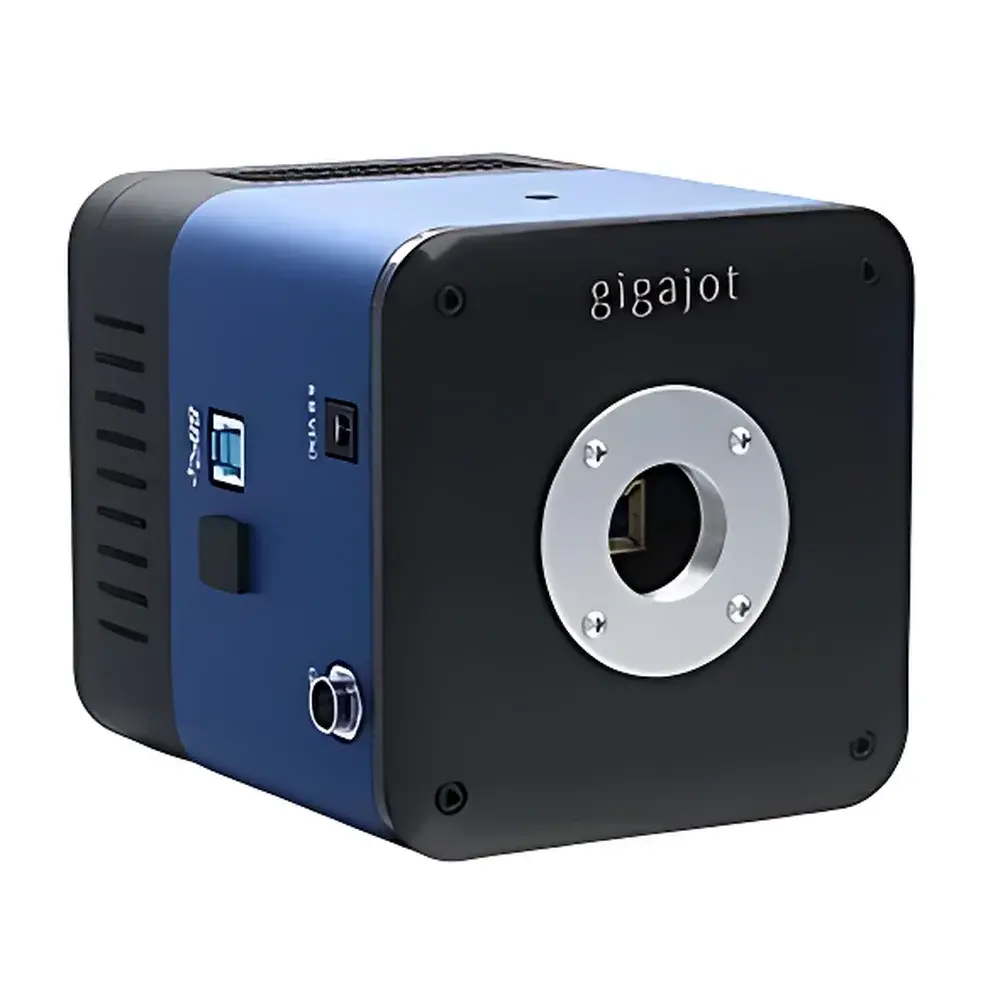
Gigajot QIS Series High-Resolution CMOS Photon-Counting Camera
| Brand | Gigajot |
|---|---|
| Sensor Type | Quantum Image Sensor (QIS) |
| Resolution | 4 MP / 16.7 MP |
| Pixel Size | 1.1 µm or 2.2 µm |
| Max Frame Rate | up to 15,974 fps |
| Read Noise | < 0.35 e⁻ |
| Dark Current | 0.002 e⁻/pix/s @ 10 °C |
| Quantum Efficiency | > 85% (BSI stack) |
| Dynamic Range | up to 96 dB (single-shot) |
| Operating Temperature | TE-stabilized @ 10 °C |
| Interface | USB 3.0 with SDK, GUI, ROI & GPIO support |
| Compliance | Designed for GLP/GMP-aligned lab environments and research-grade optical metrology |
Overview
The Gigajot QIS Series High-Resolution CMOS Photon-Counting Camera represents a paradigm shift in low-light imaging by integrating Quantum Image Sensor (QIS) architecture into a commercially deployable, room-temperature-operable platform. Unlike conventional CMOS sensors limited by analog readout noise and stochastic photon shot noise, QIS technology digitizes photoelectron events at the pixel level using ultra-small, high-gain JOT (jot) pixels—enabling true linear photon-number-resolving detection without avalanche gain or cryogenic cooling. This architecture eliminates the trade-offs historically associated with EMCCD, ICCD, or sCMOS systems—such as excess noise factor, thermal dark current amplification, or complex cooling infrastructure—while delivering deterministic single-photon sensitivity across megapixel-scale arrays. The camera is engineered for quantitative optical metrology where photon-limited signal fidelity, temporal precision, and spatial resolution are simultaneously critical—applications including fluorescence lifetime imaging (FLIM), quantum optics experiments, time-resolved spectroscopy, super-resolution microscopy (e.g., PALM/STORM), and low-flux beam profiling.
Key Features
- Photon-number-resolving capability with sub-electron read noise (< 0.35 e⁻ RMS) and calibrated linearity across full dynamic range
- Two native resolution variants: 16.7 MP (1.1 µm pixels) for high spatial fidelity and 4 MP (2.2 µm pixels) optimized for enhanced full-well capacity and SNR in ultra-low-flux regimes
- Thermoelectric (TE) stabilization at 10 °C, minimizing dark current to 0.002 e⁻/pix/s—critical for long-exposure quantitative acquisition
- Backside-illuminated (BSI) stacked CMOS architecture achieving > 85% peak quantum efficiency from 400–900 nm, with no amplifier glow or fixed-pattern artifacts
- High-speed USB 3.0 interface supporting real-time streaming at up to 15,974 fps (QIS16TS), with hardware-triggered synchronization and precise timestamping
- Comprehensive software suite including GUI-based acquisition control, region-of-interest (ROI) selection, GPIO signaling for external device coordination, and programmable exposure sequencing
Sample Compatibility & Compliance
The QIS camera is compatible with standard C-mount and F-mount optical interfaces, enabling seamless integration into inverted/epifluorescence microscopes, confocal platforms, custom-built interferometers, and vacuum-compatible optical benches. Its mechanical design conforms to ISO 10110 optical mounting standards and includes M4 threaded holes for rigid kinematic alignment. From a regulatory standpoint, the system supports audit-ready data acquisition workflows: metadata embedding (exposure time, temperature, gain settings, firmware version) is automatically recorded per frame; raw image buffers are stored in lossless 16-bit TIFF or HDF5 format; and SDK-level hooks enable integration with LIMS or ELN systems compliant with FDA 21 CFR Part 11 requirements for electronic records and signatures. While not certified for clinical diagnostics, the platform meets ISO/IEC 17025 traceability guidelines for calibration of photon flux measurement in accredited metrology labs.
Software & Data Management
A cross-platform SDK (C/C++, Python 3.8+, MATLAB R2020b+) provides low-level register access, asynchronous frame capture, and real-time histogramming of photon counts per pixel. The included GUI application supports live histogram overlays, dark-frame subtraction, flat-field correction, and export of calibrated photon maps in SI units (photons/pixel/frame). All acquired datasets include embedded EXIF-like metadata compliant with the FITS standard for astronomical imaging interoperability. For high-throughput applications, the SDK supports memory-mapped I/O and zero-copy buffer sharing with third-party frameworks such as Micro-Manager, NIS-Elements, or LabVIEW via shared memory or TCP/IP socket APIs. Firmware updates are delivered via signed binary packages with SHA-256 verification to ensure integrity during field deployment.
Applications
- Quantitative fluorescence correlation spectroscopy (FCS) and number & brightness (N&B) analysis requiring single-molecule photon statistics
- Time-correlated single-photon counting (TCSPC) synchronization with pulsed lasers for lifetime mapping at video rates
- Optical coherence tomography (OCT) systems leveraging photon-counting sensitivity to extend imaging depth in scattering tissues
- Quantum key distribution (QKD) testbeds requiring spatially resolved detection of heralded single photons
- Beam characterization of ultrafast laser systems where pulse-to-pulse intensity fluctuations must be resolved at pixel level
- Industrial inspection of semiconductor photomasks under extreme low-dose illumination to prevent radiation damage
FAQ
Does this camera require liquid nitrogen or thermoelectric cooling to achieve single-photon sensitivity?
No. Single-photon sensitivity is achieved through QIS pixel architecture—not cryogenic gain mechanisms. TE stabilization at 10 °C suppresses dark current sufficiently for most scientific applications; operation at ambient temperature (25 °C) remains viable for shorter exposures.
Can the camera resolve photon numbers beyond 10 photons per pixel per frame?
Yes. The QIS architecture supports multi-photon event discrimination up to ~100 photons/pixel/frame with calibrated linearity, depending on exposure duration and incident flux density.
Is hardware triggering supported for synchronization with pulsed light sources?
Yes. The camera features TTL-compatible input/output lines for precise external trigger initiation, frame start synchronization, and shutter control with jitter < 100 ns.
What is the maximum sustained data throughput over USB 3.0?
At full 16.7 MP resolution and 1,000 fps, sustained throughput reaches 1.2 GB/s—fully utilizing USB 3.0 Gen 1 bandwidth; lower resolutions enable higher frame rates without data loss.
Are calibration certificates available for radiometric accuracy?
Yes. NIST-traceable quantum efficiency and photoresponse non-uniformity (PRNU) calibration reports are provided with each unit, updated annually per ISO/IEC 17025 laboratory procedures.





