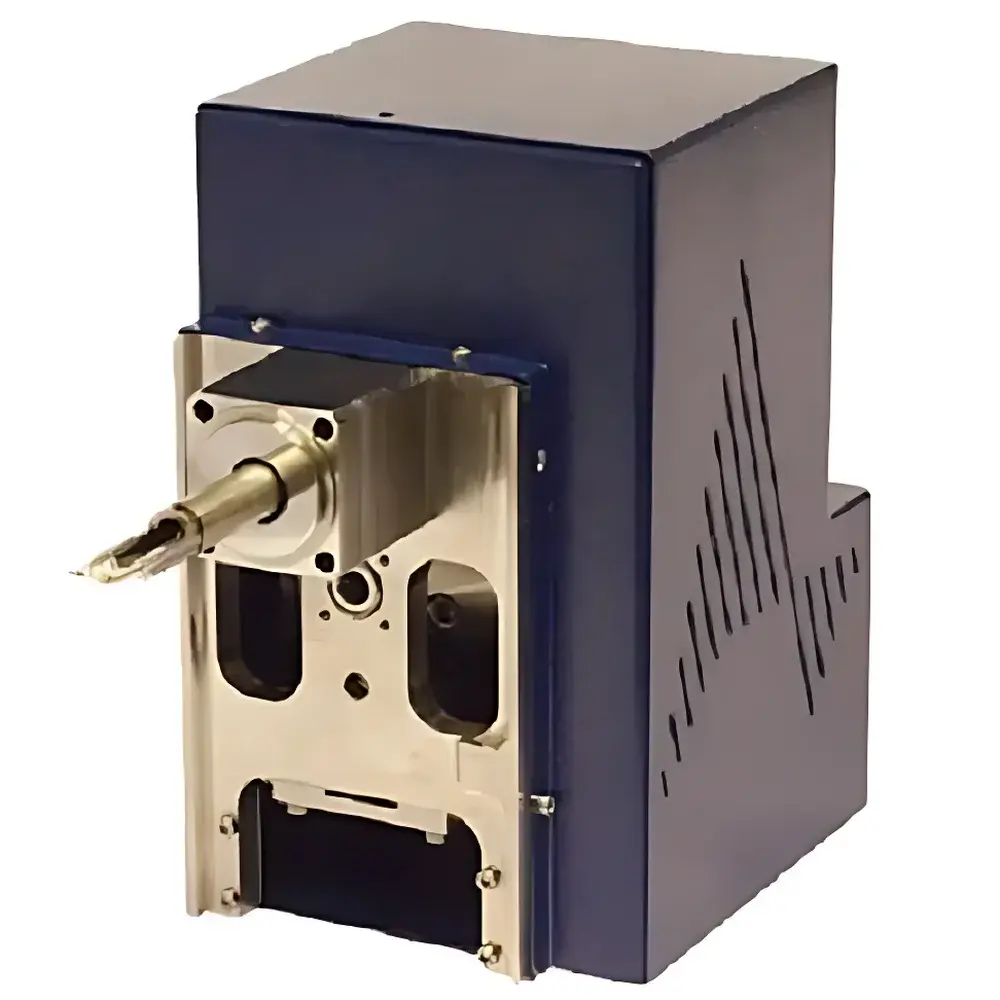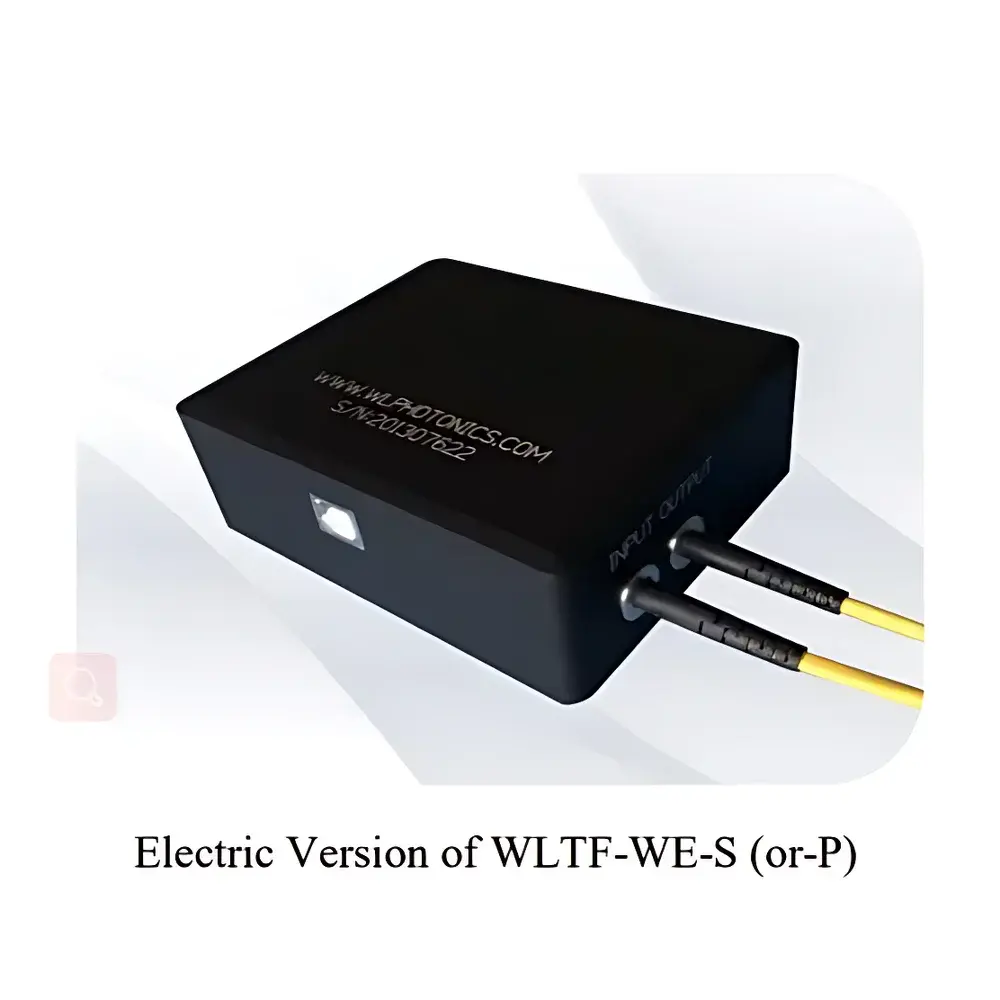
Auniontech WLTF-WM Broadband Fiber-Optic Tunable Filter (1060–1600 nm)
| Brand | Auniontech |
|---|---|
| Model | WLTF-WM |
| Wavelength Range | 1060–1600 nm |
| Tuning Mechanism | Manual micrometer or motorized USB-controlled actuation |
| FWHM Options | 0.2–2.5 nm (selectable by configuration) |
| Insertion Loss | ≤3.0 dB (typ. 1.5–2.0 dB) |
| Polarization-Dependent Loss (PDL) | ≤0.30 dB |
| Wavelength Resolution | 0.01 nm (motorized), 0.02 nm (manual) |
| Optical Power Handling | 500 mW |
| Return Loss | >45 dB |
| Group Delay Ripple | <0.1 ps/nm |
| Extinction Ratio | ≥20 dB |
| Weight | <0.75 kg |
Overview
The Auniontech WLTF-WM is a high-performance broadband fiber-optic tunable filter engineered for precision spectral selection across the 1060–1600 nm wavelength window—spanning the X, O, S, C, and L telecommunication bands as well as key near-infrared research windows. It employs a free-space Fourier-transform architecture based on diffraction grating optics, enabling high-fidelity spectral decomposition and real-time wavelength-selective transmission. Unlike interference-based thin-film or Fabry–Pérot filters, this design delivers inherently flat-top passband profiles with steep roll-off characteristics (>50 dB/nm typical), minimal group delay distortion, and low polarization sensitivity—critical for coherent optical systems, ultrafast pulse shaping, and ASE noise suppression in amplified spontaneous emission environments. The device operates in either manual (micrometer-driven) or motorized (USB-controlled microstepping actuator with encoder feedback) configurations, supporting both laboratory benchtop deployment and integration into automated test platforms compliant with industrial and research-grade optical measurement workflows.
Key Features
- Flat-top passband profile with sharp spectral edges (roll-off >50 dB/nm) ensuring minimal signal distortion in selected channels
- Low insertion loss (≤2.0 dB typical, ≤3.0 dB max) and exceptionally low polarization-dependent loss (PDL ≤0.30 dB)
- High optical power handling capacity up to 500 mW (CW), suitable for high-intensity source conditioning and amplifier output filtering
- Wide tuning range: up to 120 nm per configuration, covering discrete center wavelengths at 1060 nm ±15 nm, 1310 nm ±15 nm, 1550 nm ±20 nm, and 1600 nm ±20 nm
- Multiple resolution options: FWHM bandwidths configurable from 0.2 nm (ultra-narrow) to 2.5 nm (broadband), supporting both dense channel isolation and wideband spectral gating
- Wavelength resolution of 0.01 nm (motorized) or 0.02 nm (manual), with repeatability better than ±0.005 nm over repeated tuning cycles
- Integrated encoder feedback loop in motorized version ensures closed-loop positional control and traceable wavelength calibration
- Return loss >45 dB and extinction ratio ≥20 dB support low-crosstalk operation in bidirectional or reflective optical paths
Sample Compatibility & Compliance
The WLTF-WM is compatible with standard single-mode fiber (SMF-28, HI1060, or similar) pigtails with FC/APC or FC/PC connectors. Its optical architecture maintains polarization stability across the full tuning range, making it suitable for polarization-sensitive applications such as coherent detection, quantum optics experiments, and polarization-multiplexed system characterization. The device complies with IEC 61300-2-4 (fiber optic connector durability), Telcordia GR-1209-CORE (optical filter reliability), and RoHS 2011/65/EU directives. While not certified for medical or aerospace use out-of-box, its mechanical robustness (<0.75 kg mass, aluminum alloy housing), thermal stability (operating temperature: 15–35 °C), and low group delay ripple (<0.1 ps/nm) meet GLP-aligned lab instrument requirements for spectral metrology traceability.
Software & Data Management
Motorized WLTF-WM units include native USB 2.0 interface and come with Windows-compatible control software supporting SCPI command set and DLL-based API integration. The software enables wavelength sweep programming, step-and-hold sequencing, real-time encoder position logging, and synchronization with external instruments (e.g., optical spectrum analyzers or tunable lasers) via TTL triggers. All tuning events—including timestamped wavelength positions, actuator steps, and encoder readings—are recorded in CSV format for audit trail generation. The firmware implements non-volatile memory storage for user-defined calibration offsets, facilitating multi-instrument alignment and long-term reproducibility. For regulated environments, optional firmware upgrade supports FDA 21 CFR Part 11-compliant electronic signatures and audit log encryption upon request.
Applications
- Amplified Spontaneous Emission (ASE) noise filtering in EDFA, YDFA, and TDFAs
- Channel selection and isolation in coarse wavelength division multiplexing (CWDM) systems
- Temporal pulse shaping via spectral phase modulation in femtosecond laser systems
- Reference line filtering for optical coherence tomography (OCT) light sources
- In-line spectral monitoring and feedback control in tunable laser cavities
- Calibration source generation for spectrometer linearity verification (NIST-traceable wavelength points)
- Multi-band optical sensing in distributed fiber sensor networks (e.g., BOTDA/BOTDR)
FAQ
What is the difference between WLTF-WM and WLTF-WE models?
The WLTF-WM denotes the standard broadband tunable filter platform with manual or motorized tuning; WLTF-WE refers to an enhanced variant with extended thermal stability (±0.002 nm/°C drift coefficient) and factory-applied NIST-traceable wavelength calibration certificate.
Can the filter be integrated into a Python-based automation script?
Yes—full SCPI command documentation and Python-compatible DLL libraries are provided with motorized units, including examples for PyVISA and NumPy-based spectral acquisition pipelines.
Is polarization-maintaining (PM) fiber input available?
Standard configurations use SMF pigtails; PM fiber (e.g., PANDA or bow-tie) variants are available as custom orders with aligned slow-axis referencing and specified extinction ratio.
Does the device require periodic recalibration?
No scheduled recalibration is required under normal operating conditions; however, users performing ISO/IEC 17025-compliant measurements may perform annual verification using a calibrated wavemeter or interferometric reference source.
What is the maximum scan speed in motorized mode?
Full 120 nm sweep completes in ≤12 seconds at 0.01 nm step resolution; continuous scanning at reduced resolution (e.g., 0.1 nm steps) achieves up to 50 nm/s linear tuning velocity.
Related Products