
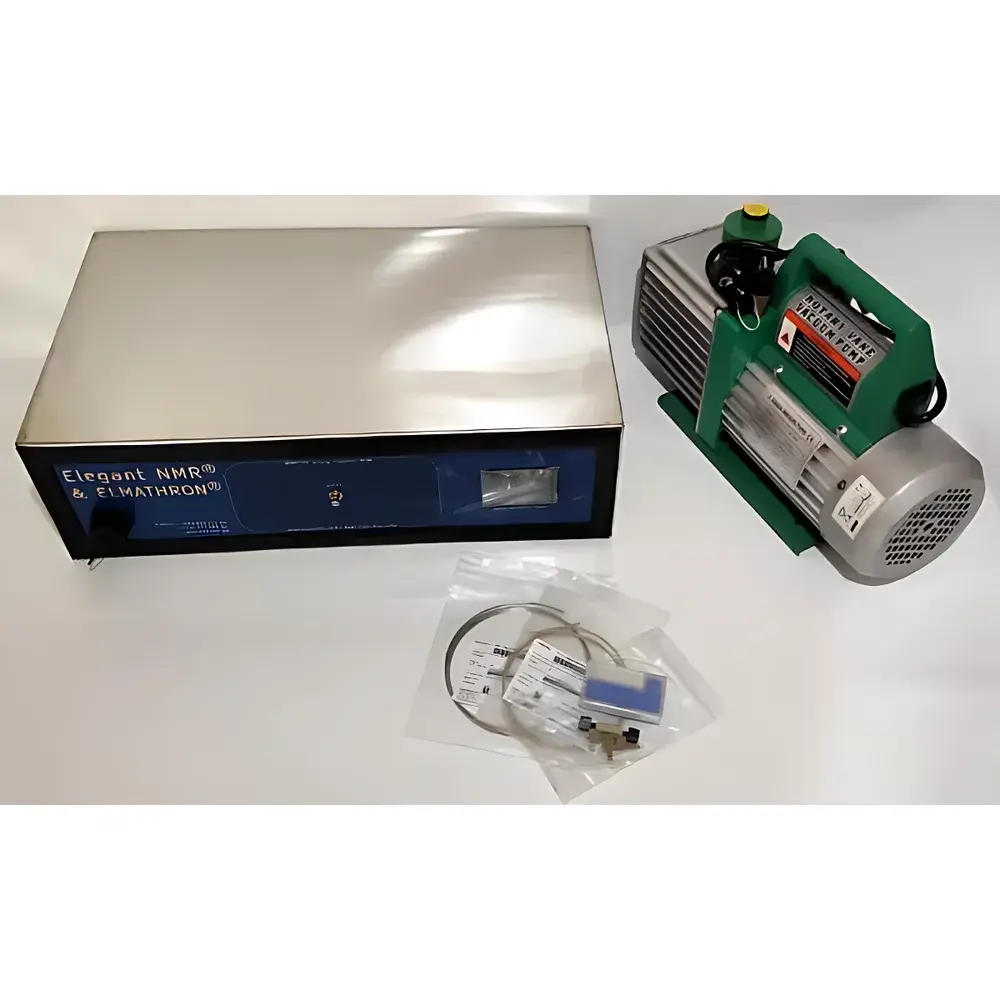
Auniontech Elegant NMR Compact Benchtop Nuclear Magnetic Resonance Spectrometer
| Brand | Auniontech |
|---|---|
| Model | Elegant NMR |
| Magnet Type | Permanent Magnet (1 T) |
| Cooling | Cryogen-Free (No Liquid Helium Required) |
| Dimensions | 50 cm × 30 cm × 15 cm |
| Weight | 18 kg |
| DNP Technology | Integrated Dynamic Nuclear Polarization (US Patent 10,773,092 B2) |
| Field Strength | 1 Tesla |
| Operating Frequency (¹H) | ~42.5 MHz |
| Data Output | Raw FID and Processed Spectra (NMRPipe, Bruker TopSpin compatible formats) |
Overview
The Auniontech Elegant NMR is a cryogen-free, benchtop nuclear magnetic resonance (NMR) spectrometer engineered for high-sensitivity structural analysis of organic molecules, mixtures, and reaction intermediates in solution phase. Unlike conventional high-field superconducting NMR systems requiring liquid helium and complex infrastructure, this instrument leverages low-field (1 T) permanent magnet architecture combined with integrated dynamic nuclear polarization (DNP) to achieve dramatic signal enhancement—up to 400× for 1D spectra and ~10⁵× for multidimensional experiments. The core measurement principle relies on the Zeeman interaction of nuclear spins in a static magnetic field, with RF excitation and detection performed at 42.5 MHz (¹H Larmor frequency). Its compact footprint (0.0225 m³), minimal power consumption (<300 W), and absence of cryogenic maintenance make it suitable for QC labs, academic teaching facilities, and process analytical technology (PAT) environments where space, operational cost, and regulatory traceability are critical constraints.
Key Features
- Integrated DNP source compliant with US Patent 10,773,092 B2 — no external microwave generator required
- Elmathron®-patented focused permanent magnet design ensuring field homogeneity < 0.5 ppm over 10 mm DSV
- Benchtop form factor (50 × 30 × 15 cm; 18 kg) with vibration-damped housing for stable operation on standard lab benches
- Real-time spectral interpretation engine powered by a curated molecular structure database containing >1.7 billion spatial conformers
- Simultaneous multi-component quantification: direct extraction of relative concentrations and pure component spectra from overlapped 2D HSQC/NOESY datasets without physical separation
- Full raw data export (time-domain FID, processed spectra in JCAMP-DX, NMRPipe, and Bruker TopSpin-compatible formats) supporting third-party modeling and ML-based chemometric workflows
- Touch-enabled GUI with preconfigured pulse sequences for 1D ¹H, 2D HSQC, NOESY, and DNP-enhanced experiments
Sample Compatibility & Compliance
The Elegant NMR accepts standard 5 mm NMR tubes (glass or disposable plastic) and supports aqueous and organic solvent systems (CDCl₃, D₂O, acetone-d₆, etc.). It is validated for use with volatile compounds, gases (via sealed microcells), and thermally labile biomolecules due to its non-destructive, non-ionizing measurement mode. The system complies with IEC 61000-6-3 (EMC emission standards) and meets mechanical safety requirements per ISO 13857. While not certified for GMP production environments out-of-the-box, its software architecture supports audit trail logging, user access control, and electronic signature capability—enabling alignment with FDA 21 CFR Part 11 and EU Annex 11 when deployed under documented SOPs. All spectral processing algorithms are deterministic and reproducible, satisfying GLP documentation requirements for method validation.
Software & Data Management
The Elegant NMR Control Suite provides a modular, role-based interface with three operational modes: QuickScan (automated 1D acquisition and library matching), ExpertMode (customizable pulse programming, phase cycling, and gradient calibration), and ResearchMode (raw FID streaming via TCP/IP for integration with Python/Matlab-based analysis pipelines). Spectral libraries are version-controlled and searchable by molecular formula, functional group, or substructure. All processing steps—including Fourier transformation, phasing, baseline correction, peak picking, and multivariate curve resolution (MCR)—are logged with timestamps, operator ID, and parameter sets. Data archives adhere to FAIR principles (Findable, Accessible, Interoperable, Reusable) and support DICOM-NMR extensions for cross-platform metadata exchange.
Applications
This system is routinely deployed in applications demanding rapid, non-invasive compositional insight without sample derivatization or chromatographic separation: real-time monitoring of polymerization kinetics; quantitative assay of pharmaceutical impurities in API batches; authentication of natural product extracts; structural verification of synthetic intermediates in flow chemistry reactors; and metabolite profiling in biofluids. Its DNP-enhanced 2D capabilities enable resolution of overlapping signals in complex mixtures—e.g., distinguishing positional isomers in substituted benzenes or resolving diastereotopic protons in chiral molecules—where conventional 1T NMR would yield unresolved envelopes. The absence of cryogens also facilitates deployment in mobile labs, field-deployable QA units, and undergraduate teaching labs emphasizing hands-on NMR methodology.
FAQ
What is the magnetic field strength in Tesla?
The system employs a permanent magnet delivering a homogeneous 1.0 T field. This low-field configuration is specifically optimized for solution-phase DNP, where microwave irradiation efficiency and spin polarization transfer are maximized below 1.2 T. Signal enhancements of 400× (1D) and up to 10⁵× (2D+) compensate for the intrinsic sensitivity penalty of low-field operation.
Can the system acquire standard 1D ¹H spectra?
Yes. The instrument supports conventional 1D ¹H, ¹³C, ¹⁹F, and ³¹P acquisitions, with optional DNP enhancement. Pulse sequences include single-pulse, inversion-recovery, and CPMG for T₂ relaxation analysis—all fully parameterizable in ExpertMode.
Is an external microwave source required for DNP?
No. The Elegant NMR integrates a solid-state microwave source operating at ~100 GHz, co-located with the sample probe and synchronized to the NMR pulse sequence. This eliminates alignment complexity and ensures optimal polarization transfer efficiency per US Patent 10,773,092 B2.
How does the system resolve components in unknown mixtures without chromatography?
It applies multivariate decomposition to 2D correlation spectra (e.g., HSQC), exploiting subtle chemical shift perturbations induced by solvation or hydrogen bonding. Using constrained iterative algorithms (e.g., MCR-ALS), it resolves pure component spectra and their relative concentrations directly from the raw 2D dataset—bypassing physical separation while preserving stoichiometric integrity.
Related Products




