
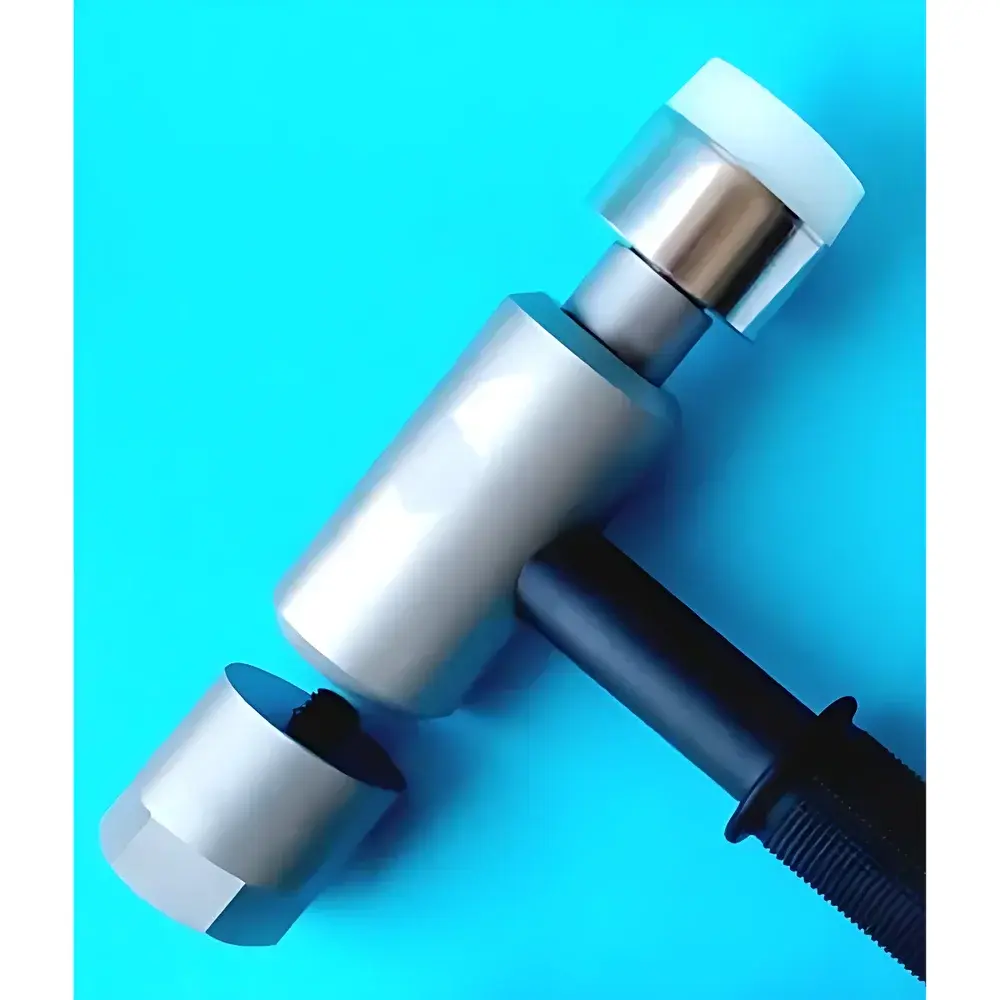
Auniontech IH Series Manual Modal Impact Hammer
| Brand | Auniontech |
|---|---|
| Model | IH Series |
| Type | IEPE-Integrated Manual Impact Hammer for Structural Modal Analysis |
| Origin | Shanghai, China |
| Sensor Technology | Piezoelectric IEPE (Integrated Electronics Piezoelectric) |
| Sensitivity Range | 0.1–100 mV/N |
| Force Range | 50–50,000 N |
| Nonlinearity | ≤1% FS |
| Resonant Frequency | 45–70 kHz |
| Low-Frequency Limit | 0.3 Hz |
| Output Connector | M5 or BNC |
| Hammer Head Mass | 15–1000 g |
| Head Diameter | Φ14–Φ45 mm |
| Hammer Length | 115–400 mm |
| Resolution (rms) | 2–1000 mN |
| Compliance | ASTM E2534, ISO 18431-4, ISO 7626-5, compliant with modal testing workflows per ISO 10816 and ANSI S2.17 |
Overview
The Auniontech IH Series Manual Modal Impact Hammer is an engineered solution for experimental modal analysis (EMA) of mechanical structures, enabling precise excitation and force measurement in vibration-based characterization. Designed around IEPE (Integrated Electronics Piezoelectric) sensor architecture, each hammer integrates a charge-mode piezoelectric force transducer with built-in constant-current signal conditioning—eliminating the need for external amplifiers while ensuring stable, low-noise output over wide dynamic ranges. The device operates on the principle of controlled impulsive excitation: when struck against a test structure, the hammer delivers a short-duration force pulse whose time-domain profile is captured synchronously with structural response (e.g., via accelerometers), allowing computation of frequency response functions (FRFs), mode shapes, natural frequencies, damping ratios, and mechanical impedance. Its calibrated sensitivity, high resonant frequency (>45 kHz), and sub-hertz low-end capability (down to 0.3 Hz) support both high-frequency component-level validation and low-frequency large-structure assessment—making it suitable for applications ranging from micro-machined MEMS devices to civil infrastructure mock-ups.
Key Features
- IEPE-integrated force sensing with factory-calibrated sensitivity (0.1–100 mV/N), traceable to national metrology standards
- Seven interchangeable models (IH-01-1 through IH-50) covering force ranges from 50 N to 50,000 N, enabling scalable excitation across light-weight prototypes and heavy industrial assemblies
- Stainless-steel impact heads with precisely engineered mass (15–1000 g) and diameter (Φ14–Φ45 mm) to control bandwidth and energy transfer characteristics
- Three proprietary tip buffer options (hard, medium, soft) for tailored spectral content—optimizing excitation energy distribution across target frequency bands
- Resonant frequencies up to 70 kHz ensure minimal phase distortion during high-frequency FRF acquisition; low-frequency limit of 0.3 Hz supports rigid-body mode identification
- Nonlinearity ≤1% full scale and rms resolution as low as 2 mN enable repeatable, high-fidelity force quantification under both static preload and dynamic impact conditions
- M5 or BNC output connectors compatible with standard data acquisition systems supporting IEPE bias voltage (18–28 VDC, 2–20 mA)
Sample Compatibility & Compliance
The IH Series supports modal testing of diverse mechanical systems—including metallic and composite plates, beams, housings, turbine blades, PCB assemblies, and automotive subframes—without requiring fixture-induced boundary condition artifacts. Its handheld ergonomics and modular head design allow direct contact excitation on surfaces ranging from polished optical mounts to rough-cast engine blocks. All models comply with international standards governing modal testing practice: ISO 7626-5 (mechanical vibration — calibration of force transducers), ISO 18431-4 (vibration and shock — signal processing — parametric methods), and ASTM E2534 (standard guide for modal testing). Data integrity aligns with GLP/GMP documentation requirements where applicable, and force-time records are fully compatible with traceability frameworks referenced in ISO/IEC 17025-accredited laboratories.
Software & Data Management
Raw IEPE output is directly ingestible by industry-standard modal analysis platforms including Siemens Testlab, Spectral Dynamics ME’scope, LMS Test.Lab, and open-source tools such as Python-based SciPy/NumPy pipelines. Each hammer ships with NIST-traceable calibration certificates listing sensitivity, nonlinearity, frequency response magnitude/phase deviation, and thermal zero shift (<0.5 µV/°C). Timestamped force data supports two-channel coherence validation and ensures compliance with FDA 21 CFR Part 11 when integrated into validated QA/QC environments using audit-trail-enabled DAQ software. Export formats include ASCII, UFF58, and HDF5 for long-term archival and cross-platform interoperability.
Applications
- Experimental modal analysis (EMA) of aerospace components, automotive chassis, and rotating machinery
- Material property extraction (e.g., elastic modulus, loss factor) via inverse FRF techniques
- Vibration signature benchmarking for predictive maintenance and fault diagnostics
- Acoustic resonance mapping of enclosures, speaker diaphragms, and MEMS resonators
- Validation of finite element models (FEM) and operational deflection shape (ODS) analysis
- Shock response spectrum (SRS) generation for environmental qualification testing per MIL-STD-810
FAQ
What is the recommended sampling rate for accurate FRF capture with the IH Series?
For optimal coherence and aliasing avoidance, use ≥5× the highest resonant frequency of interest—typically 100 kS/s minimum for full-bandwidth utilization up to 70 kHz.
Can the hammer be used with non-IEPE DAQ systems?
No—IEPE operation requires constant-current excitation (18–28 VDC); external charge amplifiers are incompatible without signal conditioning modification.
How often should recalibration be performed?
Annual recalibration is recommended per ISO 9001 and ISO/IEC 17025; more frequent verification is advised after mechanical shock or exposure to temperatures beyond –20 °C to +70 °C.
Is the hammer suitable for underwater or vacuum testing?
Standard models are rated IP54; hermetically sealed variants (IH-VAC series) are available for vacuum environments up to 10⁻⁵ mbar; underwater use requires custom encapsulation and pressure compensation.
Does Auniontech provide modal test protocol guidance?
Yes—application notes, ISO-compliant test plans, and MATLAB/Python FRF preprocessing scripts are provided with purchase and accessible via secure customer portal.



