
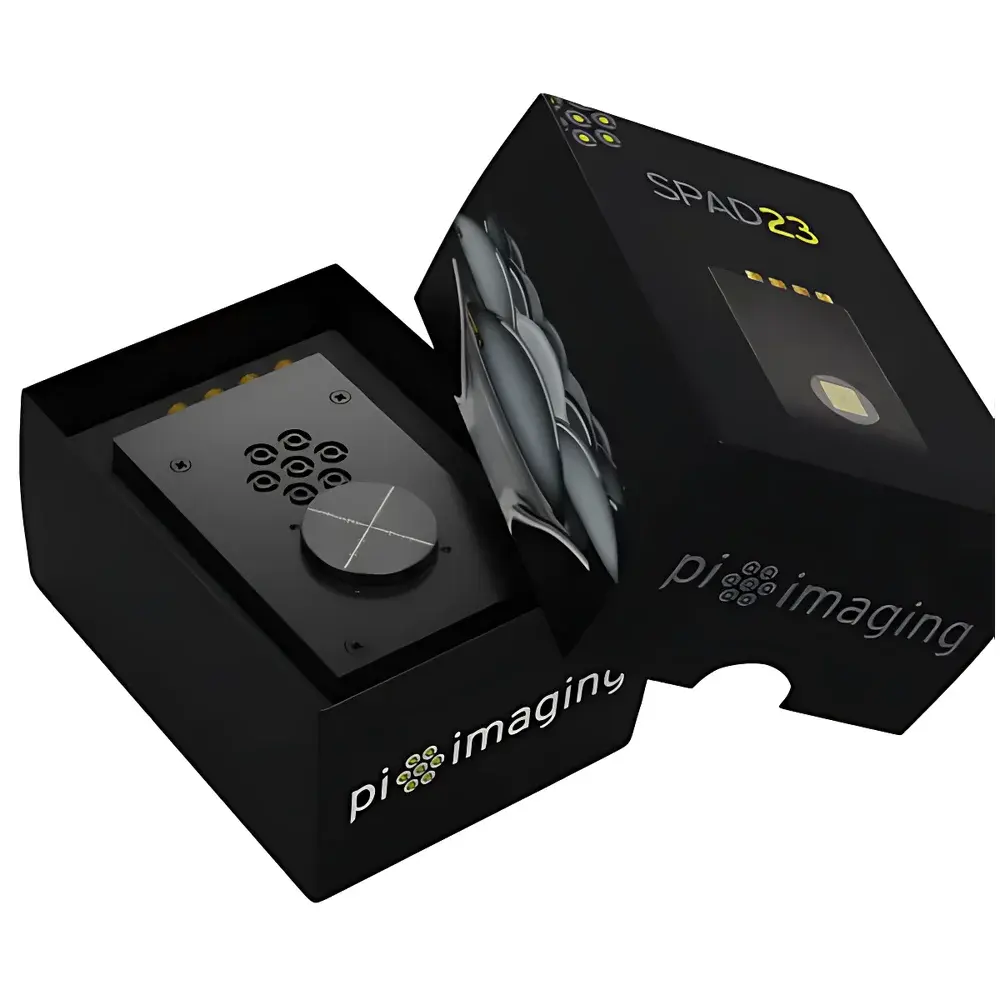
Auniontech SPAD93 Single-Photon Avalanche Diode Array Detector
| Brand | Auniontech |
|---|---|
| Model | SPAD93 |
| Array Size | 93 pixels (hexagonal layout) |
| Peak Detection Efficiency | >45% @ 520 nm |
| Wavelength Range | 440–660 nm |
| Fill Factor (collimated light) | >80% |
| Median Dark Count Rate | <100 cps per pixel |
| Max. Pixel Count Rate | 39.3 Mcps |
| System Throughput (counting mode) | 3.6 Gcps |
| Photon Timing Throughput (timing mode) | 70 Mcps |
| Timing Resolution (TDC) | 20 ps |
| Power Consumption | <2 W |
| Peltier Cooling | Yes |
| Protective Glass Window | Yes |
| Robust Aluminum Enclosure | Yes |
| Trigger Inputs | SMA (dwell clock, line clock, frame clock, laser clock) |
Overview
The Auniontech SPAD93 is a high-performance, monolithic single-photon avalanche diode (SPAD) array detector engineered for time-resolved optical imaging and quantum photonic applications. Built using advanced CMOS-compatible SPAD technology, the device integrates 93 independently addressable pixels arranged in a compact hexagonal lattice—optimized to match the sampling geometry of scanning confocal and super-resolution microscopes. Each pixel incorporates a dedicated time-to-digital converter (TDC), enabling parallel, per-pixel timestamping of photon arrival events with 20 ps resolution. The detector operates on the principle of Geiger-mode avalanche multiplication, delivering deterministic, digital photon detection with sub-nanosecond timing fidelity. Its spectral response (440–660 nm), peak detection efficiency (>45% at 520 nm), and ultra-low median dark count rate (<100 cps/pixel) make it particularly suited for low-flux fluorescence lifetime imaging (FLIM), quantum correlation measurements, and photon-starved scanning modalities such as ISM, Q-ISM, and STED.
Key Features
- 93-pixel hexagonal SPAD array with individual per-pixel TDCs for parallel time-stamping
- 20 ps timing resolution across full array—enabling picosecond-level FLIM and TCSPC reconstruction
- Peak photon detection efficiency exceeding 45% at 520 nm; optimized quantum efficiency within 440–660 nm band
- Median dark count rate <100 cps per pixel—critical for high signal-to-noise ratio in weak-light applications
- On-chip FPGA enables real-time photon event filtering, histogramming, and coincidence logic without host CPU overhead
- Full-system throughput up to 3.6 Gcps in counting mode and 70 Mcps in high-precision timing mode
- Integrated thermoelectric (Peltier) cooling and hermetic metal enclosure ensure thermal stability and long-term operational reproducibility
- USB 3.0 interface (3 Gbps) with TCP/IP server support for remote control and seamless integration into LabVIEW, MATLAB, Python, and OCTAVE environments
- Four synchronized SMA trigger inputs (dwell, line, frame, laser clocks) for precise hardware synchronization with scanning mirrors, pulsed lasers, and galvanometers
Sample Compatibility & Compliance
The SPAD93 is designed for integration into regulated and research-grade optical instrumentation platforms. Its deterministic photon counting behavior, calibrated timing linearity, and stable dark count characteristics support compliance with GLP-aligned data acquisition workflows. While not certified to specific regulatory standards (e.g., ISO/IEC 17025 or FDA 21 CFR Part 11), the detector’s architecture—including persistent timestamp logging, audit-ready binary output formats, and deterministic firmware revision control—facilitates traceability required for method validation in academic, pharmaceutical, and quantum R&D settings. The device meets CE electromagnetic compatibility (EMC) requirements and operates within Class 1 laser safety limits when used with standard confocal excitation sources. Its aluminum housing and protective fused-silica window provide mechanical robustness suitable for benchtop and OEM integration.
Software & Data Management
The SPAD93 ships with a cross-platform SDK supporting Windows, Linux, and macOS. The native API provides low-latency access to raw photon timestamps, per-pixel intensity histograms, and time-gated correlation matrices. All data streams are delivered in memory-mapped binary format compatible with HDF5 and NumPy for scalable post-processing. The included GUI application supports real-time FLIM decay fitting (multi-exponential convolution), ISM point-spread function reconstruction, and second-order intensity correlation (g²(τ)) computation. Remote operation via TCP/IP enables headless deployment in automated microscopy rigs and quantum optics testbeds. Software outputs conform to FAIR principles—data files include embedded metadata (wavelength, exposure, TDC bin width, cooling setpoint) and support standardized interchange formats including Photon-HDF and TCSPC-XML.
Applications
- Super-resolution scanning microscopy: Enables image scanning microscopy (ISM) and quantum ISM (Q-ISM) by resolving sub-diffraction spatial features through pixel-wise photon localization and temporal multiplexing
- Fluorescence lifetime imaging (FLIM): Supports time-correlated single-photon counting (TCSPC) with 20 ps resolution—ideal for metabolic sensing, FRET analysis, and microenvironment mapping in live cells
- Quantum optics characterization: Measures g²(τ) and g³(τ) correlations with minimal inter-pixel crosstalk (<0.5%), enabling verification of non-classical light sources and photon antibunching
- Quantum random number generation (QRNG): Leverages intrinsic quantum randomness of photon arrival times for NIST SP 800-90B-compliant entropy extraction
- Fluorescence correlation spectroscopy (FCS): Delivers high-temporal-bandwidth autocorrelation traces with dead-time-corrected photon statistics
- OEM integration: Compact form factor, low power draw (<2 W), and dual-interface (USB + TCP/IP) simplify incorporation into custom optical systems, including portable FLIM endoscopes and quantum communication terminals
FAQ
What is the maximum sustained photon flux per pixel in timing mode?
Each pixel supports up to 70 Mcps in timing mode—limited by TDC dead time and on-chip histogram memory depth.
Does the SPAD93 support photon-number-resolving (PNR) capability?
Yes—the array implements per-pixel photon counting with overflow detection and supports multi-photon event discrimination via temporal pile-up analysis in post-processing.
Is external cooling required?
No—integrated Peltier cooling maintains optimal junction temperature; ambient air convection suffices for continuous operation.
Can I synchronize the detector with a pulsed laser operating at 80 MHz?
Yes—the SMA laser clock input accepts TTL-compatible signals up to 100 MHz with sub-nanosecond jitter tolerance.
How is calibration traceability maintained across pixels?
Factory calibration includes per-pixel TDC offset maps and DCR baselines; users may perform in-situ uniformity correction using built-in LED flash reference pulses.





