
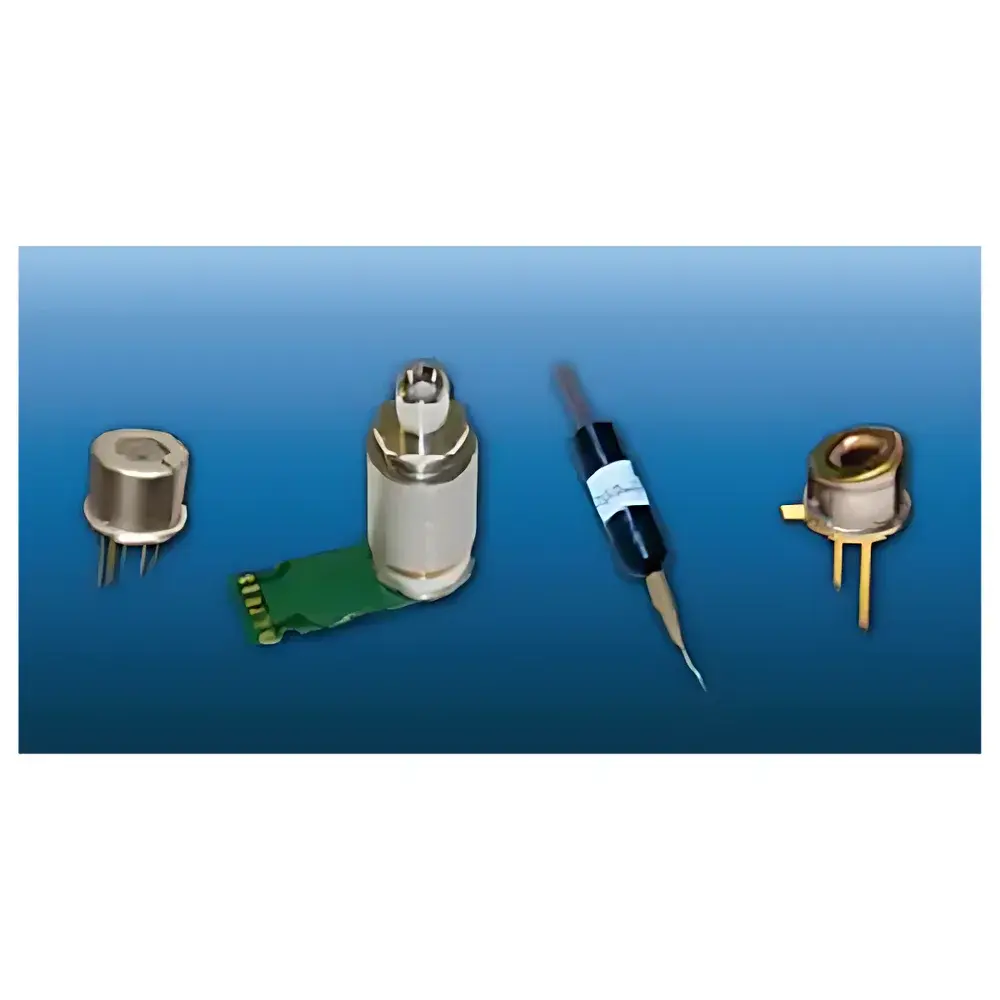
Auniontech CW Mid-IR VCSEL Laser Source (1.2–2.4 µm) for Spectroscopy, Optical Communications & 3D Sensing
| Brand | Auniontech |
|---|---|
| Origin | Shanghai, China |
| Model | CW Mid-IR VCSEL |
| Laser Type | InP-based Buried Tunnel Junction (BTJ) VCSEL |
| Wavelength Range | 1.2–2.4 µm |
| Output Power (QCW) | Up to 8 W (2D array) |
| Single-Mode SMSR | >40 dB |
| Operating Temperature | –40 °C to +90 °C (model-dependent) |
| Threshold Current | Low |
| Power Consumption | 10–20 mW (typical) |
| Beam Profile | Circular, Low Astigmatism |
| Packaging Options | TO-can, fiber-pigtailed, hermetically sealed with AR-coated window |
| Customization | Wavelength, array configuration, drive electronics, and fiber coupling available |
Overview
The Auniontech CW Mid-IR VCSEL Laser Source (1.2–2.4 µm) is a semiconductor-based vertical-cavity surface-emitting laser engineered for precision applications in gas-phase spectroscopy, high-speed optical interconnects, and structured-light 3D sensing. Unlike edge-emitting lasers or quantum cascade lasers (QCLs), this device leverages an InP substrate with a buried tunnel junction (BTJ) architecture—enabling stable, single-longitudinal-mode emission across the technologically critical short-wave infrared (SWIR) to mid-wave infrared (MWIR) transition band. Its fundamental operating principle relies on resonant cavity enhancement of stimulated emission within a monolithic III–V heterostructure (InGaAsP/AlGaInAs layers), where wavelength selection is determined by epitaxial layer thickness and distributed Bragg reflector (DBR) design—not external gratings or temperature tuning alone. This results in intrinsic wavelength stability, low relative intensity noise (RIN), and high side-mode suppression ratio (SMSR >40 dB), making it suitable for absorption spectroscopy requiring sub-picometer spectral resolution and for coherent communication systems demanding narrow linewidth and low chirp.
Key Features
- InP-based BTJ VCSEL architecture enabling continuous-wave (CW) operation from 1278 nm to 2400 nm—covering key absorption lines of H2O, CO, CO2, CH4, NH3, HCl, and other trace gases
- Low threshold current (15%, supporting ultra-low-power system integration (10–20 mW static dissipation)
- Thermally robust design with operational range spanning –40 °C to +90 °C; optional thermoelectric coolers (TEC) available for wavelength-stabilized TDLAS configurations
- Circular, low-divergence output beam (M² <1.3) without external optics—ideal for free-space coupling into spectrometers, interferometers, or photonic integrated circuits
- Scalable 1D and 2D arrays up to 800 emitters (e.g., 1.3 µm QCW array delivering >8 W peak power at 300 µs pulse width)
- Multiple packaging options: industry-standard TO-46/TO-56 cans, fiber-pigtailed modules (SMF-28 or PMF), and hermetic packages with broadband AR coatings (R <0.25% per surface, 1.2–2.4 µm)
Sample Compatibility & Compliance
This VCSEL platform is compatible with standard optical bench setups, fiber-coupled gas cells (e.g., multipass White cells), silicon photonics test platforms (including SiN and SOI waveguides), and CMOS-based SWIR image sensors. All devices are fabricated under ISO 9001-certified processes and meet RoHS Directive 2011/65/EU requirements. For regulated environments—including environmental monitoring stations, pharmaceutical process analytical technology (PAT), and medical device OEM integration—the laser modules support optional traceable calibration certificates aligned with NIST-traceable reference standards. While not inherently FDA 21 CFR Part 11 compliant (as a hardware component), the laser driver and control interface can be configured to support audit trails, electronic signatures, and secure data logging when integrated into GLP/GMP-compliant instrumentation stacks.
Software & Data Management
Auniontech provides vendor-agnostic digital control interfaces including analog current modulation (0–10 V, bandwidth >100 MHz), TTL-triggered pulse mode, and I²C/SPI-configurable registers for real-time bias adjustment. Optional evaluation boards feature onboard temperature monitoring (±0.1 °C accuracy), photodiode feedback, and USB-C connectivity. The accompanying AunionVCSEL Control Suite (Windows/Linux/macOS) enables automated wavelength sweep sequencing, lock-in detection synchronization for TDLAS, and eye-diagram analysis for high-speed modulation validation (up to 53 GBd PAM4). Raw spectral data export supports HDF5 and CSV formats; metadata fields include timestamp, drive current, junction temperature, and calibrated wavelength (via built-in grating reference or external wavemeter input). No proprietary runtime or dongle licensing is required.
Applications
- Tunable Diode Laser Absorption Spectroscopy (TDLAS): Targeting ppm–ppb detection limits in industrial stack emissions, landfill methane monitoring, and breath analysis—leveraging inherent current-tuning coefficients (0.08–0.12 nm/mA) and sub-kHz linewidth for Doppler-free saturation spectroscopy
- High-Speed Optical Interconnects: O-, C-, and L-band transmitters for datacenter intra-rack links (25–100 Gbps NRZ/PAM4), supporting single-mode fiber transmission with extinction ratios >10 dB and jitter <0.3 UI
- 3D Flash LiDAR & Structured Light: High-peak-power 2D VCSEL arrays synchronized with global-shutter SWIR sensors (e.g., InGaAs focal plane arrays) for automotive ADAS, robotics navigation, and biometric authentication under ambient sunlight
- Photonic Integrated Circuit (PIC) Testing: On-wafer probing source for characterizing low-loss SiN waveguides, microresonators, and Mach–Zehnder modulators in the 1.3–1.55 µm telecom windows
- Process Control in Semiconductor Manufacturing: In-situ endpoint detection during dry etching of GaN, SiC, and compound semiconductor wafers using characteristic molecular emission bands
FAQ
What wavelength tolerances are guaranteed for custom-ordered VCSELs?
Standard units are binned to ±1.5 nm at 25 °C; tighter tolerances (±0.3 nm) are available with additional spectral sorting and characterization—quoted separately.
Can these VCSELs be driven directly from commercial laser diode drivers?
Yes—compatible with any constant-current source featuring low-noise (<10 µA RMS) output and compliance voltage ≥2.2 V. Recommended drivers include Thorlabs LDCxx, Wavelength Electronics QCL series, and ILX Lightwave LDC-37x.
Is fiber coupling included as standard or optional?
Fiber pigtail (SMF-28, HI1060, or PM980) is optional and specified at time of order; coupling efficiency is typically 40–60% depending on numerical aperture matching and alignment method.
Do you provide reliability test reports (e.g., HTOL, ESD rating)?
Yes—accelerated life testing (1000 hrs @ 85 °C/85% RH) and human-body-model ESD ratings (±2 kV HBM) are documented per batch in the Certificate of Conformance.
Are there restrictions on export or end-use for these devices?
These VCSELs fall outside EAR99 classification and do not require export licenses for most civil applications; however, end-use verification is required for defense, aerospace, or nuclear-related deployments per U.S. EAR §734.3.





