
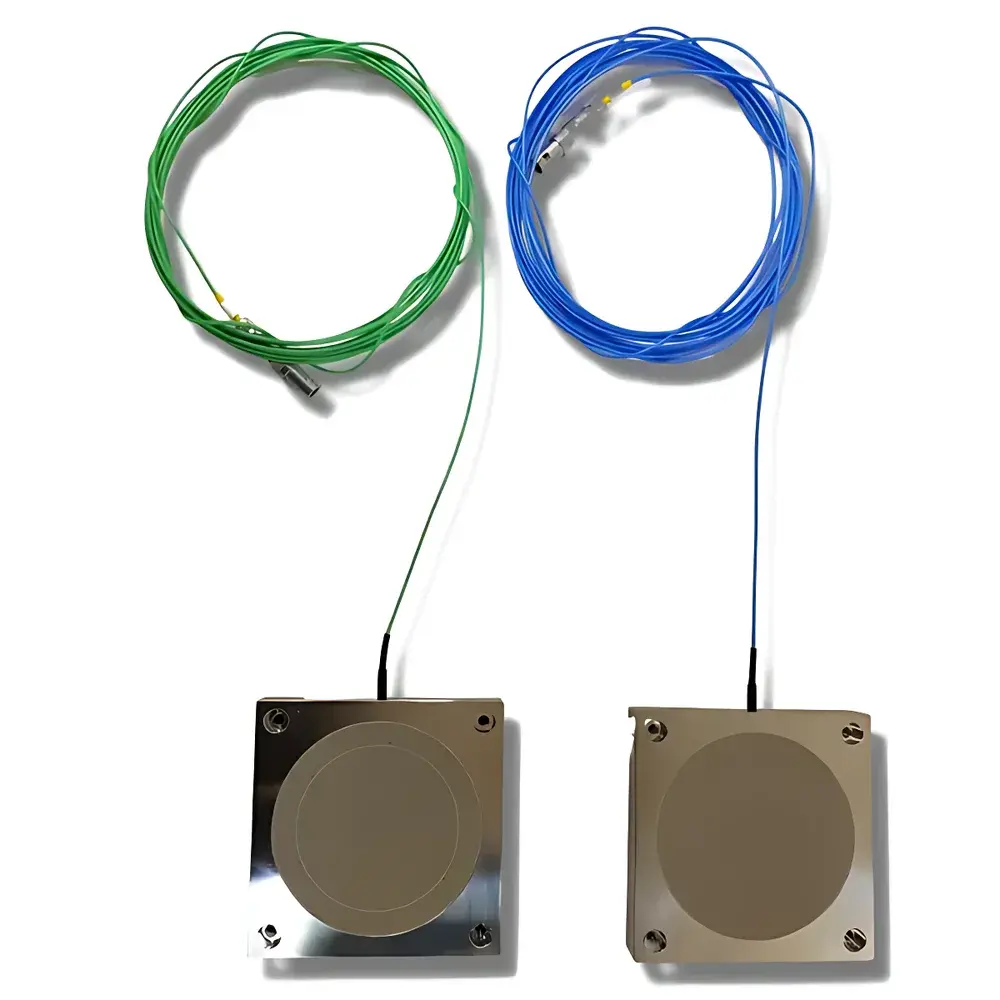
Auniontech AU-NX Series Nanometer-Resolution Capacitive Displacement Sensor
| Brand | Auniontech |
|---|---|
| Model | AU-NX Series |
| Measurement Principle | Capacitive Sensing (Non-contact) |
| Resolution | Down to 7 pm (0.007 nm) |
| Full-Scale Range | Up to 11 mm (AU-NCG-1-AL-UHV) |
| Linearity Error | As low as 0.02% FS |
| Bandwidth | Up to 10 kHz |
| Thermal Drift | As low as 1.5 nm/K (Super Invar/Zerodur variants) |
| Operating Temperature | Sensor –273 °C to +150 °C |
| Probe Material Options | Aluminum, Super Invar, Zerodur, Gold-Plated Alumina Ceramic |
| Compliance | Designed for GLP/GMP-aligned metrology workflows |
Overview
The Auniontech AU-NX Series Nanometer-Resolution Capacitive Displacement Sensor is a high-precision, non-contact position measurement system engineered for sub-nanometer stability and repeatability in demanding optical, metrological, and ultra-precision motion control applications. It operates on the fundamental principle of parallel-plate capacitance variation: a fixed sensor probe and a conductive target form a dynamic capacitor, where minute changes in separation distance (Δd) induce proportional changes in capacitance (ΔC ∝ 1/d). This analog signal is conditioned by a low-noise, high-stability oscillator-demodulator circuit within the dedicated controller unit, enabling real-time conversion into calibrated displacement output. Unlike optical interferometers or eddy-current sensors, capacitive sensing delivers inherently high signal-to-noise ratio at DC and low frequencies, exceptional thermal stability when constructed with low-expansion materials (e.g., Super Invar, Zerodur), and immunity to electromagnetic interference—making it ideal for vacuum-compatible, cryogenic, and vibration-sensitive environments including scanning probe microscopy, adaptive optics alignment, and nanomechanical testing.
Key Features
- Sub-picometer resolution: Achieves 7 pm RMS noise floor (AU-NX models) over 1.25 mm range—enabling detection of atomic-scale surface deformations and piezoelectric actuator hysteresis.
- Multi-material probe architecture: Standard aluminum probes for ambient lab use; Super Invar and Zerodur variants (AU-NZ series) reduce thermal drift to ≤1.5 nm/K—critical for long-duration interferometric alignment or cryostat-integrated measurements.
- Extended-range capability: AU-NCG-1-AL-UHV model supports 11 mm full-scale travel with gold-plated alumina ceramic electrodes, rated for ultra-high vacuum (UHV) and extreme temperatures (–200 °C to +150 °C).
- High dynamic fidelity: 10 kHz bandwidth ensures faithful tracking of rapid mechanical oscillations, such as resonant frequency characterization of MEMS devices or active vibration cancellation loops.
- Zero-mechanical-interaction design: Non-contact operation eliminates stiction, wear, and loading effects—essential for measuring soft biological samples, thin-film stress, or delicate optical coatings.
- Configurable linearity: Optimized electrode geometry and digital linearization algorithms deliver ≤0.02% full-scale linearity error across short-range configurations, meeting ASTM E2548 and ISO 230-2 requirements for precision stage verification.
Sample Compatibility & Compliance
The AU-NX sensor requires a conductive, grounded target surface (e.g., stainless steel, silicon wafers, gold-coated mirrors) with minimum thickness ≥0.5 mm to ensure stable field coupling. Surface roughness should not exceed Ra < 0.1 µm to minimize capacitive fringe-field perturbation. All sensor heads are RoHS-compliant and CE-marked for EMC and LVD directives. Controller units support optional audit-trail logging and user-access-level controls aligned with FDA 21 CFR Part 11 for regulated QC laboratories. Calibration certificates traceable to NIST or PTB standards are available upon request, supporting ISO/IEC 17025 accreditation pathways.
Software & Data Management
Auniontech provides the NX-Control Suite—a Windows-based application supporting real-time waveform capture, FFT spectral analysis, multi-channel synchronization (up to 4 sensors), and export to CSV, HDF5, or MATLAB .mat formats. The SDK includes C/C++, Python, and LabVIEW APIs with full documentation for integration into custom automation platforms (e.g., EPICS, National Instruments DAQmx). All controllers feature USB 2.0 and RS-422 interfaces; optional EtherCAT support enables deterministic hard-real-time feedback in industrial motion systems compliant with IEC 61784-2.
Applications
- Precision metrology: Calibration of laser interferometers, coordinate measuring machines (CMMs), and nanopositioning stages per ISO 230-6.
- Adaptive optics: Closed-loop wavefront correction using deformable mirror position feedback in astronomical and ophthalmic systems.
- Materials science: In-situ strain mapping during nanoindentation, thermal expansion coefficient determination below 4 K, and piezoelectric coefficient (d33) quantification.
- Photonics alignment: Sub-microradian beam steering stabilization and fiber-to-waveguide coupling optimization.
- Quantum instrumentation: Position monitoring of trapped-ion electrodes, superconducting qubit dilution refrigerator stages, and gravitational wave detector suspension systems.
- Industrial QC: Real-time thickness monitoring of deposited films, flatness verification of EUV mask blanks, and wafer edge-profile inspection.
FAQ
What target conductivity and surface finish are required for optimal performance?
A minimum bulk conductivity of 1 × 10⁶ S/m (e.g., aluminum, copper, or gold-plated surfaces) and surface roughness Ra ≤ 0.1 µm are recommended to maintain specified linearity and noise performance.
Can the AU-NX sensor operate inside ultra-high vacuum (UHV) chambers?
Yes—the AU-NCG-1-AL-UHV variant is specifically designed for UHV environments (≤10⁻¹⁰ mbar), featuring ceramic-insulated electrodes, vacuum-compatible adhesives (or adhesive-free Zerodur construction), and outgassing-tested housing materials.
Is temperature compensation included in the controller firmware?
Standard controllers provide fixed-temperature linearization; optional firmware upgrade enables real-time thermal drift correction using integrated Pt100 sensor inputs (available on AU-NZ series with Super Invar/Zerodur probes).
How is traceability maintained during factory calibration?
Each unit undergoes multi-point calibration against a HeNe laser interferometer referenced to a NIST-traceable wavelength standard; full calibration reports include uncertainty budgets per GUM (JCGM 100:2008) and are archived for 10 years.
Does the system support synchronized multi-axis acquisition?
Yes—NX-Control Suite supports hardware-triggered acquisition across up to four independent channels with ≤100 ns inter-channel skew, enabling simultaneous X-Y-Z-θ motion analysis in multi-degree-of-freedom platforms.




