
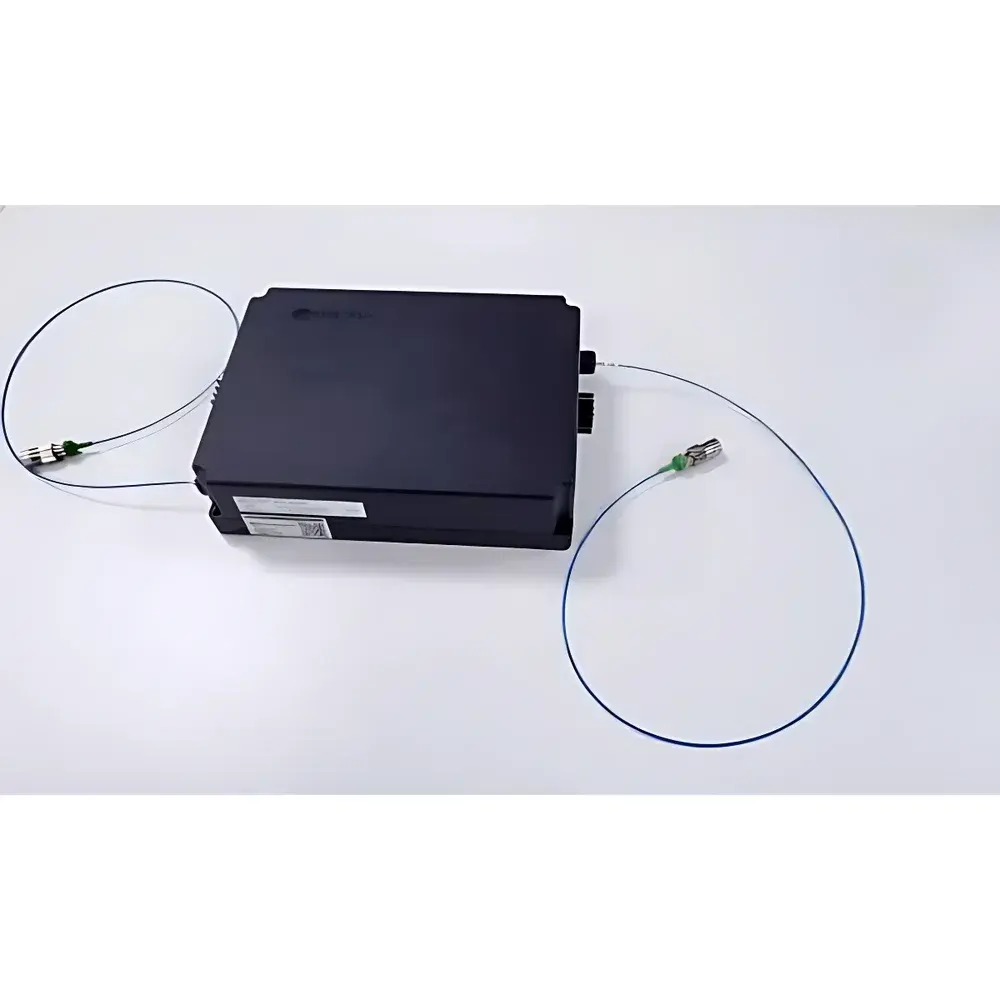
Covesion FCBM Series Fiber-Coupled MgO:PPLN Module
| Brand | Covesion |
|---|---|
| Origin | Shanghai, China |
| Manufacturer Type | Authorized Distributor |
| Product Category | Optical Component |
| Model | Periodically Poled Lithium Niobate (MgO:PPLN) Module |
| Form Factor | Fiber-Coupled Bulk Crystal Module |
| Core Function | Nonlinear Wavelength Conversion |
| Compliance | RoHS-compliant housing, ISO 10110 optical surface specifications, ITU-T G.652.D fiber interface standard |
| Operating Modes | CW and pulsed (fs–ns pulse widths) |
| Temperature Control | Integrated TEC or resistive heater, compatible with Covesion TC-100 series controllers |
| Wavelength Range | 350 nm – 4500 nm (depending on poling period and phase-matching configuration) |
| Applications | SHG, SFG, DFG, OPA, SPDC, quantum light source generation |
Overview
The Covesion FCBM Series Fiber-Coupled MgO:PPLN Module is an engineered nonlinear optical component designed for high-efficiency, phase-matched wavelength conversion in compact, alignment-free configurations. Built around single-domain, stoichiometric MgO-doped lithium niobate (MgO:PPLN) crystals with precisely fabricated periodic poling gratings, the module leverages quasi-phase-matching (QPM) to enable broadband parametric interactions across the visible to mid-infrared spectrum. Unlike free-space PPLN setups requiring active beam stabilization and precision angular tuning, the FCBM integrates input/output single-mode fibers (typically SMF-28 or PM980, customizable) directly onto the crystal facet via ultra-low-loss fusion splicing and AR-coated collimation optics. This architecture eliminates sensitivity to mechanical drift and environmental vibration—critical for long-term operation in OEM instrumentation, quantum photonics platforms, and field-deployable spectroscopic systems. The module operates under thermally stabilized conditions, with temperature-dependent phase-matching bandwidths typically <1 °C full-width at half-maximum (FWHM), ensuring reproducible conversion efficiency over extended duty cycles.
Key Features
- Fiber-coupled architecture with <0.5 dB insertion loss per interface (measured at 1064 nm)
- Customizable poling periods (Λ = 4.5–32 µm) enabling tailored phase-matching for SHG, SFG, DFG, OPA, and SPDC processes
- Integrated thermoelectric cooler (TEC) or resistive heater with ±0.05 °C thermal stability, compatible with Covesion TC-100 temperature controller and PID firmware
- Hermetically sealed, passivated aluminum housing meeting IP52 environmental rating for lab and light industrial use
- Input/output fiber options include polarization-maintaining (PM), ultra-low NA, or dispersion-compensated variants
- Pre-aligned and factory-verified for specified pump/signal/idler wavelengths; no user alignment required
- Supports both continuous-wave (CW) and pulsed excitation (repetition rates from single-shot to 100 MHz, pulse durations from 50 fs to 10 ns)
Sample Compatibility & Compliance
The FCBM module is compatible with industry-standard single-mode and polarization-maintaining fibers adhering to ITU-T G.652.D and G.657.A1 specifications. All optical surfaces conform to ISO 10110-7 scratch-dig standards (20–10), and anti-reflection coatings are optimized for target wavelength bands (e.g., R < 0.2% @ 1064/532 nm for SHG modules). The housing meets RoHS Directive 2011/65/EU and REACH Regulation (EC) No. 1907/2006. For regulated environments—including GLP-compliant quantum optics labs or medical device R&D—the module supports optional audit-ready calibration reports traceable to NIST-certified power meters and wavemeters. While not a standalone medical or safety-certified device, it complies with IEC 60825-1:2014 Class 1 laser product requirements when integrated into properly interlocked host systems.
Software & Data Management
No embedded firmware or onboard software is present—the FCBM is a passive, analog optical component. However, integration with Covesion’s TC-100 temperature controller enables serial (RS-232/USB) or analog (0–5 V) interface for remote setpoint control and real-time temperature monitoring. Controller logs include timestamped thermal profiles and error flags (e.g., TEC current limit, sensor open-circuit), exportable as CSV for traceability. When deployed in automated test benches, the module interfaces seamlessly with LabVIEW, Python (PyVISA), or MATLAB via standard SCPI commands—supporting scheduled thermal ramping, dwell sequencing, and synchronized data acquisition with power meters or spectrometers. Audit trails comply with FDA 21 CFR Part 11 requirements when used with validated third-party DAQ software.
Applications
- Second-harmonic generation (SHG) of 1064 nm lasers to 532 nm (e.g., 125 mW output demonstrated with 500 mW input, >25% conversion efficiency)
- Optical parametric amplification (OPA) for tunable IR sources (1.4–4.5 µm) in gas sensing and molecular fingerprinting
- Spontaneous parametric down-conversion (SPDC) for heralded single-photon pair generation in quantum key distribution (QKD) and Bell-state measurement setups
- Sum- and difference-frequency generation (SFG/DFG) in ultrafast spectroscopy for coherent anti-Stokes Raman scattering (CARS) and mid-IR pump-probe experiments
- OEM integration into portable fluorescence lifetime analyzers, atomic clock reference lasers, and chip-scale frequency combs
FAQ
What fiber types can be integrated into the FCBM module?
Standard configurations use SMF-28 or PM980 fiber; custom options include HI1060, LMA-10, or fluoride fibers for UV/mid-IR extension.
Is polarization control supported?
Yes—PM-fiber-coupled variants maintain extinction ratios >20 dB over operating temperature range; non-PM versions require external polarization management.
Can the module operate without active temperature control?
Phase-matching is highly temperature-sensitive; uncontrolled operation results in >90% efficiency drop within ±0.3 °C deviation—TEC or heater integration is strongly recommended.
What is the typical damage threshold?
For CW operation: 1 MW/cm² (measured at 1064 nm, 100 µm beam diameter); for pulsed operation: 0.5 J/cm² (10 ns, 10 Hz, 1064 nm).
Do you provide spectral response data for custom poling periods?
Yes—upon request, we supply calculated phase-matching curves (Δk vs. T, λ) and measured conversion efficiency maps derived from Sellmeier equation fits and experimental validation.



