
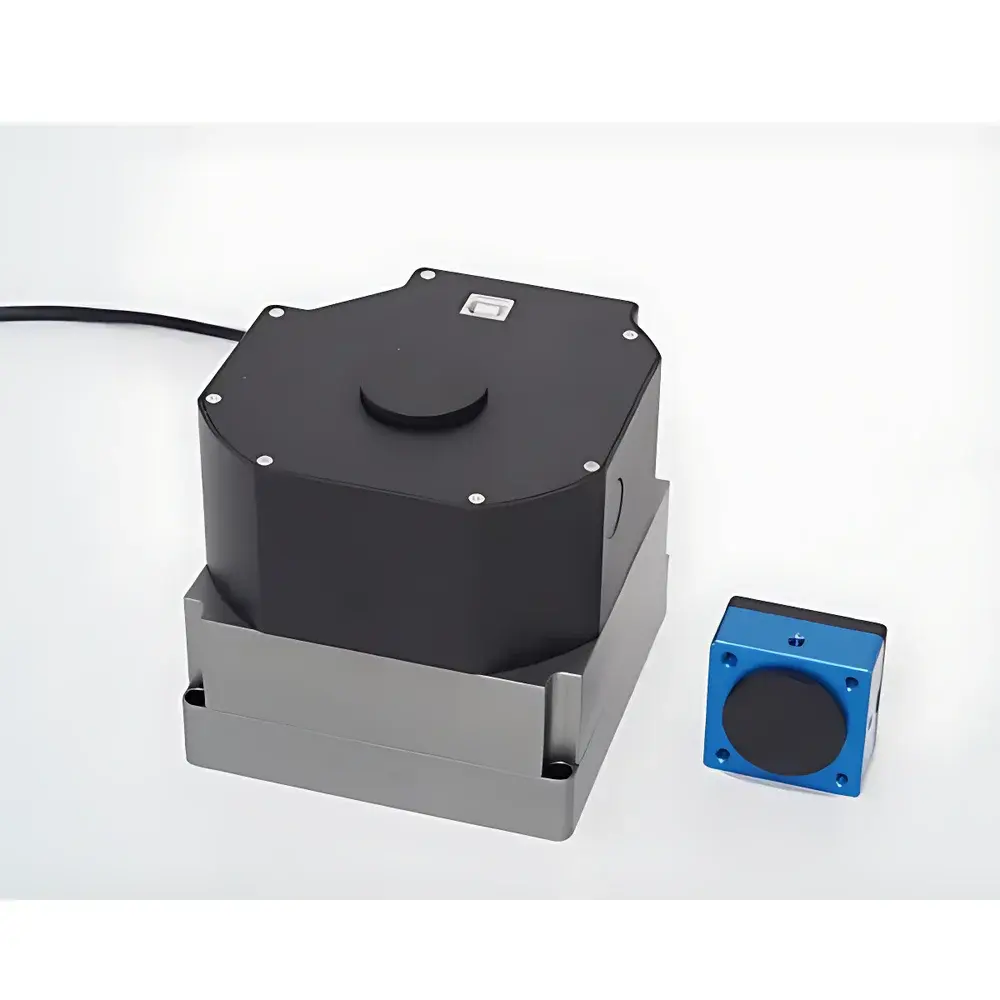
Cinogy INSIDE PowerCube Series Near-Field & Focus Beam Profiler
| Brand | Cinogy |
|---|---|
| Origin | Germany |
| Model | PowerCube Series Beam Profiling System |
| Wavelength Range | 200–1600 nm |
| Minimum Measurable Beam Diameter | >10 µm |
| Maximum Power Handling | 500 W |
| Dimensions | 100 × 100 × 85 mm (standard) / 100 × 100 × 93 mm (with power meter) |
| Detector | High-Performance CinCam CMOS/InGaAs Sensor |
| Interface | USB 2.0 / USB 3.0 / GigE |
| Cooling Options | Air-Cooled or Water-Cooled |
| Software | RayCi v5.x with M², Rayleigh Range, Divergence, Beam Waist, Stability, Encircled Energy (EF), and Power/Energy Integration Modules |
Overview
The Cinogy INSIDE PowerCube Series Near-Field & Focus Beam Profiler is an integrated, compact optical measurement instrument engineered for high-fidelity characterization of laser beams both in the near-field (immediately after the output aperture or collimator) and at the focal plane. Based on calibrated camera-based beam profiling principles—employing pixel-resolved intensity mapping and centroid-based spatial moment analysis—the system delivers quantitative, traceable metrics essential for laser development, optical alignment validation, and industrial process control. Unlike scanning-slit or knife-edge profilers, the PowerCube leverages direct-imaging methodology with high dynamic range and sub-pixel interpolation algorithms to resolve beam features down to >10 µm while maintaining linearity across five orders of magnitude in irradiance. Its dual operational capability—simultaneous acquisition of spatial profile and total power/energy—is achieved via synchronized sensor readout and calibrated photodiode integration (in the power-meter variant), eliminating sequential measurement errors common in hybrid setups.
Key Features
- Compact monolithic architecture: 100 × 100 × 85 mm footprint (standard); optimized for integration into OEM laser heads, fiber coupling stations, and cleanroom-compatible optical tables.
- Wide spectral coverage: Interchangeable sensor modules support UV (200 nm), visible, NIR, and SWIR (up to 1600 nm) with quantum efficiency >70% across primary laser bands (e.g., 405 nm, 532 nm, 780 nm, 1064 nm, 1550 nm).
- High-power resilience: Water-cooled variant enables continuous-wave (CW) operation up to 500 W without thermal drift; air-cooled configuration supports up to 100 W with active ambient stabilization.
- Real-time metrology: Full-frame acquisition at ≥60 fps (USB 3.0/GigE), enabling beam stability monitoring (intensity RMS <0.5% over 1 h) and pulse-to-pulse analysis for quasi-CW and modulated sources.
- Traceable calibration: Factory-calibrated against NIST-traceable standards for beam width (ISO 11146-1:2022 compliant), power (IEC 61228), and M² (ISO 11146-2:2022), with certificate of conformity supplied.
Sample Compatibility & Compliance
The PowerCube accommodates free-space Gaussian, multimode, top-hat, and structured beams—including high-NA focused spots from aspheric lenses and fiber outputs (SMF, MMF, LMA). It complies with ISO 11146-1/2 for second-moment beam width (D4σ), knife-edge equivalent diameter, and M² determination. For regulated environments, RayCi software supports audit trails, electronic signatures, and user access levels aligned with FDA 21 CFR Part 11 requirements. All hardware meets CE, RoHS, and IEC 61000-6-3 EMC immunity standards. Calibration intervals are defined per ISO/IEC 17025:2017 guidelines, with optional annual recalibration services available through authorized Cinogy service centers in Europe and North America.
Software & Data Management
RayCi v5.x provides a deterministic, scriptable interface for beam analysis and automation. Core modules include real-time profile visualization, temporal averaging, beam propagation modeling (based on ABCD matrix formalism), and automated M² scan sequencing per ISO 11146-2. Export formats include HDF5 (for MATLAB/Python post-processing), CSV (with metadata headers), and PDF reports embedding raw data, statistical summaries, and pass/fail thresholds. The software supports LabVIEW, Python (via PyCinogy SDK), and .NET APIs for integration into custom QC workflows or PLC-controlled manufacturing lines. Audit logs record all parameter changes, measurement timestamps, and operator IDs—enabling full GLP/GMP traceability.
Applications
- Laser diode and fiber laser qualification: M² verification, focusability assessment, and thermal lensing evaluation under load.
- Optical component testing: Quantifying aberrations introduced by lenses, beam expanders, and spatial light modulators via comparative near-field/far-field analysis.
- Additive manufacturing process monitoring: In-situ beam shape and power consistency validation prior to powder bed interaction.
- Medical laser system certification: Compliance testing for dermatology, ophthalmology, and surgical platforms per IEC 60601-2-22.
- Ultrafast optics characterization: Pulse energy distribution mapping and hot-spot detection in amplified Ti:sapphire and Yb-doped systems.
FAQ
Does the PowerCube require external beam attenuation for high-power lasers?
Yes—while the water-cooled detector head tolerates up to 500 W CW, appropriate neutral density filters or reflective attenuators must be used upstream to avoid saturation or damage to the sensor surface. Attenuation ratios are logged automatically in RayCi when calibrated ND filters are selected.
Can M² be measured without moving the profiler along the propagation axis?
No—M² determination per ISO 11146-2 requires at least ten axial measurements across the Rayleigh range. The PowerCube supports motorized stage integration via RS-485 or TTL triggers, with RayCi automating position synchronization and data stitching.
Is the system compatible with vacuum or inert-gas environments?
The standard enclosure is rated IP40 for ambient lab use. A hermetically sealed variant with CF-flange mounting and sapphire window option is available for vacuum chambers (≤10⁻⁶ mbar) and nitrogen-purged enclosures.
How is pixel calibration verified during routine operation?
RayCi includes a built-in grid pattern generator and auto-alignment routine using a reference pinhole source. Users may execute daily verification per internal SOPs, with results archived alongside production data.
What is the uncertainty budget for beam diameter measurement at 1064 nm?
At 1064 nm, with optimal signal-to-noise ratio (>50 dB), the expanded uncertainty (k=2) for D4σ width is ±1.2% (including pixel pitch tolerance, lens distortion correction, and interpolation algorithm variance), as documented in the calibration certificate.




