
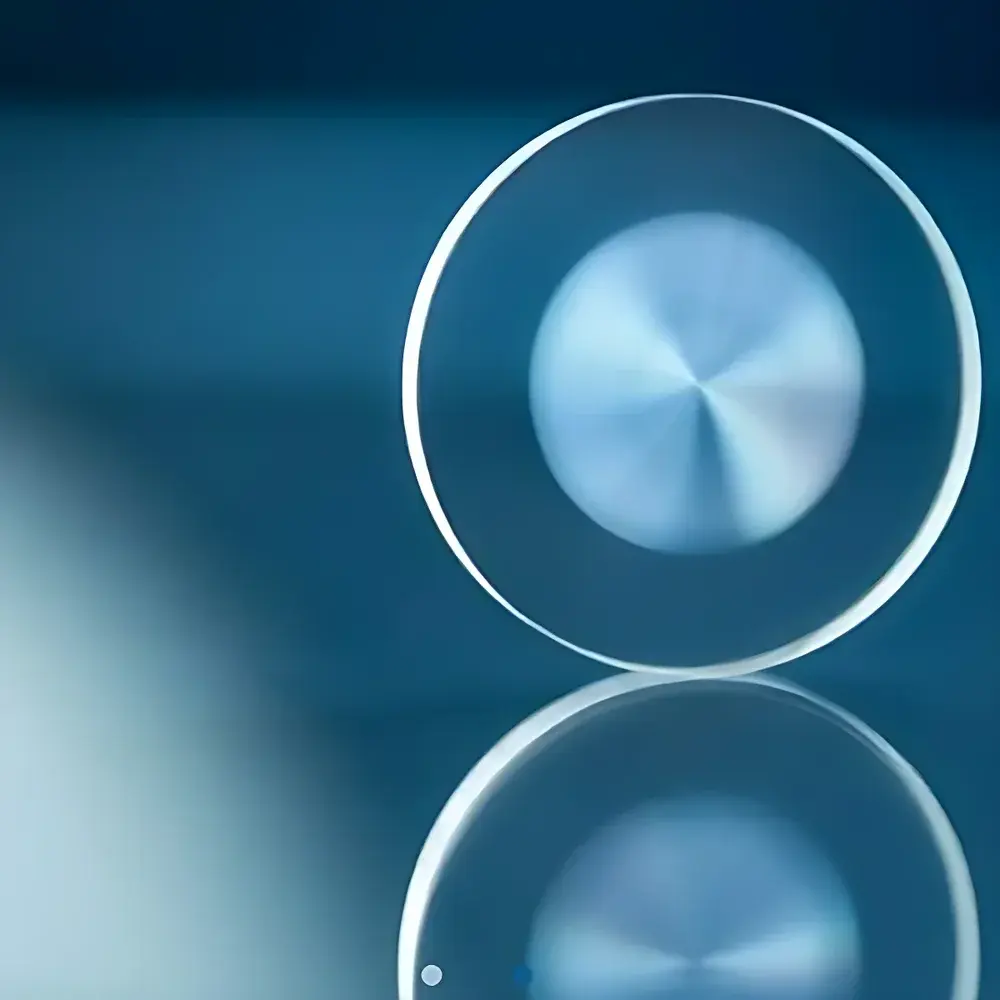
Auniontech Circular Grating / Planar Axicon Lens
| Brand | Auniontech |
|---|---|
| Material | UV-Fused Silica (UVFS) & IR-Fused Silica (IRFS) |
| Wavelength Range | 330–2000 nm |
| Apex Angle Tolerance | 176–179.9° @ 1030 nm |
| Diffraction Efficiency | Up to 95% |
| Clear Aperture | Up to 15 mm |
| LIDT | 63 J/cm² @ 1064 nm, 10 ns pulse |
| Transmission (uncoated) | 85% @ 343 nm, 92% @ 515 nm, 94% @ 1030 nm |
| Cone Tip Diameter Uncertainty | ~20 µm |
| Polarization Sensitivity | Yes (birefringent nanograting embedded in bulk substrate) |
| Optional Coating | Broadband AR/AR on both surfaces |
Overview
The Auniontech Circular Grating / Planar Axicon Lens is a monolithic, polarization-sensitive diffractive optical element engineered for high-fidelity conversion of Gaussian laser beams into non-diffracting Bessel–Gaussian beams. Unlike conventional axicons based on refractive or reflective geometry, this device leverages a sub-wavelength birefringent nanograting structure permanently inscribed within the bulk of high-purity fused silica—eliminating surface-relief limitations and enabling exceptional laser-induced damage threshold (LIDT) performance. Its operational principle relies on spatially varying form birefringence, where the local fast-axis orientation rotates continuously along a circular path across the aperture. This design allows deterministic generation of co-propagating positive- and negative-order Bessel–Gaussian beams with orthogonal circular polarizations (LHCP and RHCP), as well as simultaneous dual-cone output under linear input polarization—effectively integrating three functional axicon modes into a single planar substrate.
Key Features
- Monolithic fused silica architecture: Nanograting embedded in UVFS or IRFS substrate ensures mechanical robustness, thermal stability, and compatibility with ultrafast and high-average-power laser systems.
- Triple-mode beam shaping: Generates positive-order (LHCP), negative-order (RHCP), and dual-cone (linear polarization) Bessel–Gaussian outputs from a single incident beam—enabling flexible experimental configuration without optical realignment.
- High laser damage resistance: Certified LIDT of 63 J/cm² at 1064 nm (10 ns pulses) and 2 J/cm² at 1030 nm (212 fs pulses), exceeding conventional coated axicons and supporting industrial micromachining applications.
- Planar form factor: Zero thickness profile eliminates chromatic aberration, simplifies mounting in multi-element beam paths, and reduces alignment sensitivity compared to bulk conical lenses.
- Broad spectral coverage: Optimized performance from deep UV (330 nm) to near-IR (2000 nm); transmission exceeds 94% at 1030 nm without anti-reflection coating.
- Polarization-encoded functionality: Fast-axis distribution is precisely mapped and verified via Hinds MicroImager, ensuring reproducible polarization-dependent response traceable to NIST-traceable calibration standards.
Sample Compatibility & Compliance
The device is compatible with continuous-wave (CW), nanosecond, picosecond, and femtosecond laser sources operating within its specified wavelength and fluence limits. It complies with ISO 10110-7 (surface imperfections), ISO 10110-3 (transmission homogeneity), and MIL-PRF-13830B (scratch-dig). When integrated into regulated environments—including ISO 13485-certified medical device manufacturing or FDA-regulated laser processing lines—the component supports full documentation traceability (material lot, interferometric verification report, LIDT test logs). Its uncoated fused silica interface meets USP particulate requirements for cleanroom-compatible optical handling.
Software & Data Management
While the element itself is passive, integration with beam profiling systems (e.g., Ophir Pyrocam, DataRay WinCamD) enables quantitative validation of Bessel beam propagation length, central lobe diameter, and side-lobe suppression ratio. Auniontech provides Zemax OpticStudio and MATLAB-compatible parameter files (including measured phase map and polarization retardance distribution) for predictive modeling. All delivered units include a digital certificate of conformance containing interferometric wavefront error data (<λ/10 PV over clear aperture), apex angle metrology report (measured via autocollimator + goniometer), and polarization-resolved diffraction efficiency curves.
Applications
- High-aspect-ratio microdrilling in transparent dielectrics (e.g., fused silica, sapphire, BK7), leveraging extended depth-of-focus Bessel beams to maintain sub-micron feature fidelity over millimeter-scale penetration depths.
- Ultrafast laser material processing requiring minimal thermal diffusion, including selective glass modification for photonic device fabrication and waveguide inscription.
- Optical trapping and manipulation of micron-scale particles in dual-beam Bessel configurations for longitudinal force calibration and axial confinement studies.
- Generation of structured illumination patterns in super-resolution microscopy (e.g., SIM, lattice light-sheet), where polarization multiplexing enables independent control of excitation and depletion channels.
- High-efficiency Bragg grating inscription in photosensitive fibers, utilizing uniform axial intensity distribution to achieve >90% reflectivity with single-shot exposure.
FAQ
What distinguishes this planar axicon from traditional refractive axicons?
It replaces bulk conical geometry with a polarization-encoded nanograting structure in fused silica—eliminating spherical aberration, enabling polarization-selective beam shaping, and achieving significantly higher LIDT due to absence of surface coatings or interfaces.
Can it be used with femtosecond lasers?
Yes—certified for 212 fs pulses at 1030 nm; dispersion compensation may be required for pulses <100 fs depending on system bandwidth and desired Bessel length.
Is custom aperture size or wavelength optimization available?
Auniontech offers OEM customization including apertures up to 25 mm, substrate material selection (UVFS, IRFS, CaF₂), and AR coating design for specific laser lines (e.g., 355 nm, 515 nm, 1550 nm).
How is polarization alignment performed during installation?
A reference mark indicating the 0° fast-axis orientation is laser-etched on the edge; alignment is verified using a rotating quarter-wave plate and polarimeter or by imaging the first-order Bessel ring asymmetry.
Does the device require recalibration over time?
No—being a monolithic, radiation-hardened fused silica component with no moving parts or hygroscopic layers, it exhibits zero drift under standard laboratory conditions (20–25°C, 30–60% RH).






