
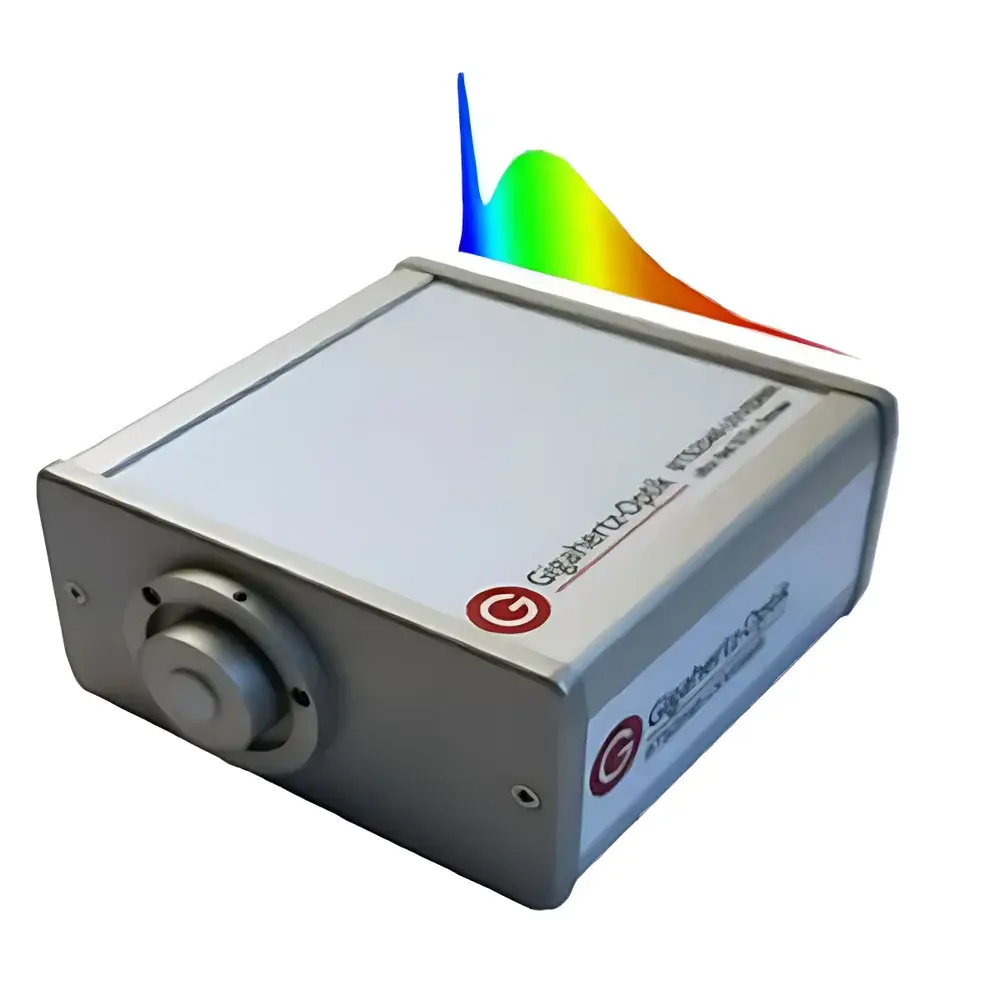
Gigahertz Optik BTS2048 Series Spectroradiometer
| Brand | Gigahertz Optik |
|---|---|
| Origin | Germany |
| Model | BTS2048 Series |
| Light Source Compatibility | Xenon, Mercury, and IR Sources |
| Calibration Traceability | ISO/IEC 17025 Accredited |
| Compliance Standards | CIE 15, CIE S025, IES LM-79-08, TM-30-18 |
| Detector Type | Back-thinned CCD with thermoelectric cooling |
| Stray Light Suppression | Dual-filter + matrix correction (equivalent to double monochromator performance) |
| Dynamic Range | >10⁶ (via electronic integration time control + mechanical filter wheel option) |
| Trigger Interface | TTL-compatible external trigger input/output for pulse-synchronized measurement |
| Shutter | Electronic global reset (<10 ns pixel zeroing) |
| Operating Temperature Stability | ±0.1 °C active stabilization |
| Enclosure | IP54-rated optional outdoor housing |
Overview
The Gigahertz Optik BTS2048 Series Spectroradiometer is a high-precision, traceable instrument engineered for absolute spectral radiance and irradiance measurements across the UV-VIS-NIR spectrum (200–1100 nm). It operates on the principle of array-based spectroradiometry, utilizing a back-thinned, thermoelectrically cooled CCD detector coupled with a high-fidelity Czerny-Turner optical bench. Unlike scanning monochromators, the BTS2048 acquires full spectral data in a single exposure—enabling accurate characterization of transient light sources such as pulsed LEDs, flash lamps, and modulated laser diodes. Its design addresses fundamental metrological challenges in photometric and radiometric validation: linearity over six orders of magnitude, stray light rejection at levels comparable to double monochromators, and temporal synchronization fidelity required for time-resolved photometry. The system is built around a modular optical interface architecture, allowing direct mechanical coupling to integrating spheres, goniophotometers, collimators, and fiber-optic adapters—eliminating coupling losses and alignment drift associated with flexible light guides.
Key Features
- Back-thinned CCD sensor with Peltier temperature stabilization (±0.1 °C), ensuring low dark current and long-integration stability for low-flux applications
- Electronic global shutter with sub-10 ns pixel reset capability—essential for flash photometry and pulse-synchronized LED testing
- Dual-stage stray light suppression: interference bandpass filtering combined with proprietary matrix-based stray light correction algorithm
- Wide dynamic range (>10⁶) achieved via software-controlled integration time (1 ms to 60 s) and optional motorized filter wheel for extended attenuation
- TTL-compatible trigger I/O for precise synchronization with external pulse generators, power supplies, or test fixtures
- Integrated reference photodiode channel enabling real-time responsivity monitoring and in-situ drift compensation
- Rugged aluminum chassis with optional IP54-rated enclosure for semi-outdoor or industrial laboratory deployment
Sample Compatibility & Compliance
The BTS2048 Series is validated for use with broadband and narrowband sources including xenon arc lamps, mercury-vapor lamps, halogen standards, and infrared emitters (up to 1100 nm). Its calibration is traceable to national metrology institutes via Gigahertz Optik’s ISO/IEC 17025-accredited calibration laboratory—ensuring compliance with international photometric standards including CIE 15:2018 (Colorimetry), CIE S025/E:2015 (LED measurement), IES LM-79-19 (Electrical and Photometric Measurements of Solid-State Lighting Products), and ANSI/IES TM-30-20 (Method for Evaluating Light Source Color Rendition). The system supports GLP/GMP-relevant workflows through audit-trail-capable software logging and user-accessible calibration certificate archives. Mechanical interface standardization (e.g., SMA905, M32×0.75, and custom flange mounts) ensures repeatable coupling to auxiliary optics without recalibration.
Software & Data Management
BTS2048 operation is managed via the proprietary BTScontrol software suite, which provides full instrument control, spectral acquisition, and post-processing in accordance with CIE and IES reporting conventions. Key functionalities include automated dark-signal subtraction, nonlinearity correction (f₃ error < 0.1%), and uncertainty propagation per GUM (Guide to the Expression of Uncertainty in Measurement). Raw spectral data are exported in standardized formats (CSV, JPK, and CIE 15-compliant .rad files) compatible with third-party analysis platforms such as MATLAB, Python (SciPy), and lighting simulation tools (e.g., Dialux, AGi32). Software supports 21 CFR Part 11-compliant user authentication, electronic signatures, and immutable audit logs—meeting regulatory requirements for quality assurance labs conducting FDA- or ISO 9001-aligned testing.
Applications
- LED and OLED package validation under pulsed and DC drive conditions
- UV curing lamp spectral output verification for semiconductor and adhesive manufacturing
- Calibration transfer between primary standards and field-deployable radiometers
- Time-resolved spectral analysis of laser-induced fluorescence and plasma emission
- Outdoor solar simulator characterization per IEC 60904-9 and ASTM E927
- Photobiological safety assessment (IEC 62471) requiring precise UV hazard weighting
- Material reflectance/transmittance spectroscopy when paired with integrating sphere accessories
FAQ
Is the BTS2048 calibrated for absolute spectral irradiance or radiance?
Yes—the instrument is delivered with a full spectral responsivity calibration (W/m²/nm or W/sr·m²/nm) traceable to PTB or NIST via Gigahertz Optik’s ISO/IEC 17025 accredited lab.
Can it measure pulsed LEDs with microsecond-level timing resolution?
Yes—using the external TTL trigger input and electronic global shutter, the system achieves temporal jitter < 500 ns and enables flash-locked spectral acquisition within individual pulses.
Does the system support automated compliance reporting for LM-79 or TM-30?
Yes—BTScontrol includes preconfigured report templates aligned with IES LM-79-19 Annex A and TM-30-20 Annex B, generating PDF and XML outputs with embedded uncertainty budgets.
What accessories are required for total luminous flux measurement?
An integrating sphere (e.g., Ulbricht sphere ≥0.5 m diameter) with calibrated baffle and port configuration, mechanically coupled via standardized flange interface; optional internal reference lamp for drift monitoring.
How is stray light performance verified and documented?
Stray light ratio is measured using the CIE-defined “bandpass leakage” method with mercury-line excitation; correction matrices are applied in real time and stored with each calibration certificate.




