
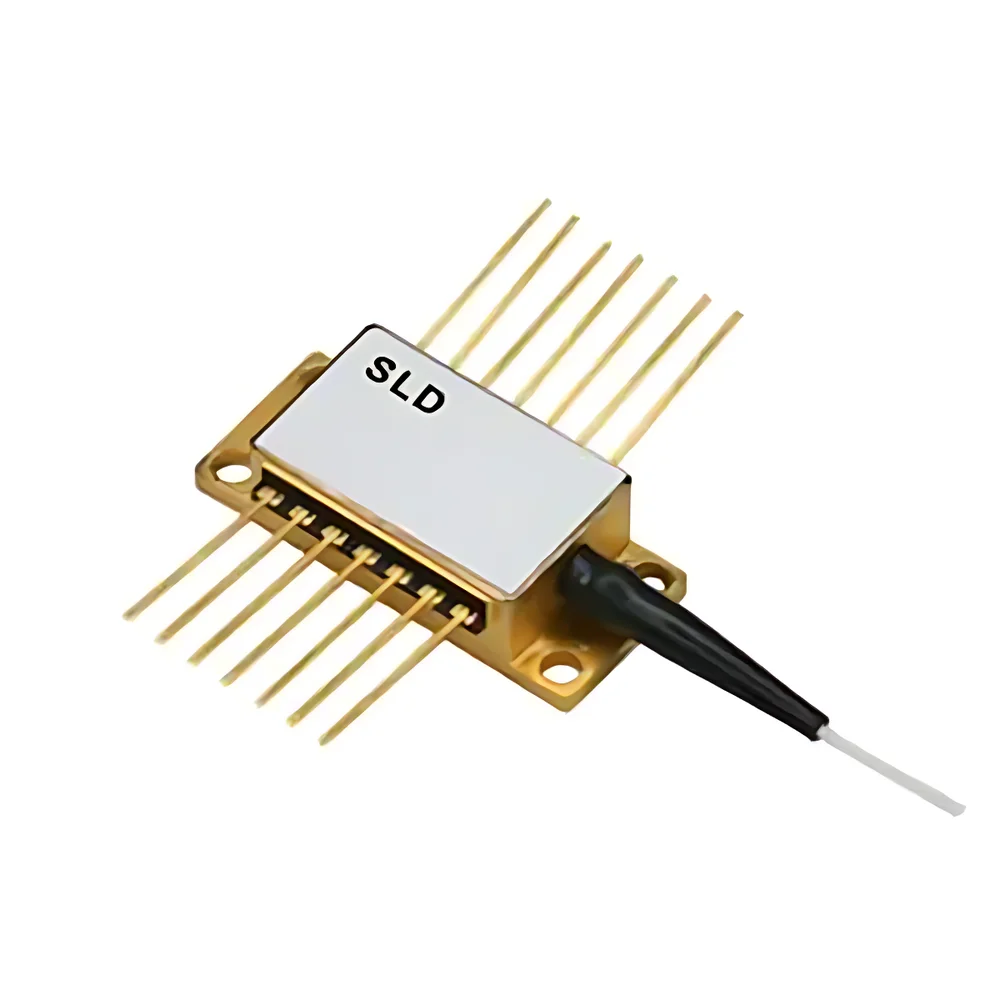
Superlum SLD-Based Broadband Light Sources for OCT and Precision Interferometry
| Brand | Superlum (distributed by Auniontech) |
|---|---|
| Origin | Shanghai, China |
| Product Type | SLD-based broadband light source module |
| Spectral Range | 650–1620 nm |
| FWHM Bandwidth | up to 100 nm |
| Output Power | up to 100 mW (fiber-coupled) |
| Compliance | RoHS-compliant |
| Control Interface | Analog/Digital (ACC/APC), RS-232, TTL |
| Power Supply | 5–30 V DC |
| Modulation Bandwidth | up to 50 kHz |
Overview
Superlum SLD-based broadband light sources are engineered for high-stability, low-coherence interferometric applications requiring spectrally broad, spatially coherent, and temporally incoherent emission. These sources leverage superluminescent diode (SLD) technology—operating on amplified spontaneous emission (ASE) in semiconductor gain media—to deliver Gaussian-like spectral profiles with narrow temporal coherence lengths (typically 5–30 µm), essential for axial resolution in optical coherence tomography (OCT). Unlike lasers, SLDs exhibit no cavity modes or spectral spikes, eliminating speckle noise and enabling artifact-free depth profiling. The devices are optimized for spectral-domain OCT (SD-OCT), fiber optic gyroscope (FOG) bias stabilization, FBG sensor interrogation, and precision metrology of photonic components—including DWDM filters, isolators, and circulators—where broadband, low-noise, and polarization-maintaining output is critical.
Key Features
- Wide spectral coverage from 650 nm to 1620 nm, supporting visible, NIR, and SWIR OCT systems
- FWHM bandwidths up to 100 nm, enabling axial resolutions down to ~5 µm in air (e.g., 840 nm ±25 nm yields ~12 µm)
- Fiber-coupled output options: single-mode (SMF-28), polarization-maintaining (PM), or free-space collimated beams
- Integrated high-precision current and thermoelectric cooler (TEC) drivers for long-term power stability (<±0.1% over 8 h)
- Modulation support up to 50 kHz (TTL/analog) for gated acquisition, synchronization with line-scan cameras, or active feedback loops
- RoHS-compliant construction with hermetically sealed TO-can or butterfly packages; optional built-in optical isolators (>30 dB return loss)
- Multiple form factors: ultra-compact modules (SLD-uCS, 30 × 30 × 12 mm), benchtop instruments (M-S, M-D series), and multi-SLD combiners (cBLMD, BLM2-D) for extended bandwidths up to 200 nm
Sample Compatibility & Compliance
These broadband sources are compatible with standard single-mode and polarization-maintaining fibers (e.g., SMF-28, PM980, HI1060), enabling seamless integration into OEM OCT engines, fiber sensing platforms, and lab-based interferometers. All modules comply with IEC 61340-5-1 (ESD protection), EN 61326-1 (EMC for laboratory equipment), and EU RoHS Directive 2011/65/EU. For regulated medical device development, the sources support traceable calibration documentation and can be incorporated into systems designed for ISO 13485 and FDA 21 CFR Part 11 compliance when paired with validated control software and audit-trail-enabled data acquisition hardware.
Software & Data Management
While the SLD modules themselves operate via analog voltage or digital TTL/RS-232 commands, full system integration is enabled through third-party SDKs and LabVIEW/ViLib drivers provided by Auniontech for host PC control. Benchtop variants (e.g., M-D, M-Q series) include embedded microcontrollers supporting remote configuration of drive current, TEC setpoint, and modulation parameters. Data logging of real-time output power and temperature enables GLP/GMP-aligned process documentation. When used in SD-OCT systems, these sources interface directly with spectrometers equipped with CMOS/CCD line-scan detectors and PCIe digitizers—enabling Fourier-domain signal processing without intermediate wavelength scanning.
Applications
- Spectral-Domain OCT: Core illumination source for retinal, dermatological, and endoscopic imaging systems; supports >100 kHz A-scan rates with high SNR (>85 dB) and minimal roll-off
- Fiber Optic Gyroscopes: Low-coherence seed source for closed-loop bias nulling and scale factor stability enhancement
- Fiber Bragg Grating (FBG) Interrogation: Wideband reference for reflection spectrum analysis in structural health monitoring and aerospace sensing
- Photonic Component Testing: Characterization of insertion loss, polarization-dependent loss (PDL), and group delay in WDM multiplexers and tunable filters
- Low-Coherence Interferometry (LCI): Sub-micron surface profiling, thin-film thickness measurement, and MEMS displacement sensing
- Research Platforms: Enabling custom OCT architectures, dispersion compensation studies, and swept-source hybrid configurations
FAQ
What distinguishes an SLD from a laser diode or LED?
SLDs combine the high brightness and spatial coherence of laser diodes with the broad spectral width and low temporal coherence of LEDs—achieved via suppressed optical feedback in a waveguided gain medium. This eliminates lasing thresholds and mode competition while maintaining directional output suitable for fiber coupling.
Can these sources be integrated into FDA-cleared OCT systems?
Yes—Superlum SLD modules are widely deployed in Class II and Class III medical OCT devices. System integrators must validate optical safety (IEC 60825-1), thermal management, and electrical isolation per their specific architecture.
Do you offer spectral calibration certificates?
Calibrated spectral power density (W/nm) and centroid wavelength data are available upon request, traceable to NIST-standard reference detectors and calibrated spectrometers.
Is polarization-maintaining output available across all wavelengths?
PM-fiber versions are standard for 780 nm, 840 nm, 1050 nm, and 1300 nm bands; custom PM configurations can be engineered for other wavelengths subject to gain chip availability.
What is the typical lifetime and reliability under continuous operation?
Rated MTTF exceeds 25,000 hours at nominal drive current and stabilized junction temperature; accelerated life testing follows Telcordia GR-468-CORE protocols.




