
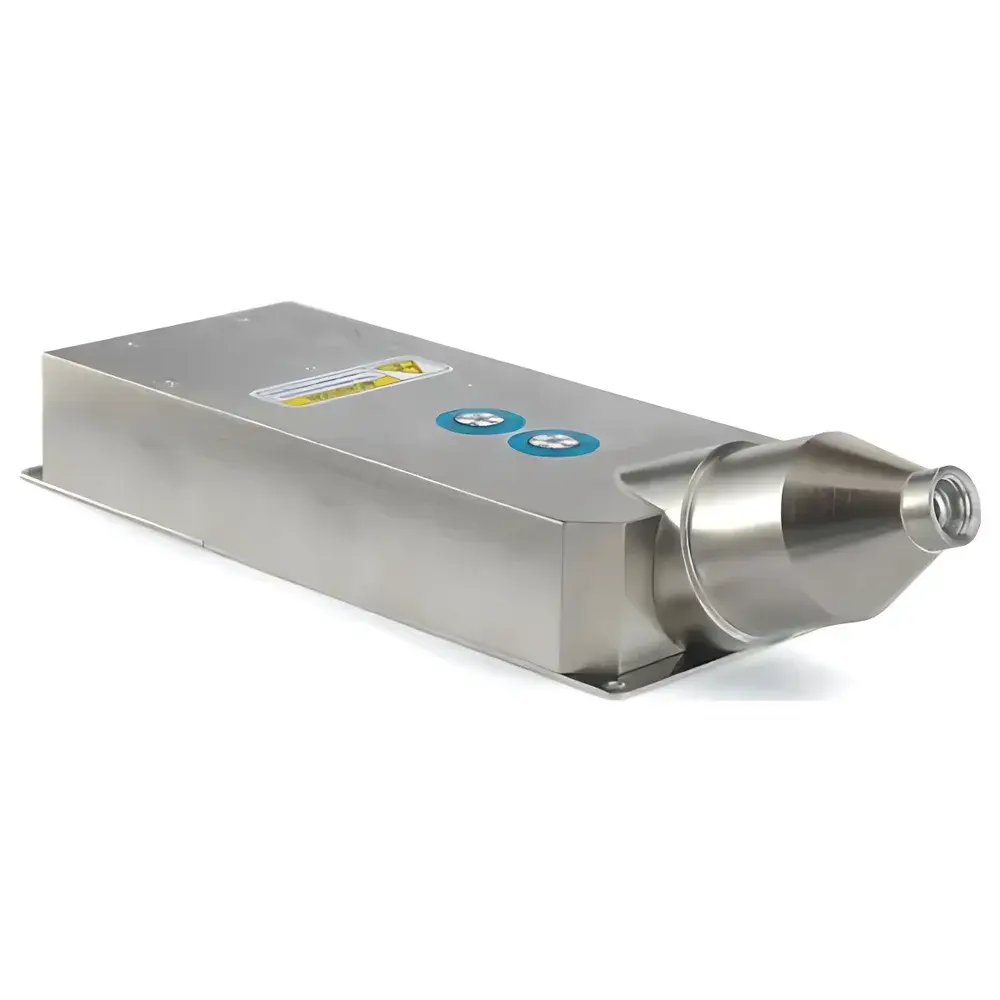
Auniontech M25/M47/M54/M237 Miniature X-ray Tube Modules
| Brand | Auniontech |
|---|---|
| Origin | Shanghai, China |
| Housing Material | Metal-Ceramic |
| Operating Voltage Range | 5–70 kV |
| Current Range | 0–200 µA |
| Max. Power Rating | 4–10 W |
| Filament Type | Tungsten |
| Window Material | Beryllium (125 µm) or Be |
| Beam Geometry | Transmission-type end-window |
| Anode Configuration | Grounded anode |
| X-ray Cone Angle | 110° FWHM |
| Input Power | 5–12 VDC |
| Cooling Method | Air-cooled |
| Radiation Shielding | Omnishield™ self-shielded, 360° |
| Operating Temperature | −10 to +60 °C |
| Storage Temperature | −25 to +85 °C |
| Humidity | ≤90% RH (non-condensing) |
| Mass | 385–700 g |
| Stability | <0.1% output drift (short-term) |
| Encapsulation | Silicone potting |
| Target Materials | W, Rh, Ag, Au |
| Collimation | Threaded adapter interface |
| Compliance | RoHS-compliant design, CE-marked per EN 61000-6-3/6-4, IEC 61010-1 safety requirements |
Overview
The Auniontech M25, M47, M54, and M237 miniature X-ray tube modules are compact, self-shielded, transmission-type X-ray sources engineered for integration into space-constrained, low-power analytical and imaging systems. Each module integrates a metal-ceramic sealed X-ray tube, high-voltage generation circuitry, and Omnishield™ 360° radiation shielding within a single mechanically stable housing—eliminating the need for external HV cabling, external shielding enclosures, or complex alignment fixtures. These sources operate on standard low-voltage DC input (5–12 VDC), enabling direct compatibility with battery-powered handheld spectrometers, portable XRF analyzers, benchtop process monitors, and educational X-ray platforms. The transmission geometry—featuring a thin beryllium (125 µm) or custom Be window—optimizes soft-to-medium energy X-ray output (characteristic lines from W, Rh, Ag, Au targets) while maintaining high photon flux efficiency. Designed in accordance with IEC 61010-1 for electrical safety and EN 61000-6-3/6-4 for electromagnetic compatibility, these modules support regulatory-ready system integration in industrial, academic, and OEM environments.
Key Features
- Compact metal-ceramic construction with integrated HV power supply and thermal management
- Omnishield™ radiation containment: fully self-shielded, no external lead housing required
- Transmission-type end-window geometry with 110° full-width half-maximum (FWHM) conical beam divergence
- Low-voltage DC operation (5–12 VDC) compatible with Li-ion battery packs and embedded controllers
- Analog control interface for real-time kV/mA regulation; grounded-anode configuration enhances stability and simplifies grounding schemes
- Silicone-potted internal electronics for moisture resistance and mechanical shock resilience
- Threaded collimator interface (standard M24×0.75 or custom) enabling rapid optical alignment and field-replaceable beam shaping
- Thermal design optimized for continuous air-cooled operation across −10 °C to +60 °C ambient range
Sample Compatibility & Compliance
These X-ray modules are designed for non-destructive excitation of elemental fluorescence in solid, powdered, and thin-film samples. Their beryllium windows transmit photons down to ~1 keV, supporting Kα line detection for elements from Mg (Z=12) through U (Z=92) in XRF configurations. In imaging applications, they deliver sufficient flux for real-time radiography of low-Z materials (e.g., plastics, composites, biological tissues) at sub-millimeter spatial resolution when coupled with scintillator-based detectors. All variants comply with RoHS Directive 2011/65/EU and carry CE marking under the Low Voltage Directive (2014/35/EU) and EMC Directive (2014/30/EU). While not classified as medical devices per FDA 21 CFR Part 820, their design supports GLP-aligned validation protocols—including traceable calibration logs, output stability monitoring (<0.1% short-term drift), and configurable interlock interfaces for system-level safety certification.
Software & Data Management
Each module interfaces via analog voltage inputs (0–5 V or 0–10 V) for kV and mA setpoints, with optional digital status feedback (TTL-level ready/busy, overtemperature, arc detect). Integration with third-party DAQ systems (e.g., National Instruments PXI, Beckhoff EtherCAT) is supported through open-loop control or closed-loop PID implementations using external current/voltage monitors. Auniontech provides reference firmware libraries (C/C++, Python) for common microcontrollers (STM32, Raspberry Pi Pico) and LabVIEW drivers for spectral acquisition synchronization. For OEMs, SDK documentation includes timing diagrams, error code mapping, and recommended PCB layout guidelines for noise suppression—critical for achieving stable X-ray output in multi-sensor embedded platforms. Audit trails for operational parameters (voltage, current, runtime, temperature) can be logged externally to meet ISO/IEC 17025 documentation requirements.
Applications
- Handheld and portable X-ray fluorescence (XRF) analyzers for alloy identification, mining exploration, and scrap metal sorting
- OEM integration into inline process control systems for coating thickness measurement and elemental composition monitoring
- Benchtop educational XRF and X-ray diffraction (XRD) demonstrators for university physics and materials science laboratories
- Low-dose radiographic imaging subsystems in NDT equipment for PCB inspection, polymer weld analysis, and cultural heritage artifact examination
- Custom X-ray source engines for synchrotron beamline diagnostics, particle detector calibration, and plasma diagnostics
- Compact excitation sources in micro-XRF mapping systems and confocal X-ray optics setups
FAQ
What is the maximum continuous operating power for each model?
The M25 and M47 are rated for up to 4 W; the M54 and M237 support up to 10 W under sustained air-cooled conditions.
Can these tubes be operated in vacuum environments?
No—they are potted and sealed for atmospheric operation only; vacuum use may compromise thermal dissipation and potting integrity.
Is beryllium window handling subject to export controls?
Yes; Be-containing components fall under EAR99 classification, and international shipments require compliance verification per destination country regulations.
Do you provide spectral output data (e.g., bremsstrahlung curves, characteristic line intensities)?
Yes—Auniontech supplies measured spectra (kV/mA-dependent) and filter transmission curves upon request for application-specific modeling.
Are custom target materials or window thicknesses available?
Yes—custom anodes (e.g., Cr, Cu, Mo) and Be thicknesses (75–500 µm) are offered under NDA for qualified OEM programs.
Related Products






