
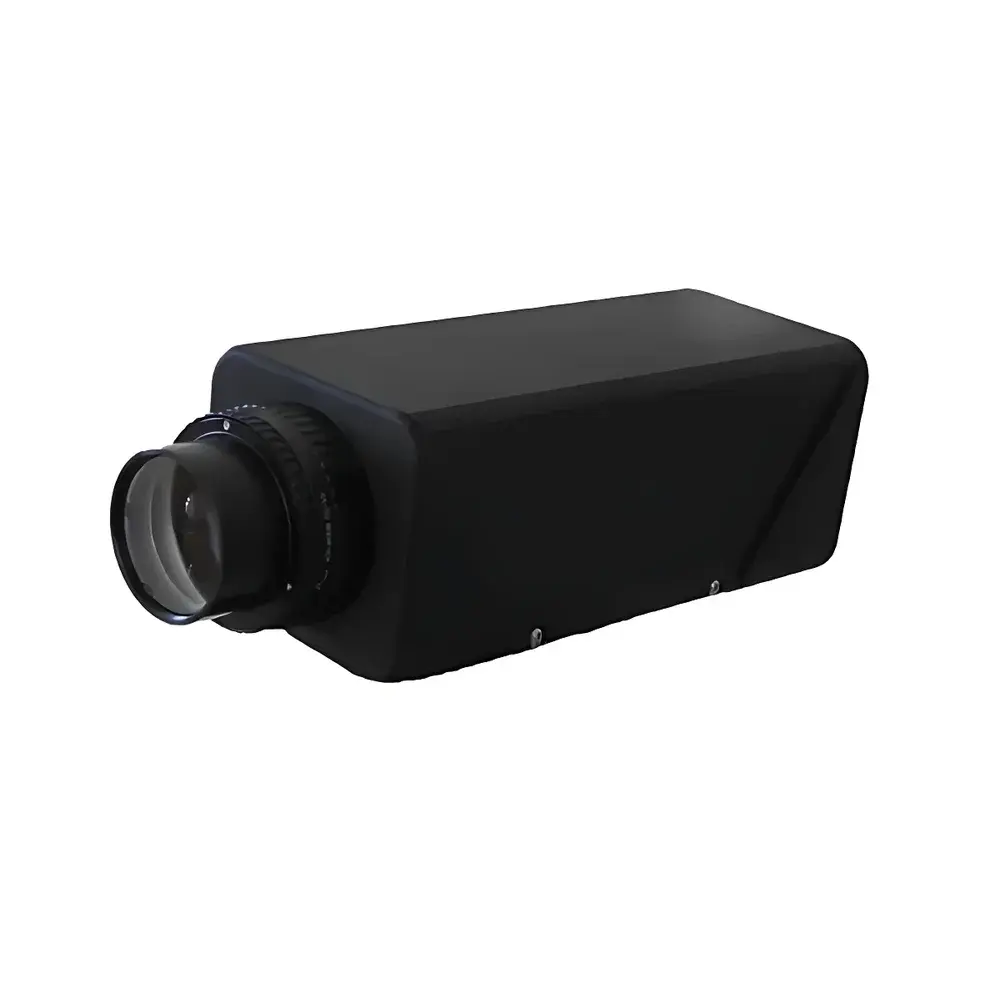
Aurexel Model 4250 VNIR & Model 4400 SWIR Snapshot Hyperspectral Imager (Fabry–Pérot Tunable Filter-Based, No Scanning Required)
| Origin | Imported |
|---|---|
| Manufacturer Type | Authorized Distributor |
| Imaging Principle | Fabry–Pérot Interferometric Tunable Filtering |
| Imaging Mode | Snapshot (Staring) |
| Platform | Ground-based |
| Spectral Range | 400–1000 nm (Model 4250), 1000–1700 nm (Model 4400) |
| Spectral Resolution | 4 nm (VNIR), 10 nm (SWIR) |
| Spatial Resolution | 1280 × 1024 pixels |
| Instantaneous Field of View (IFOV) | < 1.5 mrad (typ.) |
| Frame Rate | Up to 60 fps (multispectral mode), 5–15 fps (full hyperspectral cube acquisition) |
| Spectral Channels | ~300 (VNIR), ~108 (SWIR) |
| Sensor Format | 2.3 MP (VNIR), 3.2 MP (SWIR) |
| Interface | USB 3.2 Gen 1 / Camera Link |
| Lens Options | 15° or 30° FOV |
| Operating Temperature | 20 °C ± 10 °C |
| Relative Humidity | ≤65% RH, non-condensing |
| Dimensions & Weight | 197.7 × 81 × 78 mm, 1.25 kg (4250) |
Overview
The Aurexel Model 4250 (VNIR) and Model 4400 (SWIR) are snapshot hyperspectral imagers engineered for high-fidelity spectral-spatial data acquisition without mechanical scanning or motion compensation. Leveraging a solid-state, voltage-tuned Fabry–Pérot interferometric filter placed directly in front of a monochrome CMOS/InGaAs sensor, these instruments enable true staring-mode operation—capturing full-frame, spatially registered spectral cubes in a single integration period per wavelength step. Unlike push-broom or whisk-broom systems that rely on platform motion or precision translation stages, the snapshot architecture eliminates motion-induced misregistration, geometric distortion, and temporal inconsistency between spectral bands. This makes the system inherently robust for field-deployable, laboratory-controlled, and airborne-integrated applications where environmental stability cannot be guaranteed. The optical design supports two complementary spectral bands: 400–1000 nm (Model 4250, visible–near-infrared) with ~300 resolvable channels at 4 nm spectral resolution, and 1000–1700 nm (Model 4400, short-wave infrared) with ~108 channels at 10 nm resolution—both calibrated traceably to NIST-traceable standards.
Key Features
- Snapshot Acquisition Architecture: Captures complete 1280 × 1024 spatial frames at each selected wavelength—no line-by-line scanning, no stage movement, no image stitching required.
- Dynamically Tunable Spectral Sampling: User-selectable wavelength steps and dwell times allow adaptive configuration—from high-resolution static cube capture (e.g., 300-band VNIR cube in <60 s) to real-time multispectral classification at up to 60 fps using pre-defined band sets.
- High Radiometric Uniformity: Eliminates pixel-to-pixel sensitivity drift and scan-line artifacts inherent in line-scan systems; delivers consistent response across full FOV under variable thermal or illumination conditions.
- Compact, Ruggedized Form Factor: Designed for integration into portable field kits, UAV gimbals, lab benches, and industrial inspection stations—mechanically stable housing with passive thermal management and low power consumption (<8 W typical).
- Modular Optomechanical Interface: Standard C-mount lens compatibility with optional 15° or 30° FOV lenses; supports external trigger synchronization and TTL-compatible strobe control for synchronized illumination.
Sample Compatibility & Compliance
The Aurexel hyperspectral imagers operate in reflective and diffuse transmittance modes, supporting non-contact analysis of solids, powders, liquids, and biological specimens without sample preparation. The system complies with IEC 61000-6-3 (EMC emission limits) and IEC 61000-6-2 (immunity requirements) for industrial environments. Data acquisition workflows support audit-ready metadata embedding—including timestamp, exposure settings, filter voltage calibration, and temperature telemetry—enabling alignment with GLP and GMP documentation practices. While not FDA-cleared as a medical device, raw spectral data output conforms to ASTM E1777 (Standard Practice for Hyperspectral Imaging Data Exchange) and is compatible with USP spectral data integrity guidelines when used in pharmaceutical QA/QC contexts.
Software & Data Management
Bundled Aurexel Hyperspectral Studio software provides end-to-end workflow support: hardware control, real-time preview, spectral cube reconstruction, radiometric correction (flat-field + dark current), and embedded spectral library matching. The application includes Python SDK (PyAurexel) and MATLAB interface for custom algorithm development, enabling integration with machine learning pipelines (e.g., PLS-DA, SVM, CNN-based classification). All processed datasets export in ENVI-compatible BIL/BIP format with full header metadata, and support direct ingestion into commercial platforms including Specim IQ Studio, Malvern Panalytical Morphologi, and Thermo Fisher OMNIC. Audit trail functionality logs user actions, parameter changes, and calibration events—meeting basic requirements for 21 CFR Part 11 electronic record compliance when deployed with validated IT infrastructure.
Applications
- Forensic Science: Non-destructive detection of erased ink, latent fingerprints, accelerant residues, and document alterations via spectral unmixing and anomaly detection.
- Geoscience & Remote Sensing: Mineral identification (e.g., clays, carbonates, sulfides), vegetation stress mapping (NDVI, PRI, MCARI), and soil organic carbon estimation from ground-based surveys.
- Pharmaceutical Quality Control: Quantitative mapping of API distribution in tablet cross-sections, excipient homogeneity assessment, and counterfeit drug screening using spectral fingerprint libraries.
- Agricultural Monitoring: In-field phenotyping of crop health, nitrogen status, water stress, and early-stage disease detection (e.g., fungal infection in wheat leaves) using hyperspectral indices.
- Food Safety Inspection: Detection of surface contaminants (e.g., fecal matter, mold), pesticide residue screening on produce skins, and meat spoilage assessment via myoglobin oxidation state analysis.
- Cultural Heritage Conservation: Pigment identification in paintings, underdrawing visualization, and degradation product mapping in historical manuscripts without UV exposure or physical contact.
FAQ
How does the Fabry–Pérot tunable filter achieve spectral selection without moving parts?
The filter consists of two highly reflective dielectric mirrors separated by an electro-optically tunable cavity. Applying a precise voltage changes the effective cavity thickness via the electrostrictive effect, shifting the resonant transmission wavelength—enabling discrete or continuous spectral tuning over the designated band.
Can the system acquire data in real time for process monitoring?
Yes—by limiting acquisition to 3–8 user-defined spectral bands, frame rates up to 60 fps are sustained with full spatial resolution, enabling closed-loop sorting or anomaly flagging in manufacturing lines.
Is radiometric calibration included and traceable?
Each unit ships with factory-applied relative spectral response (RSR) and flat-field calibration data, verified against NIST-traceable tungsten halogen and blackbody sources. Optional annual recalibration services are available.
What computing resources are required for real-time processing?
Real-time cube reconstruction and basic PCA operate on systems with ≥16 GB RAM and Intel i7-8700K or equivalent; GPU-accelerated unmixing and deep learning inference require NVIDIA GTX 1080 Ti or newer.
Does the system support synchronization with external lighting or motion stages?
Yes—TTL trigger input/output ports support hardware-level synchronization with pulsed LEDs, laser illuminators, or motion controllers, ensuring precise timing for gated imaging or multi-modal data fusion.



