
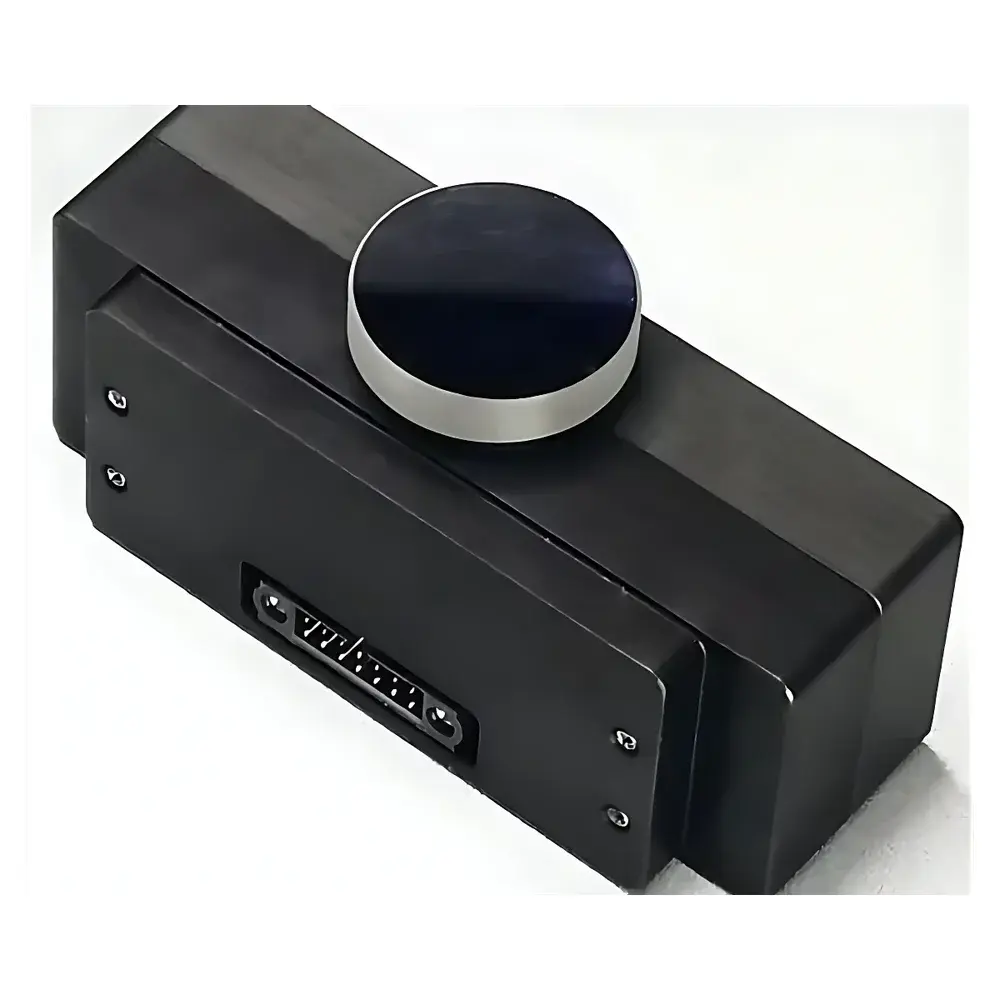
Auniontech FSM Series Fast Steering Mirrors
| Brand | Auniontech |
|---|---|
| Model | FSM-06M / FSM-45M / FSM-1400U / FSM-2000U |
| Type | Manual Translation Stage (Optical Beam Steering) |
| Angular Range | 6 mrad / 45 mrad / 1400 µrad / 2000 µrad |
| Resonant Frequency | 2200 Hz / 600 Hz / 2500 Hz (9 g) / 1500 Hz (25 g) |
| Guidance | Flexure-based zero-backlash mechanism |
| Feedback | Strain-gauge (FSM-06M/FSM-45M), Closed-loop (FSM-2000U) |
| Thermal Stability | Yes (FSM-2000U) |
| Load Capacity | High (FSM-2000U, up to 60 g dynamic load) |
| Cross-Axis Coupling | Low (FSM-2000U) |
Overview
Auniontech Fast Steering Mirrors (FSMs) are high-bandwidth, precision angular positioning devices engineered for real-time optical beam direction control. Operating on the principle of flexure-guided tip-tilt motion, these mirrors eliminate mechanical backlash and hysteresis—critical for applications demanding sub-millisecond response and nanoradian repeatability. Unlike conventional gimbals or motorized rotation stages, FSMs utilize piezoelectric or voice-coil actuators coupled with monolithic flexure hinges, enabling resonant-frequency-limited bandwidths from 600 Hz to 2500 Hz. This architecture supports closed-loop stabilization of laser beams under dynamic disturbance conditions, making them foundational components in free-space optical communication links, adaptive optics wavefront correction, active vibration isolation systems, and high-speed optical scanning platforms.
Key Features
- Flexure-based monolithic design ensures zero mechanical backlash, high stiffness, and long-term alignment stability without lubrication or wear
- Strain-gauge position feedback (FSM-06M, FSM-45M) enables linearity better than ±0.5% over full stroke; closed-loop operation with integrated PID controller (FSM-2000U) delivers <100 nrad RMS angular noise
- Resonant frequencies up to 2500 Hz (FSM-1400U, 9 g load) support real-time correction of high-frequency jitter sources including acoustic noise, pump vibration, and thermal drift
- Compact footprint (e.g., FSM-1400U: 45 mm × 45 mm base) facilitates integration into space-constrained optical breadboards and OEM instrumentation
- Thermally stable housing and low-CTE mirror mounts (FSM-2000U) minimize thermal drift during extended operation—critical for interferometric and metrology-grade applications
- Low cross-axis coupling (<0.3% for FSM-2000U) preserves orthogonal actuation fidelity, essential for decoupled X/Y beam steering in dual-axis configurations
Sample Compatibility & Compliance
Auniontech FSMs accommodate standard optical substrates—including fused silica, BK7, and enhanced aluminum-coated mirrors—up to Ø25.4 mm (FSM-06M/FSM-45M) and Ø50.8 mm (FSM-2000U). Mirror mounting is compatible with industry-standard kinematic adapters (e.g., Thorlabs KM100, Newport UMB series). All models meet RoHS 2011/65/EU directives and are manufactured under ISO 9001-certified processes. While not FDA-regulated, FSM-2000U’s closed-loop architecture and deterministic step response align with GLP/GMP-aligned system validation requirements for optical subsystems in regulated R&D environments. Mechanical shock tolerance is validated per IEC 60068-2-27 (FSM-2000U: 60 g, 6 ms half-sine pulse).
Software & Data Management
Each FSM model ships with Auniontech’s FSMLink™ Control Suite—a Windows-based application supporting analog voltage input (±10 V), digital command via USB 2.0 (SCPI-compliant), and real-time streaming of position telemetry at up to 10 kHz sampling rate. The SDK includes C/C++, Python, and LabVIEW APIs with full access to internal PID parameters, gain scheduling tables, and hardware-triggered data logging. For traceability-critical applications, FSMLink™ supports audit-trail-enabled session logging compliant with 21 CFR Part 11 Annex 11 principles—including user authentication, electronic signatures, and immutable timestamped records of all actuator commands and sensor readings.
Applications
- Laser Communication Systems: Maintains pointing accuracy within ±5 µrad under satellite platform vibration; demonstrated in ground-to-air FSO links operating at 10 Gbps modulation rates
- Adaptive Optics Subsystems: Serves as tip-tilt correction stage in Shack-Hartmann wavefront sensors, compensating for atmospheric turbulence at frame rates >500 Hz
- Optical Image Stabilization: Integrated into UAV gimbal assemblies to suppress >1 kHz microvibrations during aerial imaging, achieving <0.5 pixel blur reduction at 4K resolution
- Confocal & Super-Resolution Microscopy: Enables jitter-free raster scanning in STED and PALM modalities, where beam positional jitter must remain below 2 nm RMS at the focal plane
- Free-Space Quantum Key Distribution (QKD): Provides active polarization alignment maintenance between entangled photon sources and receivers across variable-path-length channels
FAQ
What is the difference between open-loop and closed-loop FSM operation?
Open-loop FSMs (e.g., FSM-06M) rely on calibrated voltage-to-angle transfer functions and assume ideal actuator linearity; closed-loop models (e.g., FSM-2000U) incorporate real-time position sensing and feedback control to correct for hysteresis, creep, and thermal drift—improving absolute angular accuracy by up to two orders of magnitude.
Can FSMs be used in vacuum environments?
Yes—FSM-1400U and FSM-2000U variants are available with vacuum-compatible materials (304 stainless steel housing, ceramic-insulated actuators) and outgassing-tested adhesives (per ASTM E595); standard models operate up to 10⁻⁵ Torr.
How is angular resolution quantified for these mirrors?
Resolution is defined by the minimum detectable angular step, determined by actuator noise floor and feedback sensor sensitivity. For FSM-2000U, closed-loop resolution is <10 nrad RMS over 100 ms averaging; open-loop resolution is limited by piezo voltage noise (~100 µV) and gain calibration uncertainty.
Are custom mirror coatings or substrate materials supported?
Yes—Auniontech offers OEM integration services including AR/HR coating deposition (193–2000 nm range), UV-fused silica substrates, and diamond-turned copper mounts for high-power CW laser applications (up to 500 W/cm²).



