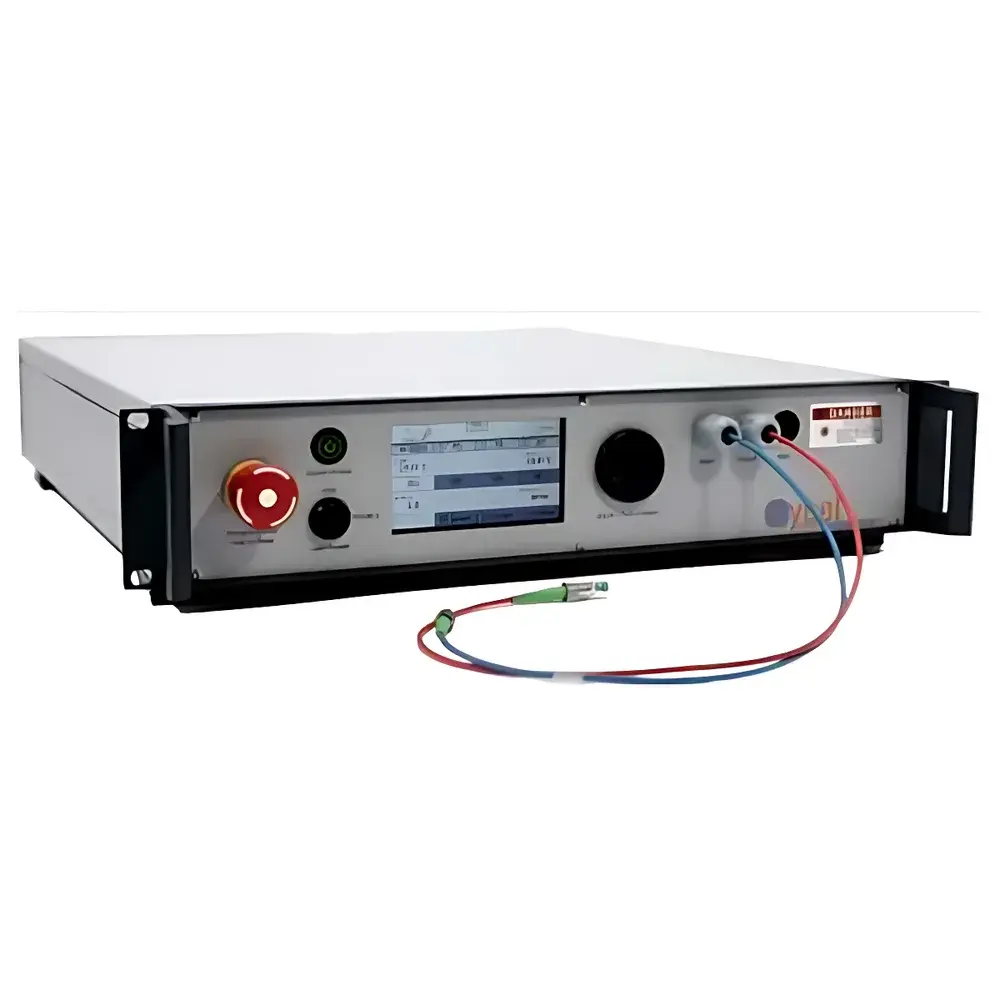
Auniontech TDFA-2000 Compact Thulium-Doped Fiber Amplifier
| Brand | Auniontech |
|---|---|
| Origin | Shanghai, China |
| Type | Thulium-Doped Fiber Amplifier (TDFA) |
| Operating Wavelength | 1900–2050 nm |
| Small-Signal Gain | >40 dB |
| Output Power Range | 10–500 mW (CW) |
| ASE Level | <1% at 0 dBm input |
| Beam Quality | M² ≈ 1 |
| Power Consumption | <15 W |
| Operating Temperature | 10–40 °C |
| Fiber Options | Standard Single-Mode or Polarization-Maintaining (PM) |
| Control Interface | USB with ACC & APC modes |
| Form Factor | Benchtop, OEM-ready |
Overview
The Auniontech TDFA-2000 is a compact, benchtop thulium-doped fiber amplifier engineered for stable, high-fidelity amplification in the 1.9–2.05 µm spectral band. Unlike erbium-doped fiber amplifiers (EDFAs) operating near 1.55 µm, this TDFA leverages the ⁴F4 → ³H6 transition of trivalent thulium (Tm³⁺) ions under 790 nm or 1550 nm pumping to achieve population inversion and optical gain across the eye-safe, atmospheric-transmission-friendly 2 µm window. Its design adheres to fundamental principles of rare-earth-doped fiber amplification—namely, pump-induced excitation, metastable-state storage, and stimulated emission triggered by weak signal photons. This enables high small-signal gain (>40 dB) with low noise figure and minimal amplified spontaneous emission (ASE), making it suitable for applications demanding high signal-to-noise ratio (SNR) and phase coherence preservation.
Key Features
- High small-signal gain exceeding 40 dB across 1900–2050 nm, optimized for low-input-power regimes (e.g., seed laser amplification)
- Continuous-wave output power scalable from 10 mW to 500 mW via digital USB interface, supporting both automatic current control (ACC) and automatic power control (APC) modes
- Near-diffraction-limited beam quality (M² ≈ 1), ensuring compatibility with free-space coupling, nonlinear frequency conversion, and interferometric systems
- Low ASE spectral density (<1% relative intensity noise at 0 dBm input), critical for maintaining spectral purity in coherent detection and heterodyne sensing
- Compact, convection-cooled architecture with <15 W total power draw—no active cooling or water circulation required
- Flexible fiber delivery: available with standard single-mode (SMF-28 compatible) or polarization-maintaining (PANDA or bow-tie) pigtails, enabling integration into PM-sensitive architectures
- Fully enclosed, EMI-shielded enclosure compliant with IEC 61326-1 for electromagnetic compatibility in laboratory and industrial environments
Sample Compatibility & Compliance
The TDFA-2000 accepts input signals from common 2 µm laser sources—including Tm:fiber lasers, Ho:fiber lasers (pumped via Tm), and optical parametric oscillators (OPOs)—with standard FC/APC or FC/PC connectors. Input power range is optimized for –30 to 0 dBm, preserving linearity and avoiding saturation effects. The amplifier meets CE marking requirements per Directive 2014/30/EU (EMC) and 2014/35/EU (LVD). Its optical safety classification conforms to IEC 60825-1:2014 Class 3B for typical operating configurations, requiring appropriate interlocks and labeling per local laser safety protocols (ANSI Z136.1 in the US, EN 60825-1 in EU). While not certified to FDA 21 CFR Part 11, its USB-based parameter logging supports GLP-compliant record-keeping when integrated into validated test environments.
Software & Data Management
Auniontech provides a Windows-compatible USB HID driver and GUI application for real-time monitoring and control of output power, pump diode current, case temperature, and status flags. All operational parameters are timestamped and exportable as CSV files for traceability. The device implements non-volatile memory to retain user-defined setpoints across power cycles. For system integrators, a documented ASCII command protocol over virtual COM port enables scripting in Python, LabVIEW, or MATLAB—facilitating synchronization with pulse pickers, wavelength meters, or data acquisition systems. Firmware updates are performed via USB without external programming hardware.
Applications
- Mid-IR laser seeding: Boosting low-power Tm/Ho fiber oscillator outputs to drive high-energy amplifiers or optical parametric chirped-pulse amplification (OPCPA) stages
- LIDAR and rangefinding: Enhancing time-of-flight signal strength in eye-safe 2 µm systems for atmospheric profiling, wind sensing, and industrial distance metrology
- Gas spectroscopy: Providing high-brightness, narrow-linewidth sources for absorption measurements of H₂O, CO₂, CH₄, and NH₃ in the 1.8–2.1 µm fingerprint region
- Nonlinear frequency conversion: Pumping periodically poled lithium niobate (PPLN) or orientation-patterned gallium arsenide (OP-GaAs) crystals for generation of 3–12 µm mid-IR radiation
- Free-space optical communications: Enabling ground-to-air and inter-satellite links exploiting low atmospheric scattering and reduced solar background in the 2 µm band
FAQ
What pump wavelengths are supported?
The TDFA-2000 uses an integrated 790 nm pump laser diode; no external pump source is required.
Is polarization extinction ratio (PER) specified for the PM version?
Yes—the PM variant delivers >20 dB PER at the output port, measured at 2000 nm with 100 mW output.
Can the amplifier be operated in constant-current mode only?
No—both ACC (constant pump current) and APC (closed-loop output power regulation) modes are selectable via software or SCPI commands.
Does the unit include thermal stabilization of the gain fiber?
Yes—a thermoelectric cooler (TEC) maintains the doped fiber coil at a fixed temperature ±0.1 °C to ensure gain stability over ambient fluctuations.
Are OEM mechanical or electrical modifications available?
Yes—custom chassis dimensions, alternate connectors (e.g., D-sub for analog monitoring), and TTL-triggered enable/disable functionality can be implemented under NDA.