
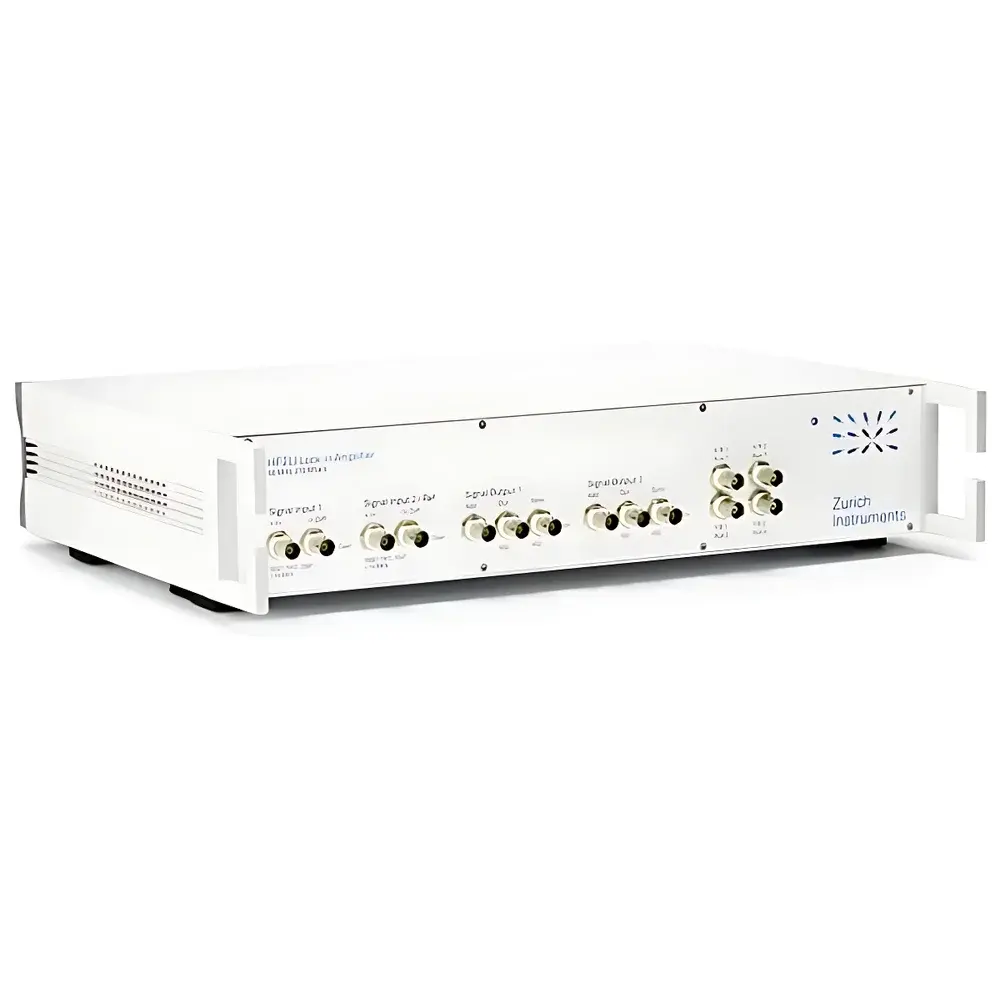
Zurich Instruments HF2LI Series 50 MHz Dual-Channel High-Frequency Lock-in Amplifier
| Origin | Switzerland |
|---|---|
| Manufacturer Type | Authorized Distributor |
| Origin Category | Imported |
| Model | HF2LI_Lock_in_Amplifier |
| Component Category | Optical Instrument Component |
| Price | USD 1,780 (est. based on market conversion) |
Overview
The Zurich Instruments HF2LI Series 50 MHz Dual-Channel High-Frequency Lock-in Amplifier is a precision digital lock-in instrument engineered for ultra-low-noise, phase-sensitive detection in demanding optical, quantum, and nanoscale measurement environments. Based on direct digital sampling architecture with 210 MSa/s ADCs and real-time FPGA-based signal processing, the HF2LI implements two fully independent lock-in units operating synchronously within a single 50 MHz frequency bandwidth (0.7 µHz to 50 MHz). Each unit performs dual-phase (X/Y), magnitude (R), and phase (θ) demodulation with 64-bit internal arithmetic and 128-bit extended-precision signal path resolution—enabling dynamic reserve up to 120 dB and input voltage noise as low as 5 nV/√Hz at 1 kHz. Unlike analog or legacy digital lock-ins, the HF2LI eliminates harmonic distortion and drift through full digital synthesis of reference signals, adaptive filter design, and time-constant-stable IIR filtering. Its architecture supports both internal and external reference modes—including auto-reference tracking—and is fundamentally designed for applications requiring high temporal stability, multi-harmonic analysis, and deterministic latency (e.g., closed-loop AFM, quantum gate readout, and cavity optomechanics).
Key Features
- Dual independent lock-in units with simultaneous baseband + 2 harmonic detection per channel (extendable to 6 frequencies via HF2LI-MF option)
- 210 MSa/s real-time sampling rate with 14-bit ADC and 16-bit DACs for analog inputs/outputs
- Full-frequency-range signal generation: 2 built-in oscillators (DC–50 MHz), programmable amplitude, offset, and phase
- 6 configurable dual-phase demodulators with selectable filter order (6–48 dB/octave), time constants from 1 µs to 500 s, and bandwidth down to 80 µHz
- 4 high-speed auxiliary outputs (±10 V, 1 MS/s, 16-bit) and 2 auxiliary inputs (±10 V, 400 kS/s, 16-bit) for real-time control and monitoring
- Integrated instrumentation suite: FFT spectrum analyzer (up to 1 Mpts), frequency response analyzer (FRA), and 2-channel oscilloscope with trigger synchronization
- USB 2.0 high-speed interface (480 Mbit/s) with deterministic latency; ZSync and ZCtrl proprietary buses for multi-instrument synchronization and external preamp control
- Compact 19-inch rack-mount form factor (45 × 28 × 9 cm), 6.2 kg, universal AC input (110–240 V, 50/60 Hz)
Sample Compatibility & Compliance
The HF2LI interfaces seamlessly with optical detectors (e.g., photodiodes, APDs, PMTs), MEMS sensors, SQUIDs, and cryogenic measurement setups via 50 Ω or 1 MΩ || 20 pF input impedance selection. Its low-noise front-end and high dynamic reserve ensure reliable extraction of weak modulated signals buried under broadband noise—critical for scanning probe microscopy (SPM), laser heterodyne spectroscopy, and magneto-optical Kerr effect (MOKE) measurements. The instrument complies with IEC 61000-6-3 (EMI emission) and IEC 61000-6-2 (immunity) standards. Firmware and software support audit trails, user access levels, and exportable metadata—facilitating GLP/GMP-aligned workflows. While not FDA 21 CFR Part 11-certified out-of-the-box, its LabOne API enables integration into validated systems where electronic records and signatures are required.
Software & Data Management
LabOne—the unified software platform for Zurich Instruments—provides a browser-based graphical user interface (GUI) with real-time plotting, parameter sweeps, and automated experiment sequencing. All instrument settings, measurement data, and metadata (including timestamps, hardware configuration, and calibration history) are stored in HDF5 format for long-term reproducibility and third-party analysis (Python/Matlab/Origin). The LabOne API supports Python, MATLAB, C, .NET, and LabVIEW, enabling custom control loops, real-time feedback algorithms, and integration into larger test automation frameworks. With the HF2LI-RT option, users deploy C-coded algorithms directly on the instrument’s FPGA for sub-10 µs loop latency—essential for adaptive optics correction or quantum error mitigation protocols. Data export supports CSV, MATLAB (.mat), and standardized scientific formats compliant with FAIR principles.
Applications
- Scanning probe microscopy (SPM) and atomic force microscopy (AFM): Multi-frequency topography, Kelvin probe force microscopy (KPFM), and magnetic force microscopy (MFM)
- Quantum transport and nanophysics: Gate-based qubit readout, Coulomb blockade spectroscopy, and shot-noise thermometry
- Laser spectroscopy: Frequency-modulated absorption spectroscopy (FMAS), cavity ring-down (CRD), and photothermal deflection
- MEMS/NEMS sensor characterization: Resonance tracking, quality factor (Q) mapping, and nonlinear dynamics analysis
- Micro-magnetism and spintronics: Ferromagnetic resonance (FMR), spin-torque ferromagnetic resonance (ST-FMR)
- Astronomical instrumentation: Adaptive optics wavefront sensing and interferometric fringe tracking
- Non-destructive testing (NDT): Electromagnetic acoustic transduction (EMAT) and eddy-current imaging
- Medical physics: Ultrasound Doppler signal recovery and MRI gradient coil characterization
FAQ
What is the maximum harmonic order supported without optional modules?
The base HF2LI supports one fundamental frequency plus two harmonics per lock-in unit—i.e., three total frequencies per channel.
Can the HF2LI operate as a standalone instrument without a host PC?
No. It requires continuous USB 2.0 connection to a host running LabOne software for configuration, control, and data acquisition.
Is the 128-bit processing implemented in hardware or software?
The 128-bit extended-precision arithmetic is performed in the FPGA during real-time demodulation and filtering; final results are output at 64-bit resolution.
Does the HF2LI support true RMS voltage measurement?
Yes—via the integrated oscilloscope and FFT modules, with calibrated scaling traceable to NIST-traceable references.
How is phase noise performance affected by the HF2LI-UHS option?
The UHS option replaces the standard oscillator with a temperature-controlled quartz crystal (30 ppb stability), reducing close-in phase noise by >20 dBc/Hz at 10 Hz offset—critical for ultra-high-resolution spectroscopy.





