
Auniontech HWG Hollow-Core Infrared Quartz Waveguide Fiber
| Brand | Auniontech |
|---|---|
| Model | HWG |
| Core Diameter | 500–1000 µm |
| Transmission Range | 2–18 µm |
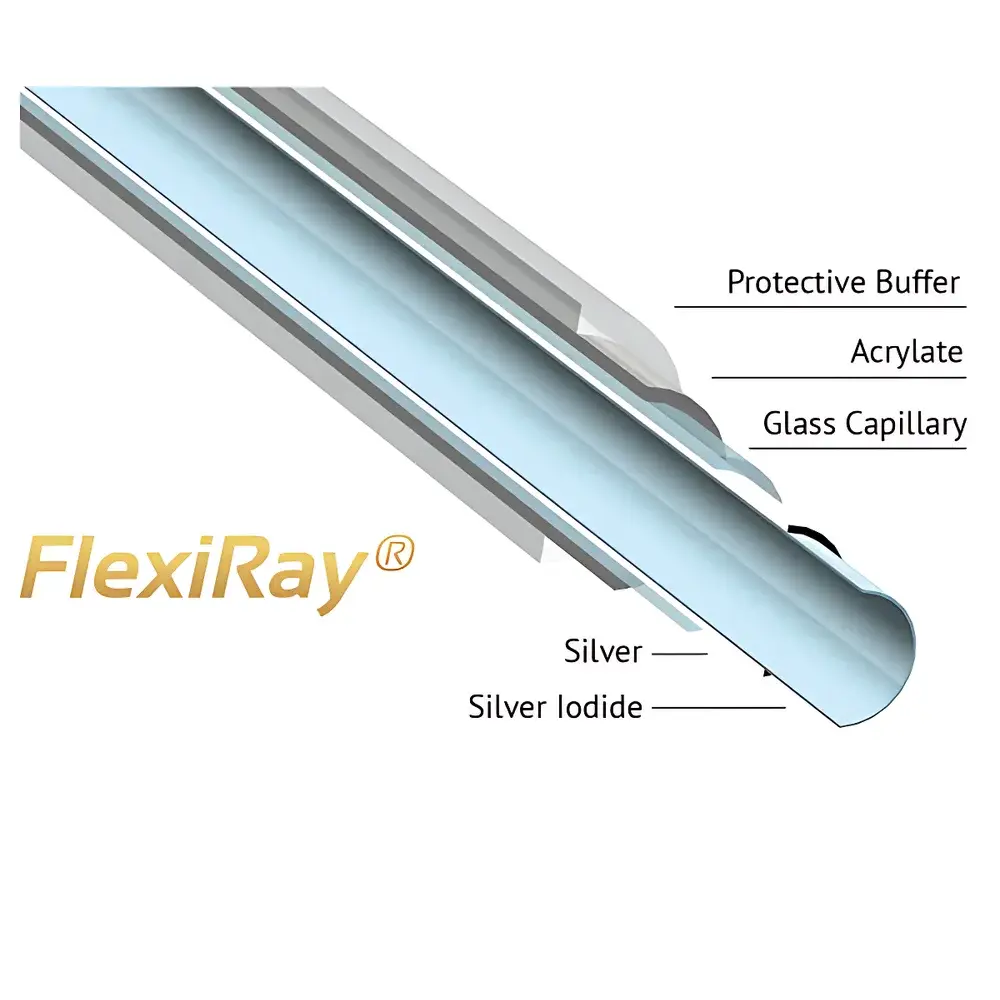
| Coating | Dual-Polymer Protective Layer |
| End-Face Fresnel Reflection | Eliminated |
| Beam Divergence | Low (vs. multimode solid-core IR fibers) |
| Compliance | Designed for ISO/IEC 61300-2-4 (fiber optic connector durability), ASTM F2961-14 (IR fiber handling standards) |
| Application Context | Compatible with Er:YAG (2.94 µm), CO₂ (10.6 µm), OPO, QCL, and broadband FTIR systems |
Overview
The Auniontech HWG Hollow-Core Infrared Quartz Waveguide Fiber is a specialized optical waveguide engineered for low-loss, high-fidelity transmission of mid-infrared radiation across the 2–18 µm spectral band. Unlike conventional solid-core infrared fibers—such as chalcogenide or silver halide fibers—the HWG employs a microstructured hollow-core design fabricated from fused silica, enabling guided propagation via inhibited coupling to the glass cladding rather than total internal reflection. This architecture fundamentally eliminates Fresnel reflection losses at the input and output facets, a critical advantage when coupling high-peak-power pulsed lasers (e.g., Er:YAG at 2.94 µm or CO₂ at 10.6 µm) where interfacial reflections can induce thermal damage or destabilize cavity feedback. The absence of core material absorption also mitigates nonlinear effects and thermal lensing under multi-watt average power conditions. Its mechanical robustness, combined with low beam divergence (<15 mrad typical full-angle output), supports stable free-space beam delivery in alignment-sensitive setups such as quantum cascade laser (QCL) spectroscopy, gas-phase absorption measurements, and laser surgery systems.
Key Features
- Hollow-core fused silica construction ensures intrinsic immunity to Fresnel reflection at air–fiber interfaces, improving coupling efficiency and reducing back-reflection-induced instability in laser cavities.
- Continuous transmission window from 2 µm to 18 µm, validated by spectral attenuation measurements per IEC 61300-3-4, making it suitable for both narrowband QCL sources and broadband FTIR applications.
- Core diameters available from 500 µm to 1000 µm—optimized for balancing power handling (>10 W CW at 10.6 µm), mode control, and bend tolerance.
- Dual-layer polymer coating (inner acrylate + outer polyimide or ETFE) provides mechanical protection, tensile strength >50 kpsi, and operational flexibility down to 30 mm bending radius without measurable loss increase.
- Thermally stable up to 250 °C (short-term), compatible with sterilization protocols used in medical laser delivery systems conforming to ISO 13485 requirements.
Sample Compatibility & Compliance
The HWG fiber is routinely deployed in regulated environments requiring traceable performance documentation. It meets mechanical and environmental test criteria outlined in IEC 61300-2-4 (vibration, shock, and temperature cycling) and ASTM F2961-14 (handling and routing guidelines for IR fibers). While not a finished medical device, its material composition (high-purity SiO₂, halogen-free polymers) aligns with USP Class VI biocompatibility testing prerequisites for non-implantable components. For GLP-compliant spectroscopic installations, fiber calibration certificates—including spectral attenuation profiles at discrete wavelengths (2.94, 4.2, 10.6 µm) and numerical aperture verification—are provided upon request. No proprietary firmware or embedded electronics are present; thus, no FDA 21 CFR Part 11 electronic record controls apply.
Software & Data Management
As a passive optical component, the HWG fiber requires no driver software or firmware updates. Integration into automated systems relies on standard optomechanical mounting (e.g., SMA-905 or FC/PC-compatible ferrules) and is fully compatible with third-party alignment platforms (e.g., Thorlabs Kinesis, Newport ESP300). Spectral transmission data (wavelength vs. dB/m loss) is delivered in CSV and MATLAB .mat formats for integration into custom spectral modeling workflows. Optional NIST-traceable calibration reports include uncertainty budgets per ISO/IEC 17025:2017 Annex A.3, covering measurement repeatability (±0.15 dB/m at 10.6 µm) and wavelength accuracy (±0.2 µm).
Applications
- Laser power delivery for Er:YAG (2.94 µm), CO and CO₂ (5–6 µm and 9–11 µm), and optical parametric oscillator (OPO) systems—especially where pulse energy stability and minimal thermal load at the distal end are critical.
- In-situ gas sensing: Coupled with multipass cells or open-path configurations for real-time detection of CH₄, CO₂, NH₃, and VOCs using tunable QCLs between 4–12 µm.
- Fourier-transform infrared (FTIR) spectrometry: As a flexible light pipe replacing rigid mirror-based beam paths in portable or field-deployable analyzers.
- Mid-IR microscopy and photoacoustic imaging: Enabling fiber-coupled illumination in hybrid modalities where spatial coherence preservation and low dispersion are required.
- Industrial process monitoring: Integration into furnace viewport feedthroughs or combustion exhaust lines for continuous emission analysis under high-temperature ambient conditions.
FAQ
What is the maximum average power the HWG fiber can transmit continuously at 10.6 µm?
Typical power handling is 10–15 W CW under optimized cooling and alignment; derating is recommended above 5 W if bent below 50 mm radius or exposed to ambient >60 °C.
Can the HWG fiber be spliced or connectorized in the field?
No fusion splicing is supported due to hollow-core geometry; factory-terminated connectors (SMA-905, FC/PC, or custom kinematic mounts) are supplied with angular cleave and AR-coated end-facets.
Is the fiber resistant to moisture or chemical exposure?
The dual-polymer coating provides IP54-level protection against humidity and non-aggressive solvents; prolonged immersion or exposure to strong acids/bases is not recommended.
How does HWG compare to photonic bandgap fibers in the mid-IR?
HWG relies on inhibited coupling rather than photonic bandgap guidance, offering broader bandwidth (2–18 µm vs. typically <3 µm windows) and higher damage thresholds, though with slightly higher bend sensitivity above 15°.
Do you provide spectral attenuation data for custom lengths?
Yes—attenuation curves are measured per IEC 61300-3-4 on every production lot; length-specific loss extrapolation is provided with ±0.05 dB/m uncertainty for orders ≥5 m.



