
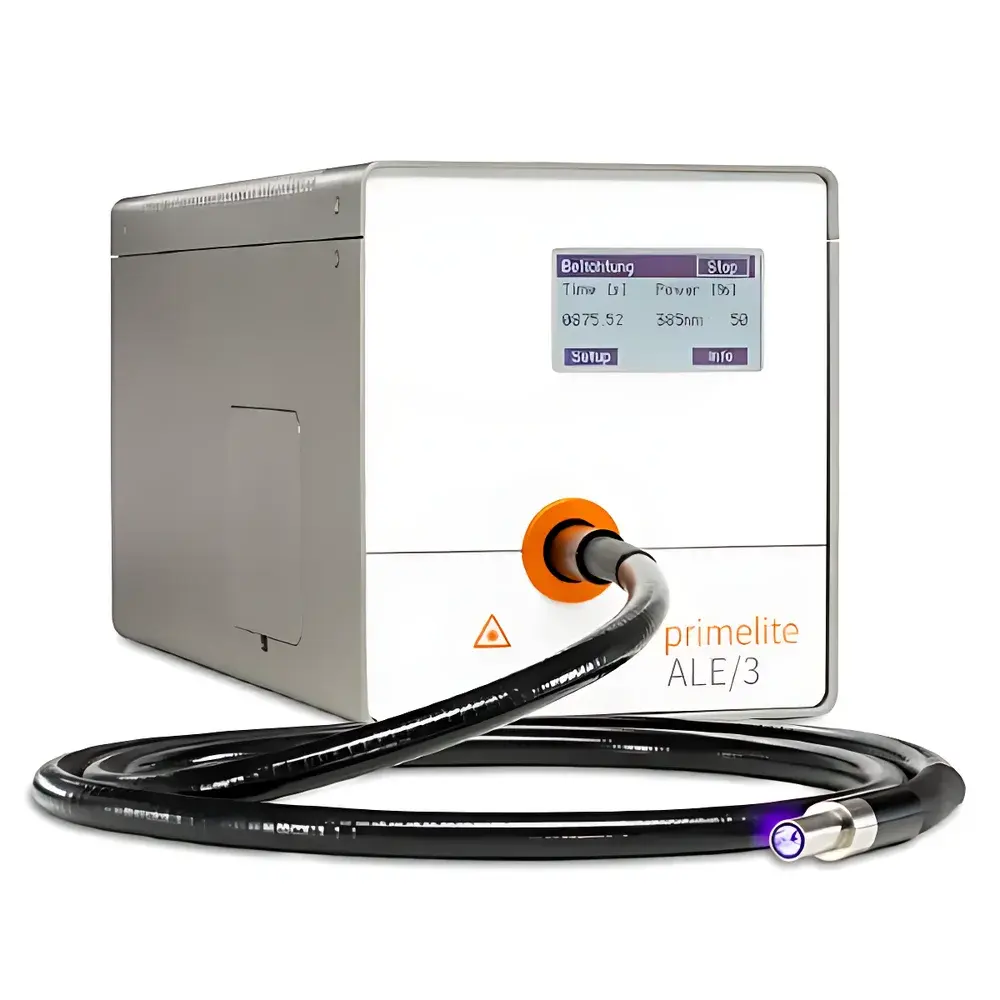
Auniontech ALE/3 Series 15W Fiber-Coupled UV-LED Spot Light Source
| Brand | Auniontech |
|---|---|
| Origin | Shanghai, China |
| Manufacturer Type | Authorized Distributor |
| Product Category | Domestic |
| Model | Tunable / Broadband UV LED Source |
| Light Source Type | UV-LED (not mercury lamp) |
| Output Power | 15 W (fiber-coupled) |
| Spectral Options | Narrowband (i-line @ 365 nm, h-line @ 405 nm, g-line @ 435 nm) or Broadband (365–405 nm) |
| Numerical Aperture (NA) | 0.6 (±70° half-angle) |
| Intensity Control | 10–100% (high-resolution analog/digital) |
| Rise Time | <1 ms |
| Cooling | Integrated active thermal management |
| Dimensions (W×H×D) | 14.5 × 16.5 × 34 cm |
| Weight | 6 kg |
| Input Power | 110–240 VAC, 50–60 Hz, 350 W max |
| Fiber Coupling | Liquid light guide options (core diameters: 5.0 mm, 6.5 mm, 8.5 mm |
| Interfaces | Touchscreen controller, USB-AUX, TTL-compatible PLC I/O, optional Ethernet/Modbus TCP |
| Compliance | CE-marked, RoHS-compliant, designed for GLP-aligned lab and industrial integration |
Overview
The Auniontech ALE/3 Series 15W Fiber-Coupled UV-LED Spot Light Source is an engineered solution for precision ultraviolet illumination in photolithography, UV curing, fluorescence excitation, and optical metrology applications. Unlike conventional mercury arc lamps—whose spectral output includes hazardous UV-C, ozone-generating wavelengths, and significant IR heat—the ALE/3 leverages solid-state UV-LED technology to deliver stable, narrowband or broadband irradiance within the 365–405 nm range. Its fiber-coupled architecture enables spatial decoupling of the emission head from thermal and electrical subsystems, supporting integration into cleanroom-compatible tooling, mask aligners, and automated assembly stations. The source operates on a fundamental principle of electroluminescence in AlGaN-based semiconductor junctions, ensuring wavelength stability (<±1 nm drift over 8 h at constant current), minimal spectral drift with temperature, and immunity to electrode degradation or plasma instability inherent in gas-discharge sources.
Key Features
- 15 W optical output power (measured at fiber exit face, calibrated per ISO 15779:2021), exceeding radiometric efficacy of 200 W mercury lamps while eliminating mercury vapor, ozone generation, and UV-C hazards
- Selectable spectral configuration: discrete narrowband modes (365 nm i-line, 405 nm h-line, 435 nm g-line) or continuous broadband (365–405 nm FWHM), enabling depth-controlled photopolymerization in multi-layer resin systems
- Fiber-coupled delivery via liquid light guides (LLGs) with NA 0.6 (±70° acceptance angle), supporting high étendue preservation and uniform irradiance profiles when paired with homogenizing optics
- Sub-millisecond optical switching (<1 ms rise/fall time) synchronized via TTL or Modbus TCP, suitable for pulsed exposure protocols in stepper lithography and digital light processing (DLP)
- Integrated thermoelectric and forced-air hybrid cooling maintains LED junction temperature within ±0.5 °C across 0–100% intensity range, ensuring long-term radiometric repeatability (±1.2% over 1,000 h MTBF)
- Modular LED engine design allows field-replaceable emitter cartridges without recalibration—reducing downtime and total cost of ownership in GMP-compliant manufacturing environments
Sample Compatibility & Compliance
The ALE/3 series is compatible with standard quartz-core liquid light guides (5.0 mm, 6.5 mm, and 8.5 mm core diameters) and supports custom termination geometries—including SMA905, FC/PC, and bare-fiber ferrules—for direct coupling to collimators, integrator rods, or microscope epi-illumination paths. All optical materials comply with ISO 10110-7 surface quality standards and are certified free of outgassing compounds per ASTM E595. The system meets CE Directive 2014/30/EU (EMC), 2014/35/EU (LVD), and RoHS 2011/65/EU. Firmware implements audit-trail logging per FDA 21 CFR Part 11 requirements when Ethernet interface is enabled, supporting electronic signatures and user-access-tiered control for regulated QC/QA workflows.
Software & Data Management
Local operation is managed via a 5-inch capacitive touchscreen running embedded Linux with real-time kernel scheduling. Intensity, pulse width, and sequence programming are configurable through intuitive GUI layers or programmatically via ASCII command set over USB-AUX or RS-485. Optional Modbus TCP gateway enables integration into SCADA platforms (e.g., Ignition, Siemens WinCC) for centralized irradiance monitoring and batch-record linkage. All operational parameters—including drive current, heatsink temperature, and cumulative LED-on hours—are logged with UTC timestamps and exportable as CSV or XML. Calibration certificates (NIST-traceable irradiance at 365 nm and 405 nm) are provided with each unit and digitally signed within firmware memory.
Applications
- Photolithography: i-line (365 nm) exposure in mask aligners and proximity printers; broadband mode enables dual-wavelength curing for graded refractive index waveguides
- UV Curing: Depth-penetrating polymerization of acrylate-epoxy hybrids in adhesive dispensing, conformal coating, and 3D printing support removal
- Fluorescence Microscopy: Excitation of DAPI, Hoechst, and quantum dot probes requiring stable, low-noise UV excitation without phototoxic background
- Optical Testing: Uniformity mapping of UV-transmissive optics (fused silica, CaF₂) and solar-blind detector calibration
- Industrial Inspection: Fluorescent penetrant testing (PT) under controlled spectral bands compliant with ASTM E1417 and ISO 3452-2
FAQ
Is this product classified as a mercury lamp replacement?
No. The ALE/3 is a solid-state UV-LED source. It contains no mercury, emits no ozone, and produces negligible IR radiation—making it inherently safer and more energy-efficient than mercury vapor lamps.
Can the spectral output be changed after purchase?
Yes. The modular LED engine supports hot-swappable emitter cartridges. Users may order additional narrowband or broadband modules and install them without recalibration or service intervention.
What is the maximum recommended fiber length for liquid light guides?
For optimal irradiance throughput and thermal stability, standard configurations use 1.5 m LLGs. Custom lengths up to 20 m are supported; however, attenuation exceeds 18% per 10 m beyond 5 m at 365 nm, necessitating power compensation or relay optics.
Does the system support automated process validation per GMP guidelines?
Yes. With Ethernet/Modbus option enabled, the device logs all critical parameters with tamper-proof timestamps, supports role-based user authentication, and exports audit trails compatible with QbD documentation frameworks.
Are NIST-traceable calibration reports included?
Yes. Each unit ships with a factory calibration certificate covering absolute irradiance (W/cm²) at 365 nm and 405 nm, traceable to NIST SRM 2241 and 2242, valid for 12 months from shipment date.





