
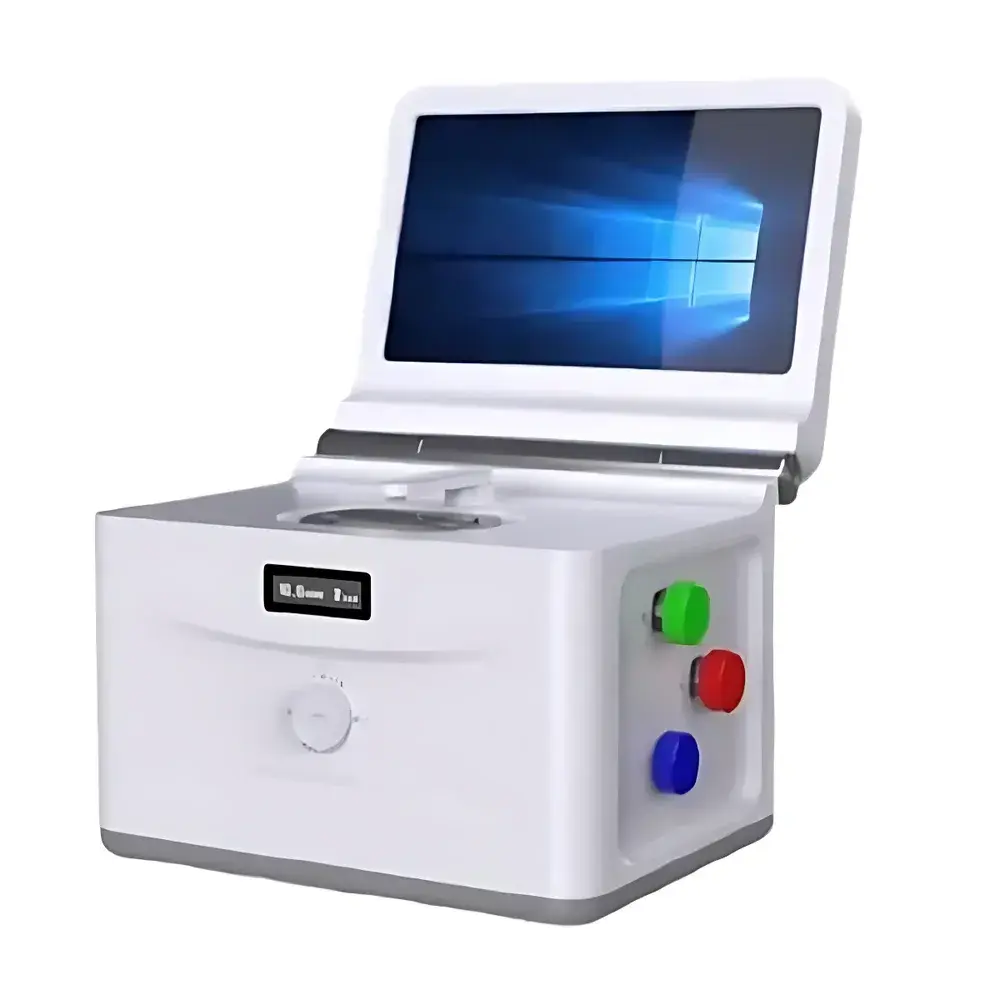
Auniontech Optical Tweezers Microscope
| Brand | Auniontech |
|---|---|
| Model | Optical Tweezers Microscope |
| Laser Source | 785 nm, TEM₀₀, 0–120 mW output |
| Objective Lenses | Dry 60× (NA 0.85) or Oil-immersion 100× (NA 1.25) |
| Sample Compatibility | Aqueous suspensions of transparent cells or polystyrene microspheres (1–5 µm, ≥200 nm standard) |
| Optical Trapping Threshold Power | 50 mW (for 5 µm yeast cells) |
| Trap Depth | >20 µm (at 100 mW, 5 µm yeast cells) |
| Trap Radius | 5 µm (at 100 mW, 5 µm yeast cells) |
| Imaging System | 5 MP CMOS camera with real-time acquisition software |
| Illumination | Adjustable LED (0–9 intensity levels) |
| Sample Chamber | Standard 0.17 mm cover glass |
| Precision Stage | Motorized XYZ platform, linear deviation / tilt <8 µm, ±2 mm travel range |
| Embedded Computer | Windows 10, 11-inch display, Wi-Fi, Gigabit Ethernet, HDMI, USB ports |
| Dimensions & Weight | 300 × 230 × 230 mm, 7 kg |
| Warranty | 12 months (normal use, non-human-induced damage) |
| Service | On-site technical training included |
Overview
The Auniontech Optical Tweezers Microscope is a fully integrated, benchtop instrument engineered for quantitative manipulation and real-time observation of microscopic dielectric particles in aqueous media. Based on the principle of radiation pressure from a tightly focused Gaussian laser beam (785 nm, TEM00 mode), it generates stable three-dimensional optical potential wells capable of trapping, translating, rotating, and holding individual cells or synthetic microspheres without physical contact. This non-invasive capability enables force calibration at the piconewton (pN) scale and displacement resolution down to nanometers—making it indispensable for single-molecule biophysics, mechanobiology, colloidal dynamics, and soft matter rheology studies. The system is designed for compatibility with standard inverted microscopy workflows and integrates seamlessly into regulated laboratory environments requiring traceable instrumentation and reproducible experimental protocols.
Key Features
- High-stability 785 nm diode laser with precise power control (0–120 mW) and TEM00 spatial profile, optimized for low photodamage in live-cell applications
- Dual-objective configuration: high-NA dry 60× (NA 0.85) for rapid survey imaging and oil-immersion 100× (NA 1.25) for maximum trap stiffness and spatial confinement
- Motorized XYZ translation stage with sub-micron repeatability and angular stability (<8 µm linear deviation over ±2 mm range), enabling calibrated force application and multi-particle positioning
- Integrated 5 MP CMOS imaging subsystem with real-time acquisition software, supporting time-lapse tracking, centroid analysis, and trajectory export in TIFF/CSV formats
- Adjustable LED Köhler illumination (0–9 intensity steps) for simultaneous brightfield visualization and optical trapping—no interference with trapping laser path
- Compact embedded computing platform (Windows 10, 11-inch touchscreen) with native support for USB peripherals, networked data export, and remote monitoring via Ethernet or Wi-Fi
- Standardized sample interface: accommodates 0.17 mm cover glasses and 5 mm internal-diameter chambers, compatible with commercial microfluidic chips and custom-designed flow cells
Sample Compatibility & Compliance
The system is validated for use with biological specimens including mammalian cells, yeast, bacteria, and erythrocytes, as well as monodisperse polystyrene (PS) microspheres (1–5 µm, ≥200 nm) traceable to NIST SRM standards. Trapping performance meets ISO 21501-4 requirements for particle sizing instrument calibration when used with certified reference materials. All optical components comply with IEC 60825-1:2014 Class 3B laser safety specifications. The embedded software architecture supports audit trails and user access logs—facilitating alignment with GLP and GMP documentation requirements where applicable. While not FDA-cleared as a medical device, the platform conforms to general laboratory instrumentation standards referenced in ASTM E2554 (standard guide for uncertainty analysis in quantitative microscopy) and ISO/IEC 17025:2017 (general requirements for competence of testing and calibration laboratories).
Software & Data Management
The proprietary acquisition and analysis suite provides synchronized control of laser power, stage motion, illumination intensity, and image capture. It includes built-in algorithms for real-time centroid tracking, mean-square displacement (MSD) computation, and passive microrheology analysis. Export formats include time-stamped TIFF stacks, CSV-based positional trajectories, and JSON metadata files containing hardware configuration, calibration parameters, and environmental timestamps. Data integrity is preserved through automatic checksum generation and optional encryption. Software updates are delivered via secure HTTPS channels, and version history is retained for regulatory traceability. The system supports integration with third-party platforms such as MATLAB, Python (via PyTweezers-compatible API), and LabVIEW through documented DLL interfaces.
Applications
- Single-cell mechanotransduction assays: quantifying cytoskeletal response to applied pN-scale forces
- Chromosome segregation dynamics during mitosis using optically trapped kinetochores
- Colloidal self-assembly and interparticle interaction mapping under controlled hydrodynamic conditions
- Micro-rheology of viscoelastic biomaterials (e.g., hyaluronic acid gels, fibrin networks) via probe-particle diffusion analysis
- Optical binding studies between dielectric nanoparticles in evanescent fields
- Educational demonstrations of radiation pressure, gradient forces, and Brownian motion in undergraduate physics laboratories
FAQ
What is the minimum particle size resolvable and trapable with this system?
Particles as small as 200 nm (polystyrene standard spheres) can be stably trapped using the 100× oil-immersion objective at full laser power (100 mW). Sub-200 nm trapping is possible but requires empirical optimization and is not guaranteed across all sample matrices.
Can the system perform dual-trap or holographic optical tweezers experiments?
This is a single-beam gradient-force optical tweezers platform. Multi-trap functionality is not natively supported; however, external spatial light modulators (SLMs) or acousto-optic deflectors (AODs) may be integrated via the available optical port and TTL synchronization interface.
Is the software compliant with 21 CFR Part 11 requirements?
The base software does not include electronic signature or role-based access controls required for full 21 CFR Part 11 compliance. However, an optional validated software module with audit trail, user authentication, and electronic signature capabilities is available upon request for regulated environments.
What maintenance is required for long-term operational stability?
Annual recalibration of laser power meter and stage position encoder is recommended. Objective lens cleaning with spectroscopic-grade solvents and periodic verification of beam alignment using shear interferometry are advised per ISO 10110-7 guidelines.
Does the system support temperature or CO₂-controlled sample environments?
The standard chamber is ambient-air compatible. Environmental control modules—including heated stage inserts (20–40 °C), humidity-regulated enclosures, and compact incubator adapters—are available as accessories and integrate mechanically and electrically with the main unit.




