
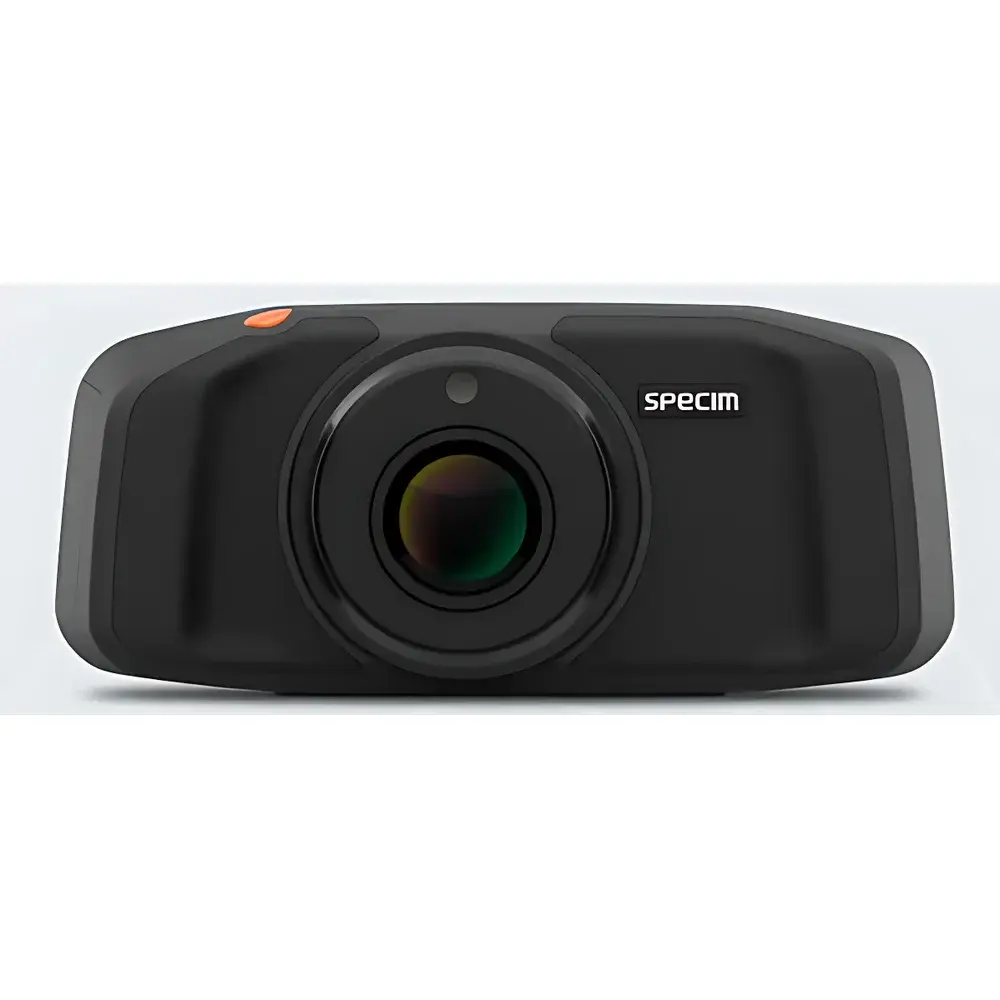
Specim IQ Handheld Hyperspectral Imaging Camera
| Brand | Specim (Finland) |
|---|---|
| Origin | Finland |
| Model | Specim IQ |
| Spectral Range | 400–1000 nm (VNIR) |
| Spectral Resolution | FWHM 7 nm |
| Spatial Sampling | 512 pixels |
| Number of Spectral Bands | 204 (with optional 2× and 3× binning) |
| Image Resolution | 512 × 512 pixels |
| Field of View (FOV) | 31° × 31° |
| Instantaneous FOV (IFOV) | ~0.06° per pixel |
| Ground Sampling Distance @ 1 m | 0.55 × 0.55 m |
| Aperture | f/1.7 |
| Peak SNR | >400:1 |
| Working Distance | 150 mm to ∞ |
| Operating Temperature | 0 °C to +40 °C |
| Operating Humidity | ≤95% non-condensing |
| Weight | 1.3 kg |
| Dimensions | 207 × 91 × 74 mm (lens length: 125.5 mm) |
| Battery | 5200 mAh Li-ion (26650) |
| Runtime | Up to 100 measurements per charge (SD card + battery) |
| Display | 4.3″ capacitive touchscreen |
| Physical Controls | 13 dedicated function keys |
| Interface | USB Type-C |
| Onboard Storage | 32 GB SD card (user-replaceable) |
| Data Format | ENVI-compatible Specim data cubes (.hdr/.raw) |
| Software | Specim IQ Studio (data acquisition, preprocessing, modeling, visualization) |
Overview
The Specim IQ Handheld Hyperspectral Imaging Camera is a fully integrated, field-deployable VNIR (400–1000 nm) hyperspectral imager engineered for scientific-grade spectral analysis in real-world environments. Unlike conventional RGB or multispectral systems, the Specim IQ captures contiguous spectral information across 204 narrow bands at 7 nm full-width-at-half-maximum (FWHM) resolution—enabling precise material identification, chemical mapping, and quantitative reflectance analysis based on spectral signature discrimination. Its compact, ruggedized architecture embeds optical imaging, spectral calibration, onboard processing, and intuitive user interaction into a single handheld unit weighing only 1.3 kg. Designed for ground-based operation under ambient lighting conditions, it operates without external power or tethered computing—leveraging its internal 5200 mAh Li-ion battery and removable 32 GB SD card for autonomous data acquisition. The system employs push-broom imaging geometry with a fixed-focus f/1.7 lens and 512 × 512 spatial sampling, delivering high-fidelity spectral cubes with peak signal-to-noise ratio exceeding 400:1. This enables reliable detection of subtle spectral features critical in plant phenotyping, food quality assessment, forensic trace analysis, and cultural heritage documentation.
Key Features
- Self-contained hyperspectral imaging platform: integrates optics, sensor, processing unit, display, battery, and storage in one handheld enclosure
- VNIR spectral coverage from 400 nm to 1000 nm with 7 nm FWHM spectral resolution and 204 native bands (configurable via 2× or 3× spatial/spectral binning)
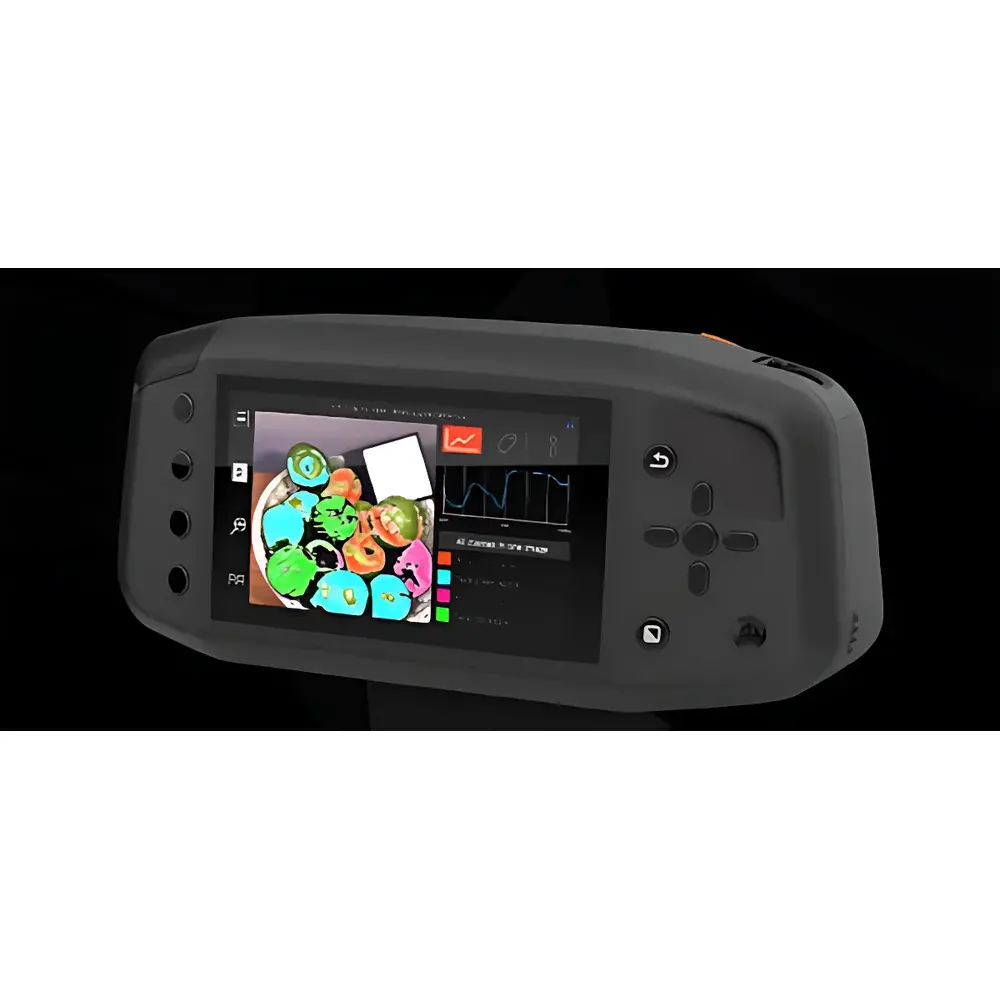
- Onboard 4.3″ capacitive touchscreen and 13 physical control keys for rapid parameter adjustment—no external device required for basic operation
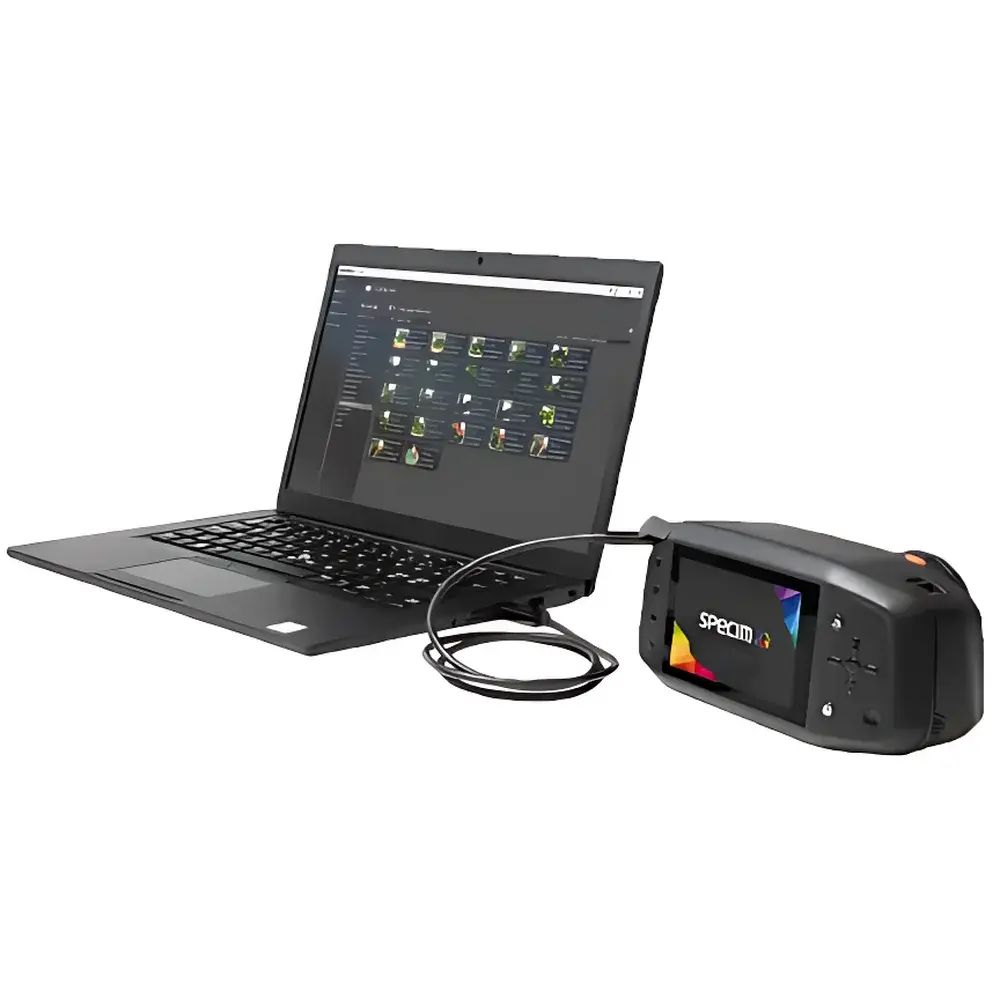
- USB Type-C interface for high-speed data transfer and remote control; dual-mode connectivity supports both wired and Wi-Fi-based operation
- ENVI-compatible data output (.hdr/.raw format) ensuring seamless integration with established spectral analysis workflows in MATLAB, Python (scikit-learn, spectral), or commercial platforms
- IP-rated mechanical housing with thermal and humidity resilience (0–40 °C, ≤95% non-condensing RH), suitable for extended outdoor use
- Real-time preview and post-capture spectral visualization—including spectral profile extraction, region-of-interest (ROI) analysis, and false-color band ratio mapping
Sample Compatibility & Compliance
The Specim IQ is optimized for reflective surface analysis under natural or controlled illumination. It accommodates heterogeneous, non-uniform, and irregularly shaped samples—from leaf canopies and food produce to painted surfaces and biological tissues—without requiring sample preparation or contact. Its 150 mm minimum focus distance and 31° × 31° FOV support flexible standoff measurements at distances ranging from close-range macro imaging to 1-meter-scale area scanning. While not certified for regulated clinical diagnostics, the instrument conforms to CE marking requirements for electromagnetic compatibility (EMC Directive 2014/30/EU) and low-voltage safety (LVD Directive 2014/35/EU). Its data acquisition workflow supports audit-ready metadata logging—including timestamp, GPS (when paired with external GNSS), integration time, and calibration state—facilitating GLP-aligned experimental documentation. Data provenance and integrity are preserved through embedded header structures compliant with ENVI and HDF5 standards.
Software & Data Management
Specim IQ Studio is the official cross-platform application (Windows/macOS) for advanced control, calibration management, and spectral modeling. It provides live camera feed monitoring, exposure optimization, dark/reference correction, and spectral cube export. Crucially, IQ Studio includes an embedded model builder enabling users to develop application-specific classification or regression models using supervised machine learning algorithms (e.g., PLS-DA, SVM, Random Forest). Trained models can be deployed directly onto the device for real-time inference—supporting edge-based decision-making in field settings. All raw and processed data retain full spectral fidelity and geotagging capability when synchronized with external GNSS modules. No proprietary lock-in occurs: spectral cubes are stored in open-format binary files with human-readable ASCII headers, compatible with third-party libraries including GDAL, SciPy, and ENVI Classic.
Applications
- Plant Science: Non-destructive chlorophyll estimation, water stress detection, nutrient deficiency mapping, and early disease symptom identification via spectral vegetation indices (e.g., NDVI, PRI, MCARI)
- Food Quality Assurance: Detection of surface contamination, bruising, spoilage, and compositional heterogeneity (e.g., sugar content in fruit, fat distribution in meat)
- Forensic Investigation: Differentiation of ink types, blood vs. non-blood stains, latent fingerprint enhancement, and document alteration analysis
- Cultural Heritage: Pigment identification, underdrawing revelation, varnish degradation assessment, and conservation material verification
- Biomedical Research: Skin lesion characterization, wound healing monitoring, and ex vivo tissue differentiation (research-use-only context)
FAQ
Does the Specim IQ require external calibration sources during field use?
No. The system includes factory-applied radiometric and spectral calibration coefficients embedded in firmware. Optional user-performed white/dark reference capture is supported via IQ Studio but not mandatory for qualitative analysis.
Can spectral models built in IQ Studio be exported for use in Python or MATLAB?
Yes. Classification and regression models are exportable as ONNX or PMML files, enabling deployment in custom analytical pipelines outside the Specim ecosystem.
Is GPS positioning natively integrated?
No. Built-in GNSS is not included, but the system supports NMEA 0183 input via USB serial or Bluetooth from external receivers for georeferenced data tagging.
What is the maximum effective working distance for reliable spectral quantification?
At 1 meter standoff, GSD is 0.55 × 0.55 m per pixel. For sub-centimeter feature resolution, optimal working distance is 150–500 mm depending on target size and required spatial fidelity.
Is the Specim IQ compliant with FDA 21 CFR Part 11 for regulated environments?
The hardware and firmware do not provide electronic signature, audit trail, or role-based access control out-of-the-box. However, IQ Studio supports export of raw data with complete metadata, enabling integration into validated LIMS or ELN systems that meet Part 11 requirements.
Related Products






