
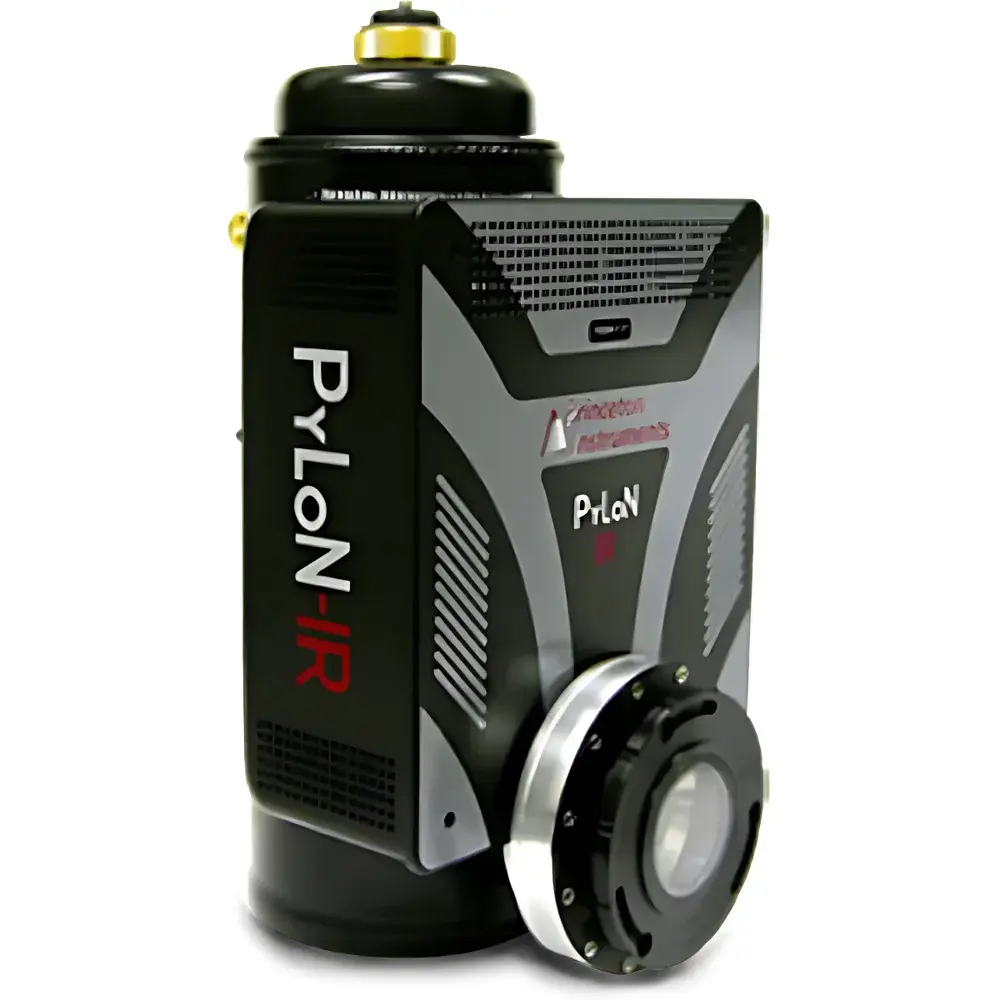
Teledyne Princeton Instruments PyLoN-IR Series Liquid-Nitrogen-Cooled InGaAs Spectral Camera
| Brand | Teledyne Princeton Instruments |
|---|---|
| Origin | Shanghai, China |
| Manufacturer Type | Authorized Distributor |
| Country of Origin | China |
| Model | PyLoN-IR Series (1024-1.7 & 1024-2.2) |
| Spectral Range | 800–1700 nm (PyLoN-IR:1024-1.7) / 1000–2200 nm (PyLoN-IR:1024-2.2) |
| Cooling Temperature | −100 °C |
| Readout Rate | 6600 spectra/s |
| Digitization | 16-bit |
| Sensor Format | 1024 × 1 linear InGaAs photodiode array |
| Pixel Size | 25 µm × 500 µm (1024-1.7) / 25 µm × 250 µm (1024-2.2) |
| Read Noise | 5000 e⁻ (low-gain, 1024-1.7) / 400 e⁻ (high-gain, 1024-1.7) |
| Well Capacity | 120 Me⁻ (low-gain) / 4.5 Me⁻ (high-gain) |
| Exposure Time | Down to 20 µs |
| Quantum Efficiency | >85% (800–1700 nm, 1024-1.7) / 75% (1000–2200 nm, 1024-2.2) |
| Software | LightField v8.x with IntelliCal, PICAM SDK support |
| Compliance | ASTM E131, ISO/IEC 17025-compatible workflows, FDA 21 CFR Part 11-ready audit trail (via LightField) |
Overview
The Teledyne Princeton Instruments PyLoN-IR Series is a high-performance, liquid-nitrogen-cooled spectral imaging camera engineered for demanding near-infrared (NIR) and short-wave infrared (SWIR) spectroscopy applications. Built around a thermoelectrically assisted, cryogenically stabilized InGaAs linear detector array, the system operates on the principle of dispersive spectroscopy—capturing spectral intensity distributions across a fixed spatial axis (1024 pixels) with sub-millisecond temporal resolution. Its core architecture leverages deep cooling (−100 °C) to suppress dark current to <0.001 e⁻/pixel/s, enabling integration times from 20 µs up to several minutes without thermal signal contamination. This makes the PyLoN-IR uniquely suited for low-light, high-dynamic-range, and time-resolved spectral measurements where signal fidelity, reproducibility, and photon-limited detection are critical—such as in Raman shift analysis, laser-induced breakdown spectroscopy (LIBS), gas-phase absorption monitoring, and quantum dot photoluminescence mapping.
Key Features
- Deep cryogenic cooling to −100 °C via integrated LN₂ Dewar, ensuring ultra-low dark current and enabling long-exposure stability
- Dual-amplifier readout architecture: high-sensitivity mode (400 e⁻ read noise at high gain) for weak-signal detection; high-capacity mode (120 Me⁻ full-well) for broad dynamic range
- Real-time 16-bit digitization across all acquisition speeds, preserving quantitative linearity and minimizing quantization error
- Optimized optical interface with single-entry cold window and re-engineered cold shield, reducing stray thermal radiation and maximizing quantum efficiency
- Modular Dewar options—including end-loaded and omnidirectional configurations—for flexible integration into vacuum chambers, cryostats, or custom optical benches
- Factory-calibrated quantum efficiency curves traceable to NIST standards, with optional user-accessible recalibration protocols
Sample Compatibility & Compliance
The PyLoN-IR supports solid, liquid, and gaseous samples in transmission, reflection, and emission geometries when coupled with appropriate spectrometers (e.g., Czerny-Turner or transmission grating systems). Its 1024-pixel linear format is optimized for slit-based spectrographs with f/4–f/8 input optics. The camera complies with foundational spectroscopic metrology standards including ASTM E131 (Standard Terminology Relating to Molecular Spectroscopy) and supports laboratory quality management frameworks aligned with ISO/IEC 17025. When operated with LightField software in validated configuration, it meets data integrity requirements for regulated environments: electronic signatures, audit trails, and instrument control logs conform to FDA 21 CFR Part 11 guidelines. No modifications to firmware or hardware are required to achieve GLP/GMP-compliant operation—only documented procedural controls and software validation.
Software & Data Management
LightField v8.x serves as the native acquisition and analysis platform, offering synchronized control of both camera and spectrometer parameters (grating position, slit width, integration time) within a single GUI. Its embedded mathematical engine enables real-time spectral processing—including background subtraction, peak centroiding, area integration, and multi-curve fitting—without exporting raw data. The software natively supports IntelliCal, an automated wavelength and intensity calibration routine that uses built-in reference sources (e.g., Hg/Ar lamp lines) to maintain spectral accuracy over time and temperature drift. For programmatic integration, the PICAM Software Development Kit provides C/C++, Python, MATLAB, and LabVIEW® bindings—enabling direct memory-mapped access to frame buffers and eliminating middleware latency. All metadata (exposure, gain, cooling status, calibration timestamps) is embedded in industry-standard HDF5 and FITS file formats.
Applications
- Time-resolved photoluminescence decay analysis of III-V semiconductors and perovskite thin films
- In-line process monitoring of polymer extrusion and pharmaceutical tablet coating via NIR reflectance spectroscopy
- High-resolution gas-phase absorption spectroscopy for CH₄, CO, and H₂O isotopic ratio quantification
- Non-destructive evaluation of composite materials using SWIR reflectance contrast imaging
- Ultrafast pump-probe spectroscopy requiring sub-100 µs spectral acquisition duty cycles
- Calibration transfer between benchtop and portable spectrometers using PyLoN-IR as a primary reference standard
FAQ
What cooling method does the PyLoN-IR use, and how often must liquid nitrogen be refilled?
The PyLoN-IR employs a vacuum-insulated, liquid-nitrogen-cooled Dewar with auto-refill capability. With standard 1-L capacity and ambient lab conditions (23 °C, 50% RH), a single fill sustains stable −100 °C operation for ≥24 hours.
Is the sensor sensitive beyond 1700 nm?
The PyLoN-IR:1024-1.7 model is optimized for 800–1700 nm; for extended response to 2200 nm, the PyLoN-IR:1024-2.2 variant is specified, with peak QE centered at ~1900 nm.
Can the camera operate in triggered or external sync mode?
Yes—hardware-level TTL triggering (rising/falling edge selectable) is supported for precise synchronization with lasers, choppers, or pulsed light sources.
Does LightField support batch processing of spectral time-series datasets?
Yes—LightField’s scripting module (Python-based) allows automated loading, normalization, PCA decomposition, and export of time-evolving spectral matrices in CSV or MATLAB .mat format.
Are factory calibration certificates provided with each unit?
Each PyLoN-IR ships with a NIST-traceable QE curve, dark current map, and linearity report. Optional ISO/IEC 17025-accredited calibration is available upon request.





