
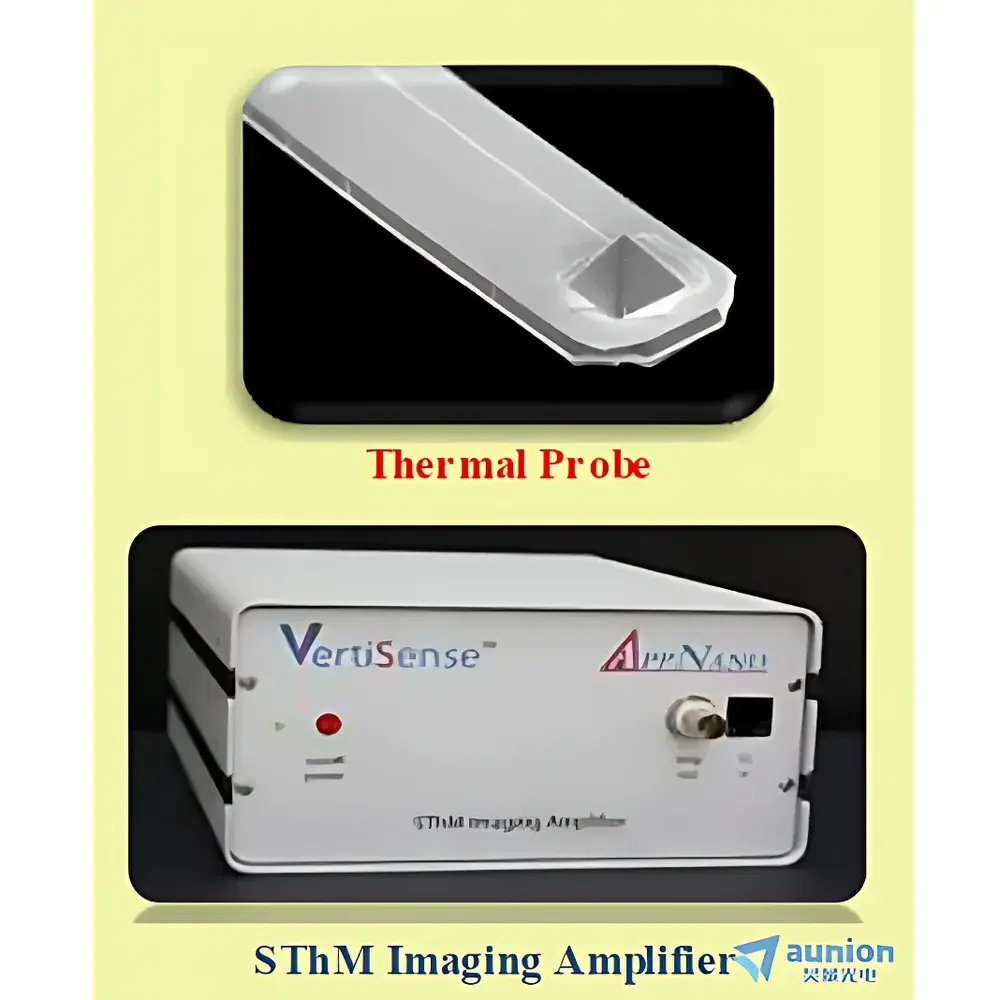
auniontech VertiSense™ SThM Near-Field Thermal Imaging Module
| Brand | auniontech |
|---|---|
| Model | VertiSense™ SThM |
| Probe Types | VTP-200 / VTP-500 |
| Spring Constant | 9.9 N/m (VTP-200) / 0.63 N/m (VTP-500) |
| Resonant Frequency | 107 kHz (VTP-200) / 17 kHz (VTP-500) |
| Cantilever Length | 200 µm / 500 µm |
| Width | 50 µm |
| Thickness | 3.5 µm |
| Tip Radius of Curvature | ≤50 nm |
| Lateral Thermal Resolution | <50 nm (contact mode) |
| Temperature Resolution | 0.1 °C @ 100× gain / 0.01 °C @ 1000× gain |
| Max Operating Temperature | 700 °C |
| Thermal Measurement Bandwidth | up to 30 kHz @ 100× gain |
| Thermal Response Time | ~100 µs (low thermal mass design) |
| Amplifier Input Range | ±10 mV |
| Output Range | ±10 V |
| Gain Adjustment | 100× – 10,000× |
| Input Noise | <1 nV/√Hz @ 1 kHz |
| Common-Mode Rejection Ratio | >115 dB |
| Interface | Analog output + Bluetooth-enabled Android app control |
| Compatibility | Integrates with commercial AFM platforms requiring minimal peripheral hardware |
Overview
The auniontech VertiSense™ SThM Near-Field Thermal Imaging Module is an engineered solution for quantitative nanoscale thermometry in scanning probe microscopy. Based on Scanning Thermal Microscopy (SThM) principles, it employs custom-fabricated atomic force microscope (AFM) probes featuring integrated thermocouple junctions positioned at the apex of the tip—enabling true local temperature measurement with sub-50 nm lateral spatial resolution. Unlike far-field infrared techniques limited by diffraction, this module operates in the near-field regime, where thermal transport occurs via solid-state conduction between tip and sample surface. The system delivers calibrated temperature maps synchronized with topographic data, supporting both temperature-contrast and thermal-conductivity-contrast imaging modes. Its low-thermal-mass probe design ensures rapid transient response (~100 µs), making it suitable for dynamic thermal analysis of microelectronic devices, phase-change materials, and heterogeneous thin-film structures under ambient or controlled environments.
Key Features
- Apex-located thermocouple sensor with ≤50 nm radius of curvature for true nanoscale thermal localization
- Real-time temperature readout with selectable gain (100×–10,000×) and noise floor <1 nV/√Hz @ 1 kHz
- Dual-probe compatibility: VTP-200 (stiff, high-frequency) and VTP-500 (soft, low-resonance) for varied sample compliance requirements
- Wide operational temperature range: ambient to 700 °C, validated for use with heated stages and vacuum-compatible AFM configurations
- Bluetooth-enabled Android application for remote parameter adjustment, live temperature monitoring, and gain calibration
- High common-mode rejection (>115 dB) ensures robust signal integrity in electrically noisy lab environments
- Modular analog interface (±10 mV input / ±10 V output) designed for seamless integration into existing AFM control electronics
- Onboard thermal delay compensation and user-accessible thermocouple calibration routines per ISO/IEC 17025 traceable protocols
Sample Compatibility & Compliance
The VertiSense™ SThM module is compatible with standard contact, tapping, and lift-mode AFM operations across diverse material classes—including semiconductors (Si, GaN, SiC), dielectrics (SiO₂, h-BN), polymers, 2D materials (graphene, MoS₂), and metallic thin films. It supports measurements under inert gas, vacuum, and ambient conditions. All probe geometries comply with ISO 11380:2017 (microcantilever dimensional tolerances) and ASTM E2579-21 (standard guide for SThM calibration). The amplifier’s analog output architecture meets IEC 61326-1:2013 requirements for electromagnetic compatibility in laboratory instrumentation. For regulated environments, the system supports audit-trail-enabled calibration logging aligned with GLP and GMP documentation workflows.
Software & Data Management
No proprietary acquisition software is required—the module interfaces directly with industry-standard AFM platforms (e.g., Bruker, Keysight, Nanosurf) via analog voltage inputs. Thermal data streams synchronously with topography and deflection channels, enabling pixel-aligned thermal mapping within native AFM software suites. Calibration parameters—including Seebeck coefficient, offset correction, and gain-dependent noise floor—are stored in non-volatile memory and accessible through the Android companion app. Export formats include ASCII (.txt), HDF5, and TIFF stacks compliant with FIJI/ImageJ and MATLAB-based post-processing pipelines. All calibration events are timestamped and exportable as CSV logs for FDA 21 CFR Part 11-compliant record retention.
Applications
- Nanoscale hotspot detection in advanced IC interconnects and power transistors
- Thermal boundary resistance quantification at metal/dielectric and 2D heterostructure interfaces
- In situ thermal profiling during electrochemical reactions or resistive switching events
- Local thermal conductivity mapping of composite polymer films and thermoelectric nanostructures
- Validation of multiscale thermal simulation models (e.g., finite-element analysis of phonon transport)
- Quality assurance of laser-welded micro-joints and additive-manufactured lattice structures
FAQ
What AFM systems is the VertiSense™ SThM module compatible with?
It integrates with any AFM platform providing analog input capability for external sensor signals and supporting third-party probe mounting. Verified compatibility includes Bruker Dimension Icon, Keysight 5500, and Nanosurf FlexAFM series.
Is vacuum or cryogenic operation supported?
Yes—the VTP-series probes and amplifier housing are rated for UHV-compatible bake-out (≤150 °C); optional cryo-adapted versions support operation down to 4 K with modified thermal anchoring.
How is temperature calibration performed?
Calibration uses dual-point reference (room temperature + known furnace setpoint) with automated slope/offset correction; NIST-traceable thermocouple standards are recommended for ISO 17025 validation.
Can thermal conductivity contrast mode be quantified?
Yes—by acquiring simultaneous topography, thermal signal, and applied heating power (via conductive or Joule heating), local thermal conductance can be derived using established SThM inversion models (e.g., Volklein et al., Rev. Sci. Instrum. 2008).
Does the module support fast thermal transients?
With 30 kHz bandwidth at 100× gain and ~100 µs thermal time constant, it resolves thermal pulses ≥200 µs duration, suitable for pulsed-laser-induced thermal diffusion studies.



